

When I sat down to write this paper, I kept picturing several faces – perhaps yours is one of them. Young people everywhere, bright and capable are constantly tussling with an invisible force field of perpetual distraction at a valuable cost: our attention spans and real-world connections.
On the whole, it’s not surprising that so many of us feel trapped in this loop that normally unfolds somewhat like this: initially, Delay (I’ll start after this one video…), then fell prey to crushing Distractions only to realise (How is it suddenly 2 AM? Where has the time gone?), which inevitably resulted in feeling of Guilt (Why can’t I just do that?) over our choices. And then, we go through this cycle over and over again. It’s exhausting, demoralising, and frustratingly common. The constant buzz of the digital world has made sustained focus feel like swimming against a raging current.
This isn’t just a collection of individual struggles or their lazy moments rather what we see is nothing short of a silent epidemic sweeping through our generation. This is what we like to call “Procrastination Spiral”.
What is Procrastination?
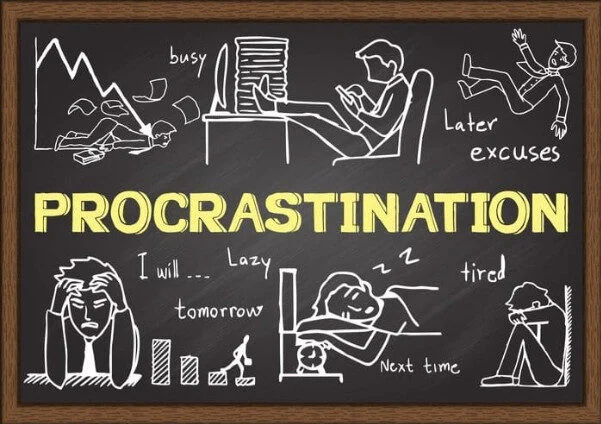
Procrastination is an act of delaying or avoiding tasks, despite understanding the value and urgency of it. It typically begins with a simple, yet unnoticeable thought like, “I’ll do it or take care of it later.” But instead of starting, these people usually engage themselves in various trivial matters like scheduling unimportant matters, scrolling through their phones, or just convincing themselves the task ahead demands much more time, energy, efforts or perfect conditions than they have right then to complete it. What is more important to understand is that this behaviour is simply not just about personal time-management issue; rather, it is rooted more in emotion-based choices such as just wanting everything to be perfect (perfectionism), feeling bogged down, fearing failure, or being afraid of what succeeding might demand next rather than being simply lazy. While they get temporary comfort, that saps their potential, leaving behind a trail of anxiety, guilt, and a nagging question: “Why did I let this happen”?
Currently, we are living in a world of incessant notifications and alerts buzzing along with constant influx of entertainment (group chats, trending reels, memes, online games…) that relentlessly lit up our screen even well before our feet touched the floor in the morning.
Pessimistically, this endless array of gratifying content is just a click away; for instance, one click offering laughter, the next life update, and the third a motivational quote – each one vying for attention, pulling focus in thousands of directions. Every ping is a small reminder that there’s something new to check. Sometimes we sat down to check only notification but end up wasting hours scrolling through trending reels or funny stories especially designed to distract us. Apps like TikTok, Snapchat, Instagram are all built to keep us hooked, feeding endless content that makes it hard to focus on anything meaningful. All of these platforms have proven themselves as the principal factor for distracting youths, enticing them towards escapism and disengagement even when the stakes are high and the to-do list is long and significant.
Initially, though, plunging into this virtual world seemed to be a small relief from the hectic schedules of every age-group, but in truth it becomes a digital loop that’s hard to break free from. In fact, they have knowingly or unknowingly woven themselves so intricately and strongly into our lives, capturing attention and consuming hours that were once dedicated to deliberate and purposeful action. Instead of beginning the day with a purposeful work, planning and focusing on task, youths today are preferring to scroll through social media, convincing themselves, “I’ll start in 10 minutes.” However, that 10-minutes silently turns into hours… the cycle continues, and the sense of guilt quite often descends like the mist over a peaceful morning. This whole scenario is just a glimpse of a growing trend that is commonly prevailing in countless homes, classrooms and other public domains where people’s gazes become fixed on their digital devices while thumb scrolling endlessly a virtual-real universe.
So, at first, what begins as harmless occasional entertainment – a brief scroll, a quick video or a momentary digital escape, subtly evolves into something far more pervasive, constant companion and into a deep-seated habit of escapism or avoidance. It’s not a sudden plunge but a silent eroding action. Tasks get postponed, goals are pushed aside, and the habits of procrastination quietly takes the root. What matters most is, the underlying shift isn’t driven by the lack of ambition – it’s the startling noise of a world that is rarely allowing the young mind to be still and focused. The struggle has now evolved further and shifted the contention from the dichotomy of discipline vs. time management, tactics best suited for quieter age, to now battling against instant gratification and fleeting attention spans. As a result, the distinction between productivity and distraction has become indistinct, not because of inherent laziness but due to an irreplaceable barrage of stimuli. Youths aren’t disengaged – they’re overstimulated and are somewhere between the allure of endless content and the pressure of expectations, and in that space, procrastination has found fertile ground to grow.
So, the true challenge today isn’t just about staying focused, it’s also about remembering what one was meant to focus on in the first place. Another layer which is serving to intensify the anxiety, and fuelling the procrastination cycle, is the pressure to perform academically, stay socially engaged, maintain a meticulously curated flawless digital persona, and juggling the everyday responsibilities. All this relentless confluence of expectations creates a perfect storm for a quiet epidemic where procrastination isn’t just a bad habit anymore; in fact, it’s rapidly becoming a defining behaviour of today’s youth. It’s a behaviour we all recognise it, but very few openly talk about it. It is hiding behind casual jokes and memes that are “relatable” but it is slowly chipping away potential, self-confidence, and mental well-being.
Science backs this up. Several research studies reveal that our constant and repeated indulgence in social media feeds and rapid-fire content isn’t just using our brains; it’s actively rewiring them. They train our neural pathways to crave that quick dopamine hit, the likes, the notifications, the viral clips creating a powerful addiction to immediate gratification. Think of it like mental fast food: satisfying in the moment, but leaving you malnourished for the real feast of long-term goals.
And that’s where the crunch hits. The things that truly matter like exam prep, crafting perfect job application, even dedicating quiet time for self-reflection, prayers or reading demand the opposite fuel. They require patience, deep focus, discipline, and the ability to sit with discomfort. It’s more like running a marathon than sprinting.
Key Reasons Behind Digital Obsession and the Rise of Procrastinations
If we want to comprehend and dissect the reason behind digital obsession that’s in reality fastening so many young people today, leading to the development of procrastination behaviour, then we need to look at it from powerful Psycho-social forces at play. Global research consistently points to the involvement of various interconnected factors that contribute to this mania. At the forefront is the instant access to information digital media is offering, which makes learning or finding anything as easy as just a click away. But it doesn’t stop here; this is further noted to be intensified by the inherent desire for social validation through likes and comments. In fact, for many, there is an emotional investment, thinking that the more online visibility one has, the better his or her social standing is. Another strong driver is the “fear of missing out” (FOMO). Observing their peers constantly post exciting content (events, achievements, or lifestyle experiences) subtly triggers that feeling of lagging behind if they are not engaged online. Gradually, this vicious cycle compels them to prioritise the digital space over numerous other significant pursuits, resulting in a relentless battle against various distractions that constantly loom around them. And lastly, the convenience of doing almost everything online, from shopping, booking tickets, to working from home, has made the digital world a central part of everyday life.
Identifying Procrastination: Key Diagnostic Approaches
Figuring out why someone procrastinates isn’t always straightforward. It often involves taking a closer look at their habits, what motivates them, and how they emotionally respond to tasks. Therapists usually use various standardised assessment tools, like the Procrastination Assessment Scale for Students (PASS) or the General Procrastination Scale (GPS), to determine how severe the procrastination is, since this assessment will guide whether someone might benefit from self-help strategies or needs professional therapy especially if it’s a chronic or deeply impacting problem. Additionally, they may also consider possible co-existing mental health illnesses, such as anxiety, depression, or ADHD which can either intensify condition or even contribute to its onset. Moreover, therapists might utilise the “Big Five” personality traits assessment tool, which assess Openness, Conscientiousness, Extraversion, Agreeableness, and Neuroticism (often summarised by the acronym OCEAN) to gain a deeper understanding of a patient’s procrastination tendencies. This framework helps identify individual variations in procrastination tendencies. For example, individuals scoring low on Conscientiousness scale are tend to be disorganised, impulsive, and lack discipline. Conversely, those with high Neuroticism scores often experience more negative emotions like anxiety, fear, and mood swings etc., making them more prone to procrastination as they tend avoid tasks that provoke discomfort. Understanding these traits allows therapists to personalise treatment like teaching emotional regulation for highly neurotic individuals or time management skills for those who are struggling with conscientiousness. Typically, therapists prefer to combine these personality-focussed interventions with cognitive-behavioural therapy (CBT) and goal-setting practices to help clients improve their relationship with procrastination, instilling resilience and more productive habits.
Characteristics of Procrastination Behaviour
Procrastination is a complex psycho-sociological trap, not a personal weakness or character flaw. Recognising its traits is the first step to disrupting the cycle of “Delay, Distraction and Guilt” and is the only exit to break free from the loop of stress and unfinished work. Here are its key characteristic features:
- The “Intention-Action Gap”: The procrastinators deliberately choose to postpone starting a task they are supposed to do, even while knowing that it’s important or urgent. So, there is a significant disconnect between what the person intends to do (start the task) and what they actually do (avoid it). So, the time and efforts are spent on activities that are:
- Less Important: Doing easier, lower-priority tasks (like cleaning instead of writing a report).
- More Pleasurable: Engaging in distracting activities (social media, games, TV).
- Trivial: Focusing on insignificant details or unrelated busywork.
- Avoidance & Escape: One of the core features of procrastinators is avoidance behaviour, where they prefer to avoid something unpleasant associated with the task to escape discomfort. These include:
- Negative Emotions: procrastinators frequently experience a range of negative emotions, such as fear of failure, fear of not being able to uphold success, fear of not meeting high standards (perfectionism), feelings of anxiety, being overwhelmed, boredom, resentment, and insecurity.
- Task Difficulty: when a task is perceived as complex, ambiguous, or demanding excessive efforts, avoidance becomes a coping mechanism.
- Illusion of “Active” and “Last minute rush”: Many procrastinators use a well-worn phrase that serves as shield: they “work better under pressure, or best ideas come at the eleventh hour”. On the surface it sounds confident and strategic but research tells a different story, suggesting this as a clever justification for avoidance or delay. The truth? While looming pressure might force action, the chronic delay itself is detrimental to well-being and often results in suboptimal outcomes compared to planned efforts.
- Temporal Displacement (“Present Bias”): Prioritising immediate mood repair (feeling better now by avoiding discomfort) over future rewards or consequences. To them negative impact of delay feels distant and abstract; so, they choose snacking, scrolling or spacing out over taking action.
- Self-Defeating Cycle: Despite knowing the delay will likely cause stress, poorer performance, or other negative outcomes, the procrastinator still delays.
- Cognitive Bias: Procrastinators often engage in unconstructive thinking patterns that seems logical for a moment but quietly sabotages progress, such as:
- Overestimation of Future Motivation: “I’ll feel more like doing it tomorrow/next week.”
- Underestimation of Time Needed: “It won’t take me that long; I can start it later.”
- Minimisation of Consequences: “It’s not that big a deal if I’m a little late.”
- Perfectionism: “If I can’t do it perfectly right now, I shouldn’t start at all.”
- Catastrophising: “If I try and mess it up, it will be a disaster.”
But here’s the thing: recognising the enemy is the first step towards fighting back. Understanding why our brains crave distraction helps us to develop effective strategies. It’s not a matter of sheer failure of willpower; it’s about our surrounding that is constantly pulling us. However, there is “good news”? Brains that have undergone training can be retrained thanks to our “Neuroplasticity”. One can rebuild focus, reclaim time, and break free from the “Delay-Distraction-Guilt cycle”.
So, to begin our understanding of this crucial issue, let’s explore what neuroscience and psychology tell us about procrastination and the habit-rewiring process. And what guidance Islam provides regarding discipline, mindfulness, and the true value of time and focus.
To Read More please click the QR Code
[The writer is Group Head, Islamic Perspectives in Bioethics Centre for Study and Research (CSR), New Delhi]