

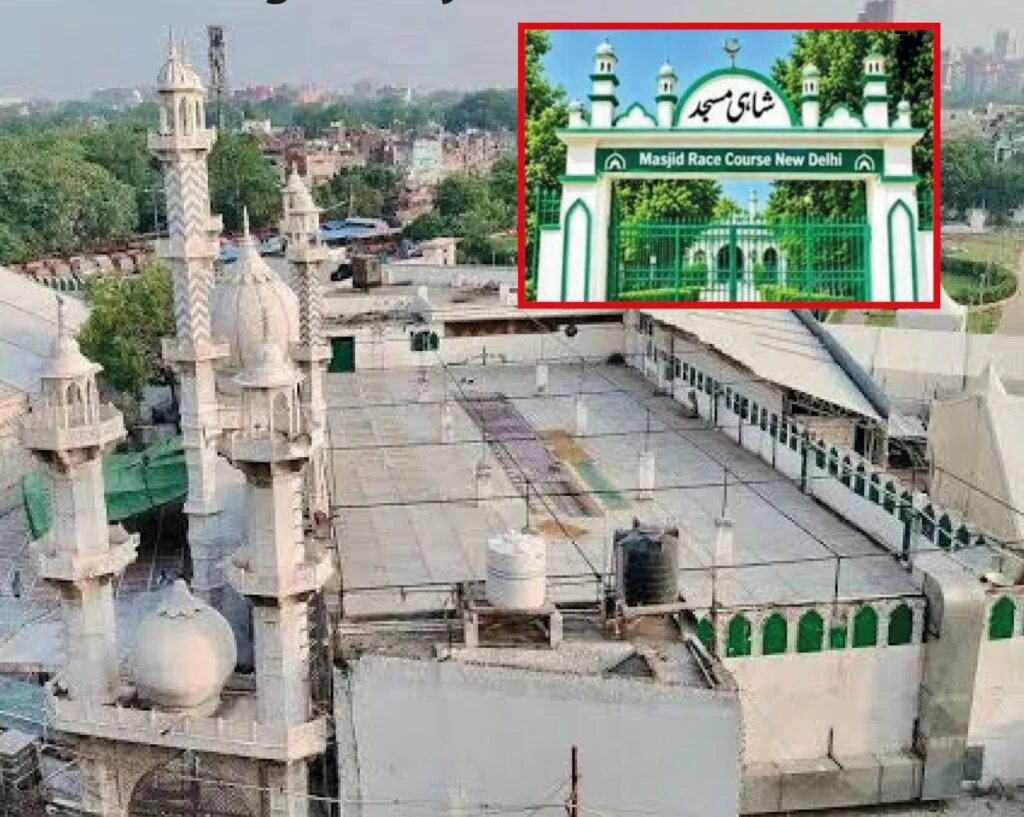
The bulldozer has increasingly become a potent symbol of a deepening controversy over Muslim places of worship in India. From Uttar Pradesh to Rajasthan, Gujarat and Madhya Pradesh, reports of demolitions and action against religious structures in states governed by the BJP have fuelled allegations of selective enforcement, religious discrimination and the use of administrative power against minorities. In the national capital, the demolition of portions of the Madina Masjid in Shalimar Bagh and the looming threat of eviction facing the century-old Race Course Masjid have brought the issue into sharp focus.
The controversy has acquired added significance following the enactment of controversialWaqf Amendment Act, 2025, which has generated widespread concern among sections of Muslims over the future of their religious properties.There is a growing perception thatalongside legal and administrative disputes concerning land ownership, the demolition of Masjids and restrictions on access to places of worship are creating an atmosphere of uncertainty for Muslim religious institutions.
The government and civic authorities, however, maintain that action against structures classified as unauthorised encroachments is undertaken under applicable laws and, in certain areas, in the interests of road widening, public safety or national security. The central question is whether these rules are being applied consistently, with due regard for legal procedures, heritage protection and the constitutional rights of all citizens. The latest developments in Delhi have brought these competing claims into direct confrontation.
A Century-Old Masjid Faces Eviction
On Oct. 19, the Race Course Masjid, located within walking distance of the Prime Minister’s residence at 7, Lok Kalyan Marg, reportedly received a notice allowing six days to vacate the premises. The development followed the disconnection of its water and electricity supplies on Oct. 7, leaving the Masjid’s management and worshippers uncertain about its future.
The Land and Development Office (L&DO), which comes under the Union government, maintains that the Masjid occupies government land and constitutes an unauthorised structure. The authorities have invoked the need to reclaim the area, citing national security concerns associated with its proximity to the PM residence and other sensitive government establishments.
Heritage Protection
The Race Course Masjid controversy also raises questions about the government’s approach to heritage conservation in the national capital.The Masjid is situated within the Race Course Club premises, an area spread over approx. 53 acres near the PM residence. The club and neighbouring informal settlements have faced eviction proceedings as the Centre seeks to take possession of the land, citing national security requirements.
The redevelopment of the Central Vista corridor has already transformed parts of the administrative heart of Delhi. Supporters describe the project as modernisation of government infrastructure and an opportunity to move beyond symbols associated with colonial rule. Critics argue that the transformation has also entailed the loss or displacement of established landmarks and historic spaces.
The government’s Central Vista website has stated that care would be taken to preserve the heritage status of existing structures while accommodating new projects. The dispute over the Race Course Masjid has placed that commitment under scrutiny.
The Masjid is inthe heritage list and the Delhi Gazette is particularly significant in this context. If a structure appears in official records as a heritage property, the relationship between that designation, the land’s ownership and the government’s proposed use of the site needs to be clearly explained.
The Masjid’scommitteestated that the authorities should not allow a disputed classification as an unauthorised structure to override historical documentation without a proper inquiry.
The controversy also extends beyond the Masjid. More than 700 families in the neighbouring Bhai Ram Camp, Masjid Camp and DID Camp clusters havebeen uprooted. Some residents said their families had lived in the area for decades. Meena Kumari, one of the residents, told Radiance that her grandfather had settled down there more than 50 years ago. She added that the area had long been a symbol of communal harmony, with Hindus and Muslims living side by side peacefully.
The Delhi High Court’s Aug. 25 judgment paved the way for their removal and relocation to Savda Ghevra, around 45 to 50 kms away. The affected residents include domestic workers, drivers, cooks and vendors whose livelihoods depend on proximity to central Delhi.Authorities have cited security concerns to justify reclaiming the area. Critics, however, question the social cost of relocating low-income families far from their employment and their children’s schools.
Political Criticism and Religious Sensitivities
The Race Course Masjid issue has drawn criticism from political leaders beyond the Congress.PDP president Mehbooba Mufti criticised the Centre over the eviction notice, describing the action as evidence of disregard for the religious sentiments of Indian Muslims. In a post on X, she contrasted the government’s public appreciation of Islamic heritage during visits to Muslim-majority countries with its treatment of the Delhi Masjid, which she described as a roughly 120-year-old heritage structure.Her criticism focused on the perceived contradiction between expressions of respect for Islamic traditions abroadby the Prime Minister and the prospect of eviction facing a historic Masjid at home.
The Masjid’s representatives and Muslim organisations, however, have challenged the manner in which the site is being treated. They contend that its historical significance and documentary presence in official records warrant a thorough examination before any irreversible action is taken.
A delegation of Jamiat Ulama-i-Hind, led by its general secretary, Maulana Muhammad Hakimuddin Qasmi, met Union Minority Affairs Minister Kiren Rijiju and submitted a memorandum. The delegation sought immediate intervention to protect the Masjid and an adjoining graveyard behind Safdarjung Tomb.The memorandum cited documentary references to the Masjid in official heritage records. According to the organisation, the structure appears at serial number 22 in NDMC heritage list, at serial number 18 in the Delhi Gazette of 1977, and in a revised list available on the Union Ministry of Minority Affairs website.
The Jamiat argued that these records required the authorities to establish the property’s legal status through a comprehensive review before proceeding with demolition or eviction. It also raised concerns about restrictions on worshippers’ movement and the disconnection of essential utilities.The minister reportedly assured the representatives that he would make every possible effort in the matter. The organisation is going to file a writ petition in this regard.
WorshippersFace Restrictions
The Masjid’s water supply had run out, while access to the premises was also restricted.The Masjid’s imam, Mohammed Harunapproached the Delhi High Court on his own after the disconnection of the services. On Oct. 15, however, the court declined to order the restoration of electricity and water, citing questions concerning his legal standing and the status of the property.
Speaking to Radiance,he underlined that he had approached the Delhi Waqf Board for around six months but received little practical assistance beyond correspondence with the civic authorities concerning the suspended utilities.
The court noted that the Waqf Board, described as the original occupant of the premises, had not itself challenged the disconnection.The NDMC, meanwhile, declined to restore the utilities while demolition work continued in adjoining areas, citing concerns about possible public harm.
The situation has also drawn attention to the functioning of the Delhi Waqf Board. Its elected body’s tenure expired in August 2023, and bureaucrats appointed by the Lt. Governor assumed charge in January 2024. The absence of a reconstituted elected body has raised questions about the Board’s ability to represent and defend the interests of religious properties under its purview.
Despite the legal setback, prayers were permitted at the Race Course Masjid on Friday, with police personnel stationed at the entrance. Worshippers were allowed in during the day, but access reportedly became more restrictive later, with some people turned away by sunset.
Speaking to Radiance, several devotees said they had come to protect the Masjid. They added that the restrictions on access and the disconnection of water and electricity had become as troubling as the uncertainty surrounding the eviction notice itself. They also criticised Opposition parties for their conspicuous silence on the issue, questioning whether the action amounted to a violation of the Constitution, the very document these parties repeatedly invoke in their campaigns to “Save the Constitution.”
The Demolition of Madina Masjid
The controversy over the RaceCourse Masjid comes in the wake of the late-night demolition of portions of the Madina Masjid and adjoining structures in Shalimar Bagh, north-west Delhi.Civic authorities carried out the operation along Max Hospital Road as part of an anti-encroachment and road-widening exercise. The operation was conducted under heavy security. Congress leader Udit Raj criticised the operation, questioning whether authorities were enforcing encroachment rules uniformly or selectively targeting structures associated with Muslims.He argued that unauthorised construction was widespread in Delhi and alleged that enforcement agencies had considerable discretion over which structures to remove and which to leave untouched.
Raj also questioned whether a similar approach would have been adopted had the disputed structure been a temple rather than a masjid. His remarks reflected a wider opposition charge that religious identity can influence the implementation of ostensibly neutral administrative rules.The distinction between the official explanation and the allegations of selective targeting is central to the controversy.
A Wider Pattern in BJP-Ruled States
Developments in Delhi have become part of a larger national debate over demolitions affecting Muslim places of worship and other religious structures, particularly in states governed by the BJP.Uttar Pradesh has repeatedly figured in controversies over bulldozer action against buildings that authorities describe as unauthorised. The demolition of a historic Masjid within the Saharanpur Collectorate in the dead of night remains fresh in public memory, intensifying concerns over the treatment of Muslim places of worship and the selective enforcement of anti-encroachment measures.
Similar concerns have been raised in Rajasthan, Gujarat and Madhya Pradesh, where action against structures identified as encroachments has prompted questions about due process and the treatment of minorities.
The available details in the present account are most specific in the cases of the two Delhi Masjids. The wider concerns nevertheless point to an urgent need for transparent information about demolitions elsewhere, including the legal notices issued, ownership disputes involved, opportunities for affected parties to seek judicial relief and the treatment of comparable structures belonging to different communities.
Undoubtedly,the recurring sight of bulldozers at Muslim religious sites has created an impression that Masjids are increasingly vulnerable to administrative action.Evenwhen authorities invoke land regulations or development requirements, the concentration of such controversies around minority institutions warrants scrutiny.
The concern is not limited to the physical destruction of buildings. A Masjid can serve as a place of worship, a community institution and a repository of local history. Its demolition or the restriction of access can disrupt religious life and unsettle communities that regard the structure as part of their inherited social and cultural landscape.The demolitions and eviction threats have revived a fundamental question about equality before the law.
The Race Course Masjid case is particularly revealing because it brings together questions of land ownership, heritage status, access to worship, the functioning of the Waqf Board and the government’s security rationale. Across BJP-ruled states, similar controversies demand the same standard of scrutiny.
As minority communities believe that their religious institutions are being treated differently, public confidence in the neutrality of state agencies can suffer.