

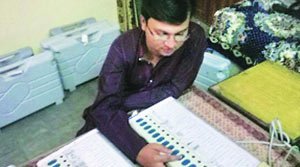
It is high time to ponder over either to go back to paper ballot or to continue with EVMs along with paper trail so that the voter gets to know whom he has voted for, observes MOHAMMAD NAUSHAD KHAN
The 2014 polls can be said to be the defining moment for the use and misuse of the Electronic Voting Machine (EVM) because in some cases tampering is so grave that it poses serious challenge to the Election Commission, to the very idea of free and fair polls, to the conduct of elections and confidence of people in the democratic process.
When EVMs were introduced in India, it was anticipated to bring speed and accuracy in counting ballots and the impression gathered at that point of time was that it may not be manipulated. The system adopted was considered an advanced concept in the electoral process. But over the years, the corrupt mindset discovered the fault lines through which the EVM could be easily tampered with for or against a political party or its candidates.
 The manner in which EVMs have been tampered with at various places provides an ample opportunity for the authorities and the experts concerned to initiate a debate on its misuse to ascertain how to contain effectively the tampering threat. The question arises: why to stick to this system, when most of the advanced countries have rejected its use for one reason or the other. Should we now go back to the old paper ballot system or should we continue with the EVM along with some rider that can hardly be tampered; and if tampered, it could be easily traced and corrected.
The present EVMs, which were introduced in 1981, can be tampered with either in association with poll officers or by manipulating the configuration of the software and hardware of the machines to help a party or its candidates no matter which button was pressed to benefit the intended beneficiary. The credibility and viability of the EVM was in serious doubt when every button of an EVM in Jorhat when pressed went in favour of the BJP during the mandatory checking of EVMs before the first phase of general elections. But what was even more surprising that neither the people, nor the authorities, or even the political parties locked horns over this issue in the desired manner. Such a serious issue which was more than enough to jolt the veracity of the voting system caught little attention by the so-called champions of democracy. Nothing more serious could have taken place other than EVM tampering and that too in this fashion but the reaction and the response to this issue was lackadaisical.
Another incident, which too required immediate attention but went almost unnoticed, came to light following a statement issued by AAP saying: “An address tag used on the control unit at polling station No 29 at the Shivaji Nagar/Mankhurd assembly segment of the Mumbai North East parliamentary constituency was found on the road at Shivaji Nagar today. This address tag is an important identifier of the machine used on the day of polling and the tag being found on the road indicates that the machine could have been tampered with before being transported to the place of storage after the elections.”
When machines are kept in a highly protected and guarded zone, is it possible for an official to carry them to his home? It is possible because Awadesh Kumar Srivastava, state government officer deputed as a sector magistrate for the Varanasi Lok Sabha polls, and his son Gaurav, have been booked under the Representation of the People Act after they posted photographs of themselves with the EVM which was kept in his house after having been allotted on the eve of polls and uploaded these on Facebook with the comment “Ab ki baar, Modi Sarkar”. At many places, there are difference in the number of votes polled and the number of votes counted. Wherefrom did the extra votes come and who was behind the game are the trillion-dollar questions.
These were not the few stray cases. Apart from these, there were many other cases of defective EVMs reported from various parts of the country. Faulty EVMs were found in Pune, Meerut, Bijnor, Saharanpur, Dehradun, and Arunachal Pradesh and at many other places. At many places it might have got unreported or the faulty machines might have not been traced or deliberately ignored to provide benefit for one or another party. Reports of faulty machines or tampering with them have become more or less a general trend; the numbers and the degree may vary from one election to another. The Election Commission, during the very process of 9-phase polling, also received complaints that polling officers were helping certain candidates rig votes.
When, in 2012, Dr Subramanian Swamy filed a petition for having a paper trail of the voting through EVMs so that the voter can get a printout of who he had voted for and can put it into a ballot box kept right beside the EVM for more transparent voting and to make sure that there is no tampering with the EVMs, the stand of the Election Commission in the court was that ‘EVMs provided by the Commission are of such a high end technology that it cannot be hacked.’ However, how such high end technology can have so many faults that votes of one candidate get transferred to another as has been seen so often in this election remains a mystery. [http://news.oneindia.in/feature/is-election-commission-fast-losing-its-credibility-lse-1445228.html]
In 2000 elections, the problems with EVM security became widely known during large-scale irregularities in Florida. In India apprehensions about EVMs were highlighted during the 2009 election following a blunder found on the Election Commission of India (ECI) website. Dr. Anupam Saraph, then Chief Information Officer of Pune, and Prof. M.D. Nalapat, Vice-Chair of the Manipal Advanced Research Group, came to witness files on the ECI website which showed election results days before votes were cast and counting was yet to take place.
Presently, most developed countries do not use EVMs. The USA uses paper and electronic ballot whereas the UK and Germany now use paper instead of electronic devices. There are many more countries to have reverted to paper ballot after discovering fault in EVMs and its susceptibility to be misused and tampered with. Steve Stigall, a CIA cyber security expert, said in 2009 that elections could be manipulated after the votes were cast, when ballots were moved to other locations, when results are finally tabulated and also when results are declared on the internet.
In 2012, Delhi High Court in its ruling on the Writ Petition filed by Dr. Subramanian Swamy challenging the use of EVMs in the present form said that EVMs are not tamper-proof and ordered the Election Commission to add a paper trail to check against any electoral fraud. In 2013, a bench of Chief Justice P Sathasivam and Justice Ranjan Gogoi of the Supreme Court, in its order said the Vote Verifier Paper Audit Trail system with EVMs would ensure free and fair polls and help in resolving disputes. The court had also asked the Centre to provide financial assistance for it. Sanjay Nirupam, who is about to file a PIL against the tampering in his constituency has alleged that the contract of the EVM was given to a multi-national company based in Gujarat, which is in itself doubtful and raises concern.
Now it is beyond doubt that EVMs can be tampered with and it can be done at will in any election and during any regime. Therefore, it is high time to ponder over either to go back to paper ballot or to continue with EVMs along with paper trail so that the voter gets to know whom he has voted for. The EVM with paper trail is right, said M.D. Nalapat to Radiance on the reliability of the EVM in India and its effective use where chance of misuse is less. Nalapat also said with strict vigilance rigging or tampering has reduced considerably but even then the EVM should have rider in the form of Vote Verifier Paper Audit Trail (VVPAT) system to ensure free and fair polls.