

Many call him the Chief Minister of Congress Party; some liken him to Maharaja Budhachandra of Manipur, who had signed the ‘Standstill Agreement’, which later led to merger of Manipur with India in 1949; and some labelled him as ‘traitor’. Well, there are lots of charges and assertions to which Okram Ibobi Singh, the Chief Minister of Manipur, can only respond.
The stake is so high that from State Government to Home Ministry and then to External Affairs Ministry, yet one is certain that the local people do not trust much to their daily judgment of “normal activity along the border”, “some remaining boundary issues” and “border fencing to security fencing.”
A few weeks ago, a local Member of Parliament from the State said at a public forum in Delhi that there are two types of answers if you pose a question to the Government: one is ‘Interesting’ and the other ‘solvable’.
The question is when the Chinese troops entered Indian territory of Daulat Beg Oldi (DBO) sector in Jammu and Kashmir on 15 April which led to 21-day faceoff between the two sides and then into Chumar sector, a remote village on Ladakh-Himachal Pradesh border on 17 June and started vandalising the observation bunkers, there were alarm bells ringing in the Parliament and media. The Government of India sent Defence Minister AK Antony to China on 4 July and sought to neutralise tension along the border to bring back peace and tranquillity.
Believe it nor not, following the next month in early August, a platoon of Myanmarese Army’s 87th Light Infantry led by its CO entered the country’s extreme east in Manipur. They called it a ‘buffer zone’ and claimed large swathes of Indian territory. Incredible as it is, no alarm bell rung anywhere in the country and life went on normally. Why? That wasn’t so ‘important’ as Jammu and Kashmir! After all, India and Myanmar do have a ‘fantastic’ working relationship from ‘strategic’ point of view – military, trade and politics. More importantly, there were no ‘left-over disputes from history’ between the two countries as it has with China, until recently.
The place where the Myanmarese Army entered into was Haolenphai village, around 3 kilometres just to the south of Moreh Sub Division of Chandel district in Manipur, where all the State and Central machineries are functioning. The village is a few dozen metres far away from the international boundary and inhabited by a few hundred villagers of Kuki community, a scheduled tribe of Manipur. The village has been a part of Manipur over centuries and there was no report of misjudgement about its existence.
Startled and bemused with the new development, the village chief Lalkholun Haokip immediately informed the local authorities. With inputs from him, ADC Moreh, and senior officials, including State police, rushed to the spot and requested the Myanmarese Army to stop their activities. However, the State officials were informed by the CO of the 87th LF that they (Myanmarese Army) were well within ‘their territory’ and they could not stop their work as it was ordered from ‘higher authority’ in Naypyidaw, the capital of that country. Also Manipur officials were told that they (Myanmar Army) had already ‘informed’ about their activities to the 9th Assam Rifles, who is the in-charge of border guard in that area a few days ago.
Though the latest development did create some ripples among the State officials including the Chief Minister, the Assam Rifles, who recently took over the charge of border guard from the Border Security Forces, did not utter a single word. Whether the Assam Rifles authorities did really inform the State Government was not clear but the ‘sensitivity’ shown by the Congress-led Government in the State spoke otherwise. Some sources, however, informed that the State Government was already intimidated by the Assam Rifles authorities about the activities of the Myanmarese Army. If so, why the Manipur Government took so long to highlight the issue to the relevant authority, says the Central Government.
A local MLA had recently said the issue of boundary between India (Manipur) and Myanmar has been going over the last one decade and disappearance of boundary pillars and loss of Manipur territory to the neighbouring country was discussed on 15 July, 2002. And the Chief Minister O Ibobi had admitted that boundary pillars numbers – 101, 66, 78 and 79 have disappeared.
Interestingly, the area, Haollenphai village, where the Myanmarese army has initiated the ground work for setting up a temporary platoon base camp lies between international border pillar numbers 75 and 77. The villagers claimed that this lost pillar number 76 was already removed by the Myanmarese Army and instead erected a fake border pillar number 23.
The Chief of Haollenphai village Lalkholun Haokip said that the Myanmarese Army has even claimed the road leading to T Minou village as theirs, but the road has been a part of Manipur with BRTF personnel working there. He also stated that Haollenphai has been redeveloped since the year 1992 after the Kuki-Naga clashes and it has now 50 houses with a population of 260 people. The villagers are also paying hill house taxes and they enjoy benefits of MGNREGS and other schemes implemented by the State Government.
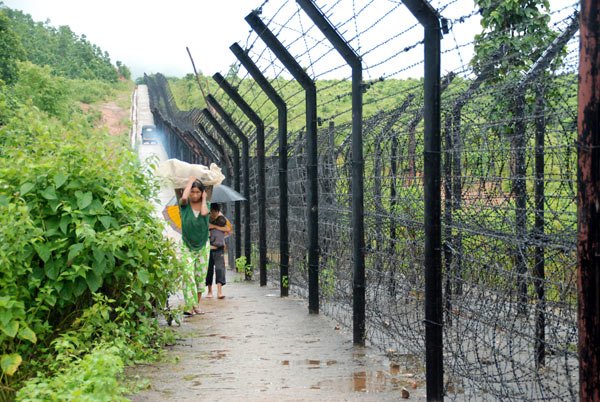
Brojendro Ningomba, spokespersons of the Information Centre for Hill Areas, Manipur (ICHAM), said that the current problem commenced when the Assam Rifles started border fencing along India-Myanmar international boundary. He said the main reasons for erecting fencing were to stop illegal drug smuggling and cross-border movement of insurgents. The Assam Rifles has already finished construction of 4 km out of the total 398 km at Manipur-Myanmar border only. However, he said, when they (Assam Rifles) started construction of fencing, they wittingly or unwittingly dug far deep inside our own territory, not exactly along or near the border, which means that vast areas of land measuring of over 500 metres or more have been left out on the other side.
H Balram, sub-divisional police officer of Moreh, told this correspondent that border pillar number 78 which lies near the Moreh town itself has vanished and instead pillar number 21 has been erected by the Myanmarese authorities, which is highly susceptible.
He further informed that the border fencing should be constructed only from Pillar Number 79 to 81, which is about 9 km. However, he said, since the Myanmarese Army constructed a makeshift near the Haollenphai village, the State police force also started patrolling.
According to Brojendro, about 10 houses out of 25 in the Haollenphai village itself, including a church, will go to Myanmar once the fencing comes into existence.
The most worrisome is that thousands of Indian citizens of around 30 villages of Manipur including Govajang, Satang, Choktong, Waksu, Lamlong Khunou, Saibol, Moirangthel, B Bongjang, Yangnoi, L Molphai, N Gamnom, Rilram Centre, Leibi and Kwatha Khunou, all in Chandel district and Wanglee, K Ashang Khullen, Bunbun, Z Choro, Skipe, Kangpat Khunou, Phaikom, Molvailup, Phaimol, Chahong Khunou, Chatric, Kashung, Kachou Phung, Haiyang, Kampal, Khayang, Khamasom, Poi, North Tusom and Wahong in Ukhrul district, would be displaced from their native villages once the border fencing is completed.
A villager in Ukhrul district said that Choro village located under Kamjong Sub Division of Ukhrul District was proposed first by the Government of India to compensate the claim of a large junk of land at Chandel district by the Myanmar Government. Earlier, India offered Tuivang-Molcham area near Moreh township but after Myanmar Government rejected the offer Choro Khunou became the best option for India. Choro is also known as Zingshophai meaning ‘eastern plain’ among the Tangkhul community. The village is inhabited by 33 households belonging to the Tangkhul community.
Meanwhile, recalling the reported ‘gifting away’ of Kabaw Valley to Myanmar (Burma) by the then Congress Government led by Jawaharlal Nehru in 1953 following the Indo-Burma Treaty, the details of which have been kept secret till date, a senior member of the new floated Committee on Protection of Land in Border Fending (CPLBF), Manipur, said that the action taken by the Centre was highly regrettable and informed that the people of Manipur are still feeling pain and anguish of the past memories.
Urging the Centre and State Governments to immediately halt the border fencing, he said that when the Border Roads Task Force (BRTF) started construction of the fencing, under the guidance of Assam Rifles, village chiefs/headmen were never informed nor did the concerned authorities issue notice well in advance of the proposed construction.
He also demanded that re-demarcation of the boundary – Pemberton Line, which was resurveyed and re-demarcated by Col Johnston in 1881 and by Col Maxwell in 1896, followed by the signing of the 1967 Boundary Agreement between Burma and India in Rangoon, should be relooked and carried out within one month. He further warned that the CPLBF along with the entire people of the State would launch intense agitation if their demands are not met.
By observing the turn and twists of the ground situation, the people in Manipur ask whether Manipur is not a part of India or not as ‘important’ as Jammu and Kashmir. Or would you say the question is just ‘interesting’ but unsolvable.