

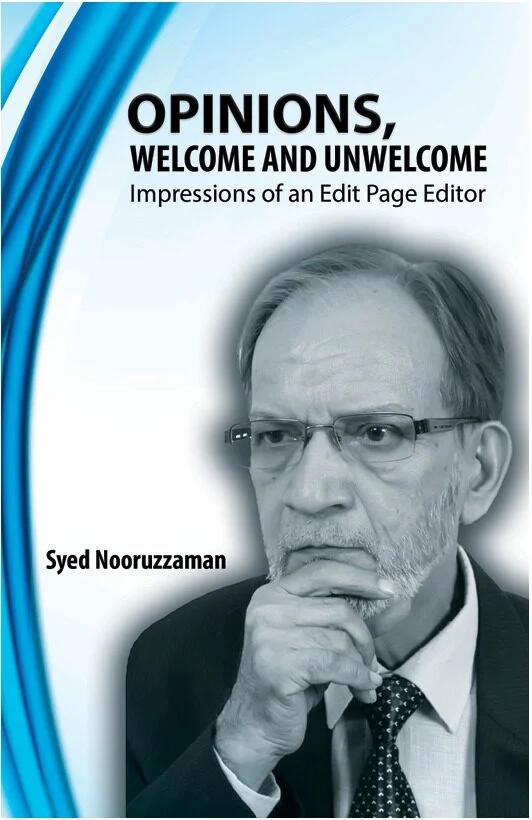
Book: Opinions, Welcome and Unwelcome: Impressions of an Edit Page Editor
Author: Syed Nooruzzaman
Publisher: The New Thinker Media Trust, New Delhi
Pages: Pages: 241 (XV + 226)
Price: ₹450
Reviewed by Dr. Abhay Kumar
Syed Nooruzzaman is a senior journalist with nearly four decades of experience in the field. Although he spent the greater part of his professional life at The Tribune, where he served in various capacities – from Sub-Editor to Assistant Editor – for more than three decades, his early journalistic training was at Radiance Viewsweekly. It is heartening that after his retirement he has published his memoir, in which he reflects on his journey of acquiring education, honing his writing skills, and eventually establishing himself as a seasoned journalist and accomplished writer.
The memoir begins with an account of his early life in his native village, Bhairopur Dargah, in Azamgarh district. It then moves on to narrate his years of struggle in New Delhi, where he went for higher education, and finally his long and productive innings at the office of The Tribune in Chandigarh. Through the story of his own life journey, the 73-year-old journalist offers many valuable lessons for aspiring journalists. The importance of the book lies in the fact that it presents the inspiring story of an ordinary person with limited resources who nevertheless strives, through perseverance and dedication, to become an accomplished journalist.
As the memoir shows, Syed Nooruzzaman remained deeply committed, from his early days, to improving the craft of writing throughout his career. It is therefore not surprising that his passion for reading and writing has continued even after retirement. The publication of this memoir stands as a testimony not only to his enduring intellectual engagement but also to his ability to write lucid prose and communicate his ideas in a clear, concise, and effective manner.
From his early days, the veteran journalist came to believe that language skills and effective communication are essential for success in the field of journalism. As he puts it forcefully, “There is no replacement for language skills…”. Among the languages he encountered, he was particularly inclined towards English, as he believed that “English was the best vehicle for socio-economic development”. At another point, he remarks: “English was my favourite subject.” His life does not fit the communal stereotype that Muslims are “averse to studying the English language” and are themselves responsible for their alleged “backwardness.”
Besides language skills, he also underscores the importance of a journalist having “an inquisitive mind” and the inclination to keep “asking questions in any situation.” With the rise of right-wing forces in Indian politics, the mainstream media, in the eyes of marginalised communities and the weaker sections of society, appears more willing to peddle the official narrative than to speak truth to power. Such a tendency existed in the past as well, but it seems to be more visible today than in earlier times. It is here that the significance of Syed Nooruzzaman’s advice becomes particularly evident.
The veteran journalist also spells out the reason why he chose the field of journalism over anything else: “I fully realised that the journey was worth undertaking as it provided opportunities to fight for injustice done to people by those in authority.”
To put it simply, the advice he offers to budding journalists, drawn from his long career in journalism, is to develop strong writing skills, never be afraid to ask questions of those in power, and use the platform of journalism to fight against injustice.
Apart from offering suggestions to budding journalists, the memoir also makes brief references to the wider political situation in the country during the 1970s, the 1980s, and the 1990s, when he was active as a journalist.However, the memoir could have benefited from a more detailed and in-depth discussion of these issues. Since the author, as he himself mentions several times in the book, was at the helm of the edit page, readers’ understanding might have been enriched further had he engaged more deeply with the larger political, social, and economic context of the country. Was it because the senior journalist wished to maintain his “neutrality”? But can one afford not to take a stand when injustice is being done?
One possible reason for this omission is that the memoir under review devotes considerable attention to the details of the author’s personal life. There is nothing wrong with discussing personal aspects in a memoir, but care should be taken to bring into the public domain only those personal details that have a wider public relevance.
For instance, the senior journalist spends considerable space at several places describing how he cleared various tests in order to secure a job. Similarly, he repeatedly mentions that he handled the important responsibility of the edit page and wrote editorials. However, more substantive issues – such as what he actually wrote, how he wrote it, what he wished to write but could not, what the social composition of the newsroom was, and what kinds of conflicts of interest or internal politics existed within the editorial team – remain largely unexplored.
While his treatment of the Punjab crisis is very brief – despite the fact that he worked and lived through those troubled and critical times – his analysis of the events is not particularly critical. Either he has largely ignored the subject, or when he does briefly mention it, he fails to offer any alternative framework beyond reiterating the larger State’s narrative.
It is to be noted that the author belongs to a minority community, and he might have been expected – perhaps more than many others – to show greater sensitivity to the issues faced by other minorities. However, the memoir does not quite live up to that expectation, and its tone often appears to be shaped by the official “nationalist” discourse.
Besides this, the veteran journalist has failed to engage with several major events of his time, such as the demolition of the Babri Masjid, the process of Globalisation, and the people’s protests against the new economic policy, despite the fact that he is a scholar of economics. More surprisingly, there is no mention of the Gujarat violence of 2002 in his memoir. Similarly, the State’s crackdown on marginalised castes and communities, and their struggles, are largely absent from the book. He briefly mentions the police encounter in Batla House in 2008, but does not analyse it in any substantive manner.
One of the debatable aspects of the memoir is the author’s claim that discrimination and hate politics were largely absent in earlier times: “there was no hate politics practised in the country” (p. 54). At another place, he states, “Those were different times. People did not like or dislike you because of your religious belief” (p. 65). While opinions may differ regarding the extent of discrimination today and in earlier periods, to deny its existence altogether is sociologically untenable. If discrimination had not existed, Muslims, Dalits, Adivasis, and Backward Castes would have been adequately represented in the media. Even today, while a Dalit and an Adivasi have risen to become the President of India – the highest constitutional office in the country – no one from these communities has become the editor-in-chief of a leading mainstream newspaper. What accounts for this absence?
While the veteran journalist denies the existence of discrimination in the past, his own narration of an incident appears to contradict this position. In the early part of the memoir, he recounts that when he met Indira Gandhi for an interview in the post-Emergency period, she referred to Radiance Viewsweekly as a “fundamentalist paper” (p. 50) and even asked him why he was working there. Such remarks themselves reflect the existence of certain prejudices against minority communities and other weaker sections within public institutions, including the media.
These facts suggest that the memoir under review could have benefited from a deeper engagement with some of the more complex issues surrounding journalism. For instance, the author briefly hints at the existence of power centres within the newsroom and editorial department but does not elaborate on them. A more detailed discussion of internal dynamics, the social composition of the media, and the gatekeeping mechanisms that shape entry and advancement in journalism would have added greater analytical depth. Similarly, the memoir might have explored how communal narratives are constructed within sections of the media and how the social profile of the Muslim community affects its representation in mainstream journalism. Given his background in economics, the author could also have devoted chapters to the political economy of the media.
The memoir would perhaps have been richer had the author devoted more space to discussing his own writings on major themes. This could have given readers a window into his times. While he mentions interviewing several high-profile leaders, including Indira Gandhi, he does not discuss the content of these interviews at all. Similarly, he has not elaborated on what he wrote over the years, how he wrote it, and what he was not allowed to write. One might expect that a senior journalist like Syed Nooruzzaman would have a wealth of stories and experiences to share with readers in the fields of media and politics. Such an in-depth and analytical discussion of his era and his critical writings would benefit journalists, researchers, historians, and readers alike. Can we hope for the inclusion of these discussions in the next edition of the memoir?
[Dr. Abhay Kumar is the author of the recently published book Muslim Personal Law: Definitions, Sources and Contestations (Manohar, 2026). Email: debatingissues@gmail.com]