

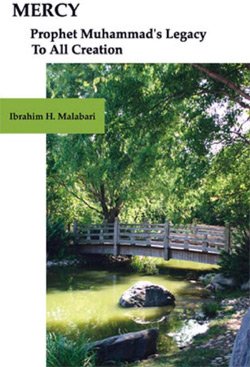
MERCY
PROPHET MUHAMMAD’S LEGACY TO ALL CREATION
Ibrahim Hussein Malabari
Compass Books
Toronto, Canada
ISBN 978-0-9811021-0-8
$ 15 cad, Paperback
Pages: 234
Price: $16.50
Reviewed by S M FASIULLAH
Numerous books have been written on the life of Prophet Muhammad (may Allah bless and greet him); millions of millions believers are chanting sallallahu alaihi wasallam every second across the globe. And surely this process will continue as long as the world exists. Such was the great personality of our beloved Prophet. The holy Qur’ān thus says: laqad kana lakum fi rasoolullahi uswatun hasana. Every aspect of his personality is a source of guidance. True guidance that leads people, whoever follow it, to the righteous path, the one chosen by God, the Almighty for human beings.
Ibrahim Hussein Malabari, in his book MERCY: Prophet Muhammad’s Legacy to All Creation, attempts to look at the great personality of our Prophet from the perspective of Mercy. Much stimulated by the demand of the people in the West after 9/11 to know more about Islam, Ibrahim Malabari projects the personality of Muhammad (may Allah bless and greet him) in a unique way that is seldom practised by earlier biographers of the Prophet. This well-researched book written in a simple, lucid style made Allama Yusuf al-Qaradawi to call it “unique in its kind, novel in presentation, and simple in style”.
Malabari stresses upon Mercy and refers to the Prophet (may Allah bless and greet him) as the Prophet of Mercy throughout his book. “The Prophet (s),” he writes, “is the human paragon of mercy, the Qur’ān is the message conveyed by the infinite Mercy of God. As the Prophet of Mercy (s) was the sole conveyer of the Qur’ān, the greatest mercy to humanity, his role as its conveyor and interpreter, embodied in his actions and decisions (sunna), confers upon him a unique position in human history.”
Divided into six chapters, the book unfolds the life of Muhammad (may Allah bless and greet him) as ‘Mercy for All Creation’, ‘Mercy to Humanity’ and his ‘Contribution to Humanity’ in the first three chapters. These chapters highlight how merciful the Prophet (may Allah bless and greet him) was with human beings and non-human beings during his life. To illustrate his point, the author switches to the Qur’ān and Ahadith. Allah (swt) says in the Qur’ān: “We sent thee not, but as a Mercy for all creatures.” (Tr. Abdullah Yusuf Ali, 21:107)
Now environmental degradation has become a serious concern for all countries. Malabari links its origin with Colonialism, the capitalist expansion of Western countries. He says the present secular West transcends the destructive legacy. It is now up to Muslims “if they actually followed the spirit of the Prophet’s (s) teachings, would be at the forefront of environmental campaigns …”
In the chapter “A History of Defamation” Malabari traces the history of defamation of Prophet (may Allah bless and greet him) beginning from his times till recent attacks. The Qur’ān records the absurd charges labelled against the Prophet (may Allah bless and greet him). He further explores the very psych of Western philosophers, scholars, poets … who launched a vicious and systematic campaign to defame and degrade Muhammad (pbuh). It starts with Manuel II Palaiologos (1391-1425), the Byzantine emperor whom Pope Benedict XVI quoted in his statement previous year. Italian poet Dante in his Divine Comedy maliciously portrays Prophet (may Allah bless and greet him) and his nephew. Christian reformer Martin Luther King and John Calvin were also in the same row. The recent among the persons to follow in their footsteps are Salman Rushdie who satirises the mission of Prophet (may Allah bless and greet him) in his The Satanic Verses and Danish cartoonist. However, the problem is that “Western people have always found it difficult to see Muhammad in a more objective light”, writes Karen Armstrong.
Though the author explores the personality of Prophet (may Allah bless and greet him) from a new perspective, but the book is written especially for Western reading public, keeping contemporary discourses in mind. Post 9/11 West raised many questions regarding Islam, and the author tries to build the bridge “to bring the two great civilizations of Islam and the West closer together” through answering it.
fasih.sm@gmail.com