

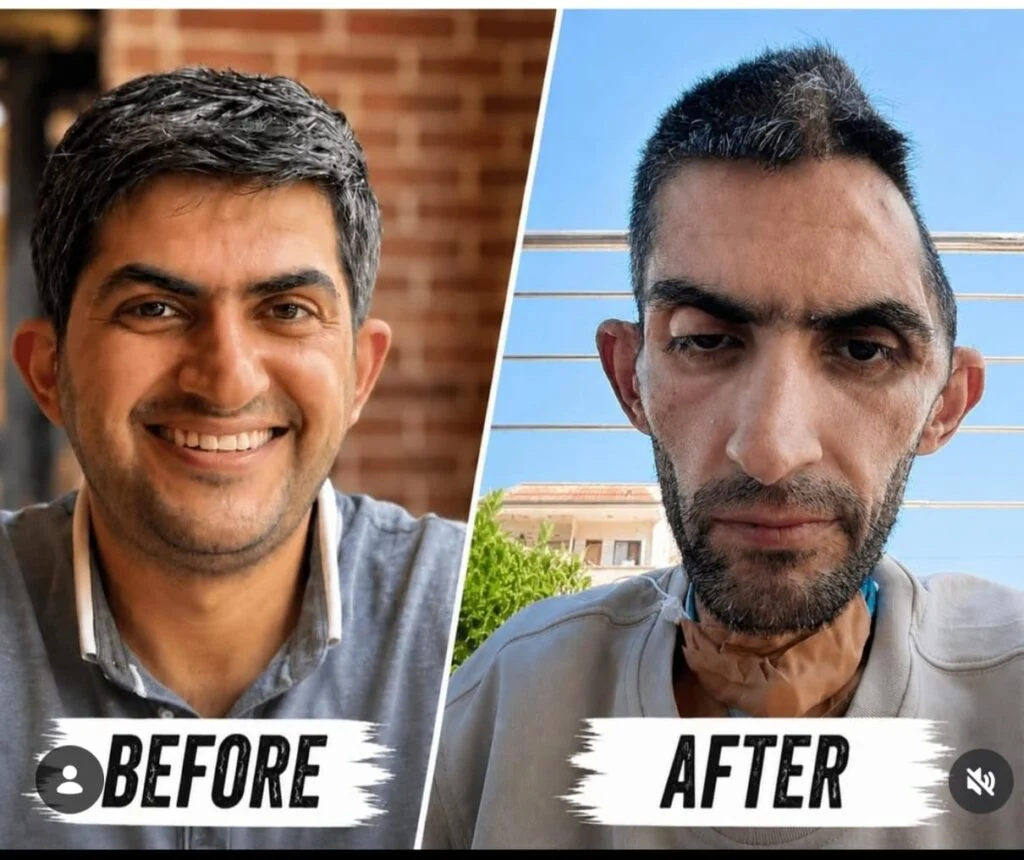
“I learned how a loaf of bread can become a dream… To have your right to the simplest things taken from you, even your privacy and dignity.” – Mujahid Bani Mufle
Before reading the article, please take a quick look at the two accompanying images, both of which feature the same individual. Only 14 months separate the two photographs, yet this brief period robbed a young Palestinian man of his health, energy, and the glow on his face.
These two images show the same Palestinian journalist, Mujahid Bani Mufleh, who was arrested in June 2025 during an Israeli military raid on his home in Beita, Nablus. Israeli authorities released him in January 2026 after months of imprisonment. Just two days after his release, he suffered a severe brain haemorrhage and was rushed to hospital in critical condition, requiring emergency surgeries that involved removing a major part of his skull.
This is not the story of a single individual but a heartbreaking glimpse into the reality faced by thousands of Palestinian prisoners enduring hunger, disease, barbaric torture, physical violence, psychological abuse, and permanent physical injuries in the darkness of Israeli prisons. Bani Mufleh’s case is an eye-opening example. In just 14 months, a young man’s health, energy, and the glow on his face were violently stripped away. This photographic comparison serves as undeniable evidence of systemic abuse and grave human rights violations against Palestinian detainees in Israeli prisons, a damning record that cannot be ignored.
Pictures can speak a thousand words, and the recent photographs of journalist Bani Mufleh do exactly that. They show a man released with a body ravaged by severe emaciation, fractures, and a cerebral haemorrhage. Bani Mufleh’s ordeal highlights what Palestinians describe as a policy of ‘slow killing’. It exposes the systematic starvation and medical neglect that detainees endure and whose consequences often continue long after their release.
According to Palestinian sources, the occupation forces placed Bani Mufleh under so-called administrative detention in June 2025 without a fair trial, and he was released in January 2026. After his release, he informed the world about his horrific experience in Israeli prison, where he endured prolonged torture, inhumane treatment, medical negligence, and multiple injuries (polytrauma). The striking visual contrast in Bani Mufleh’s physical condition – from a healthy young man to someone who became severely emaciated and required emergency surgery to remove part of his skull – has provoked strong perspectives.
His health rapidly deteriorated due to the combined physical, metabolic, and physiological stress placed on his body. Just 14 months earlier, Bani Mufleh had been a healthy, smiling young man. Following his release and extensive medical treatment, he shared a photograph documenting his recovery, which shocked the international community.
The before-and-after photographs of Palestinian journalist Bani Mufleh document the severe physical toll of his 14-month detention by Israel. As stated earlier, he suffered a life-threatening brain haemorrhage just days after his release. Rights groups emphasise that his condition reflects systematic torture and medical neglect inside Israeli detention centres. The drastic change in Bani Mufleh’s health during his imprisonment reflects the conditions documented by several human rights organisations regarding the treatment of Palestinians in Israeli prisons.
After his release and subsequent medical treatment, Bani Mufleh shared his experience on social media as a testimony to the continued Israeli terrorism against Palestinians in the occupied territories, detailing the suffering he endured during his detention:“I learned how to feel gratitude and understood the true meaning of suffering and humiliation; waiting for a morsel that isn’t enough, going to sleep with a stomach ache, and waking up with the same pain. I learned how a loaf of bread can become a real dream, and how a single dose of medicine can feel like a blessing from heaven.”
Recalling the days of treatment, he adds:“During my treatment journey, I learned the meaning of helplessness; when taking action becomes an achievement, and sleeping without pain becomes a distant luxury.”
“I also learned the truth of humiliation, when the power to eat, sleep, get up, and sit is in the hands of someone else. When your private life, your dignity, and your peace are taken away from you,” says Bani Mufleh.
Prisoner Rights Groups and Media Response
Prisoner advocacy and media groups have highlighted Bani Mufleh’s case as a ‘shocking’ and ‘tragic’ example of severe medical neglect and human rights violations.
Organisations like the Palestinian Prisoner’s Society (PPS) describe Mufleh’s case as clear and compelling evidence of systematic abuse, medical neglect, and starvation targeting Palestinian detainees. They argue that his condition is not an isolated incident but rather a devastating example of a broader Israeli policy of ‘slow killing’ and the long-term consequences suffered by former detainees after their release. The International Federation of Journalists (IFJ) has also cited Mufleh’s ordeal, using these images to call for international investigations into the targeting of media workers and the deteriorating conditions in Israeli detention facilities.
“Israeli prisons have turned into a tool for the slow and direct killing of Palestinian prisoners,” the PPS said in a statement.
“Bani Mufleh is not an isolated case but points to thousands of cases of Palestinians who have been subjected to systematic violations inside Israeli prisons, including starvation, denial of medical treatment, and physical and psychological assaults,” the society added.
The PPS statement further said that international human rights and prisoners’ rights organisations have documented hundreds of cases of Palestinian detainees who were released from Israeli detention centres or prisons in critical health conditions. However, many of these cases are never publicly reported because of the severe psychological trauma, shock, and brutality experienced by the released prisoners and their families, who continue to live in fear of re-arrest due to the lasting effects of torture and intimidation.
According to these organisations, several released prisoners have died shortly after their release, succumbing to the torture, medical neglect, and physical abuse they endured during their imprisonment. Conversely, Israeli officials and state institutions continue to maintain a contrasting hypocritic stance as usual on this issue.
While the medical claims relating to Mufleh and other detainees have been documented by Palestinian and international rights groups, Israel shamelessly defends this type of administrative detention without fair trial as a necessary measure based on, as Israeli regime states, ‘secret evidence’ for maintaining internal security.However, they refuse to provide any details about the so-called ‘secret evidence’, describing it a security matter.But human rights organisations argue that administrative detention, as practised in these cases, violates international law and is used to suppress Palestinian individuals.
As for the growing concern over alleged violations of prisoners’ rights in Israeli detention centres, critics argue that Israeli authorities have consistently refused to comply with UN resolutions and international legal standards. They contend that the system of state-sanctioned abuse continues under the occupation while Israeli authorities maintain that the prison system operates within the framework of Israeli law. But the reports published by the PPS and other human rights organisations state that many Palestinian detainees are routinely released with bodies ravaged by illness, fractures, trauma, starvation, and prolonged medical neglect.Several reports published by the PPS on Palestinian detainees also highlight the highly contentious nature of administrative detention. Palestinian and international advocacy organisations frequently point to the thousands of Palestinians held without formal charges as evidence of a systemic crackdown on journalists, activists, and civilians.
UN Calls It Ethnic Cleansing
Observing the situation in Gaza and other Occupied Palestinian Territories, the United Nations has once again raised concerns over what it describes as the ongoing ethnic cleansing by Israeli authorities in occupied Palestine. An official report released on 19 June 2026 by the UN Office of the High Commissioner for Human Rights (OHCHR) raises serious concerns over the killing of children and the increasing practices of ethnic cleansing by the Israeli regime in both Gaza and the West Bank. The report cites the continued bombing of Gaza by Israeli forces and the increased attacks by Jewish settlers on Arab civilians in the West Bank, including forced evacuations aimed at the permanent displacement of Palestinians from their lands throughout the occupied Palestinian territories.
UN human rights experts have reiterated their warning that Israel’s military campaigns, forced displacement of Palestinians, and mass detention of Palestinian youths in Gaza and the West Bank constitute ethnic cleansing.
The UN report covers the period from 1 November 2024 to 31 October 2025. It focuses on the methodical execution of an Israeli plan that appears to aim at genocide and ethnic cleansing. According to the report, the “intensified attacks, the methodical destruction of entire neighbourhoods, and the denial of humanitarian assistance appeared to aim at a permanent demographic shift in Gaza.”
The report details “the systematic unlawful use of force by Israeli security forces, the widespread arbitrary detention and torture and other ill-treatment of Palestinians in detention, and the extensive unlawful demolition of Palestinian homes.”This is a pattern of “systematically discriminate, oppress, control and dominate the Palestinian people,” the report says.
The UN report also notes the deaths of 79 Palestinians in Israeli detention during the reporting period and highlights that “Palestinians detained from Gaza remained particularly vulnerable to torture” and other forms of ill-treatment.
The OHCHR further detailed alarming patterns of forced displacement, systemic abuses, the continued killing and maiming of civilians, the blockade that has pushed Gaza towards famine, and the widespread use of torture. It also highlights increasing violence and displacement in the West Bank, as well as the destruction of civilian infrastructure aimed at depopulating large parts of the territory. These findings were also recently emphasised by the UN Relief and Works Agency (UNRWA).
The UN’s Independent International Commission of Inquiry concluded that these actions, together with the deliberate targeting of civilians, amount to war crimes and crimes against humanity. The UN has consistently condemned the systematic forced displacement and destruction as a path towards ethnic cleansing and as a pattern amounting to the ‘collective punishment of Palestinians’. It further states that such conduct may constitute war crimes, crimes against humanity, and genocide.
Israeli Terrorism against the Children
Meanwhile, a report by the Independent International Commission of Inquiry on the Occupied Palestinian Territory, including East Jerusalem and Israel, examined the condition of Palestinian children. The Commission documented continuing violations and crimes against Palestinian children, including ‘serious physical and psychological harm’ allegedly inflicted by the Israeli security forces since 7 October 2023, resulting in the deaths of at least 20,179 children and injuries to 44,143 others.
The Conference Room Paper (CRP) of the Commission was prepared to examine Israeli violations and crimes against Palestinian children in the Occupied Palestinian Territories and their long-term impacts on children. The report covers the period from 7 October 2023 to 31 March 2026. The Commission published its latest report in the second week of June 2026. Since 7 October 2023, it has published four mandated reports and four CRPs.
An excerpt from the report, published by the UN on June 18, details what it describes as Israel’s state terrorism against Palestinian children, presenting several shocking examples.
The Commission examined “the use of torture, inhumane and degrading treatment, including sexual and gender-based violence, against Palestinian children, particularly during mass arrests and in detention.” It also analysed the pattern of Israel’s “targeting of critical infrastructure essential to children, such as healthcare facilities, and its short- and long-term consequences, as well as the impact of reproductive violence on newborns, resulting in poor neonatal health and birth outcomes; attacks on orphanages and schools, leading to the loss of care for orphans and unaccompanied children, and causing academic harm and learning disruption.”
The Commission also examined the impact of the conditions of life imposed by Israel in Gaza, stating that they have resulted in preventable child mortality, increased morbidity, and severe psychological trauma caused by relentless and widespread attacks over nearly two years, collectively revealing “severe, multi-layered harm to Palestinian children’s survival, health, and development.” Furthermore, the Commission documented instances in which Israeli soldiers allegedly mocked and weaponised symbols of childhood in Gaza, raising ethical, disciplinary, and legal questions about the conduct of Israeli security forces during the ground invasion.
The report assessed the impact of the conditions imposed on Palestinian children through relentless attacks, continued bombing, the blockade, and the destruction of infrastructure and essential sources of livelihood. According to the Commission, these actions have caused catastrophic physical and psychological harm, preventable child mortality, worsening morbidity, medical complications, and severe mental trauma, “revealing severe, multi-layered harm to Palestinian children’s survival, health, and development.”
“The essence of childhood has been destroyed” due to Israel’s deliberate targeting of Palestinian children in the Occupied Palestinian Territory since 7 October 2023, the Commission reported concluding the vital part of their findings about the Palestinian children.
Finally, the Commission provided recommendations to stop the Zionist entity from further destruction. It called on the international community to act to stop the attacks on children, work towards an immediate cessation of hostilities, ensure accountability, provide reparations to restore what has been lost in Gaza, and, among other recommendations, consider the international enforcement of sanctions against those found responsible, aiming at advancing ‘child-responsive justice’.