

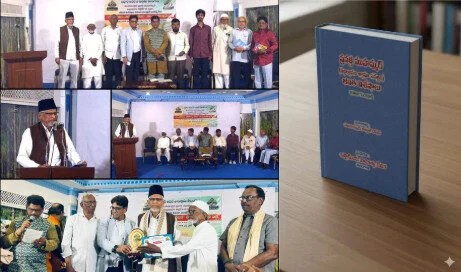
Title: An Anthology of Poems on the Life of Prophet Muhammad ﷺ
Compiler: Mohammad Abdul Rasheed
Publisher: Islamic Sahitya Vedika, Hyderabad
Year: 2026
Pages: 80
For free distribution
Reviewed by: Muhammad Mujahid
In a significant cultural milestone for the twin cities, the historic Ravindra Bharathi auditorium recently played host to the launch of a profound Telugu literary work: “An Anthology of Poems on the Life of Prophet Muhammad ﷺ.” Compiled by the distinguished Joshua Sahitya Bhushan awardee Mohammad Abdul Rasheed, this book was unveiled on the auspicious occasion of the Republic Day.
The launch was presided over by Shoub-ul-Haq Talib, President of IdaraAdab-e-Islami (Telangana and AP), who emphasised that literature remains the most potent tool to dissolve social barriers and foster interfaith dialogue.
The Telugu anthology stands as a luminous example of India’s secular fabric. Its most compelling feature is its inclusivity, featuring contributions from over 60 non-Muslim poets alongside their Muslim counterparts. This “literary harvest” (Akshara Sedyam) transcends theological boundaries, presenting the Prophet’s life as a universal lighthouse for humanity. By doing so, the work underscores a vital truth: that the essence of human goodness is a territory shared by all faiths.
Beyond its lyrical appeal, the volume is grounded in intellectual depth. Scholarly essays by Dr. T. Gouri Shankar and KalasindhuDr. Alapati provide the critical framework for the book. They depart from traditional hagiography to present the Prophet as a revolutionary social reformer, a man who championed women’s dignity, fought for the disenfranchised, and laid the foundations for a society built on equity and peace.
The verses vividly capture the Prophet’s legendary empathy, his ability to forgive his fiercest persecutors and his tenderness toward the orphaned. The poets poignantly explore the emotional and spiritual depths of his teachings, most notably the veneration of motherhood with the maxim: “Paradise lies beneath the feet of your mother.”
In an age shadowed by rising misconceptions and Islamophobia, this publication by the Islamic Sahitya Vedika is both timely and necessary. It serves as more than just a collection of verse; it is a scholarly resistance against prejudice, advocating for truth and harmony.
As the compiler Abdul Rasheed suggests, this is not merely a book for the shelf but a “message for the heart.” It is a mandatory read for those seeking to understand the intersection of poetic expression and universal morality.