


 India, known for its democracy and equal rights for all citizens, has failed to give Muslims their due political representation. Muslims in India, who are 14.2 per cent of the population according to the 2011 census, have witnessed a huge decline in political representation in recent decades, with only 24 Muslim MPs out of 545 in the current Lok Sabha. Across several Indian states, Muslim political representation remains far below their population share. In the recent Bihar election, Muslim MLAs fell to their lowest since Independence with just 11 seats despite having nearly 18 per cent of the population.
This underrepresentation of Muslims has been documented in detail in Abdur Rahman’s book, “Absent in Politics and Power: Political Exclusion of Indian Muslims”. Abdur Rahman, an ex-IPS officer from batch 1997 worked as a government Servant for 22 years in Maharashtra. The author resigned in 2019 to protest against the Citizenship Amendment Act.
He has written three books until now, “Sachar kiSifarishen”, “Denial and Deprivation”, “Absent in Politics and Power: Political Exclusion of Indian Muslim”. His book examines how Muslims are under-represented and excluded from political power since 1952. He recorded in his book the number of Muslims elected so far in the Indian Parliament and in state assemblies with deprivation. He also provides historical context of Muslim representation. The book addresses the causes of political exclusion and internal challenges, identifies multiple reasons behind this exclusion, and also provides solutions to overcome it in order to achieve better representation and secure its due share in politics. The book argues that without equal political representation, the marginalisation of Muslims will continue.
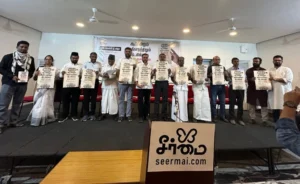
His book originally published in 2023 has now been translated into Tamil by Riaz Ahmed, who is an author of ten books. The book launch event was conducted by Seermai Publications in Chennaion December 12.
Seermai Publications is a Chennai based independent publishing house that translates books from multiple languages into Tamil.
The event marked the release of the book:
ஆட்சியிலும்அதிகாரத்திலும்இடமில்லை — அரசியலில்ஓரங்கட்டப்படும்இந்தியமுஸ்லிம்கள்
Author: Abdur Rahman EX-IPS
Translator: B. Riaz Ahmed
The event gathered public figures with backgrounds as political leaders, social activists, community leaders and intellectuals.
Speaking at the event, the author Abdur Rahman highlighted from his book about the political deprivation of Muslims, stating that nearly 70 per cent of political power meant for Muslims is diverted to others. He pointed out that there is no Muslim minister in the central government. Muslims are denied their fair share in welfare schemes and are subjected to discrimination, lynching and targeted legislation, he added.
According to him, this situation exists because Muslims lack political power. He addressed the role of the BJP in suppressing Muslim political participation, stating that the party denies Muslims their rightful share in politics and reduces them to second-class citizens through CAA, NRC, SIR and UCC. The author criticised secular parties for failing to provide Muslims with equal political representation and criticised the Congress for not giving a fair share of nominations to Muslims in recent Bihar election.
He also addressed how Muslim votes are taken for granted. Political parties expect Muslims support but do not raise Muslim issues and even fail to visit Muslim localities during election campaigns.
The author recalled that when India became independent, his father was working in the field, unaware that the country had become free or that Pakistan had been created. The author states that Muslims are not responsible for the Partition of India. It was a political decision, and he urged Muslims to remove this sense of guilt and demand their constitutional rights. He then instructed Muslims to prepare themselves to:
- Obtain a Voter ID,
- Check that their names are included in the SIR,
- Vote on election day, and
- Read party manifestos and hold elected representatives accountable after five years for unfulfilled promises.
He further urged Muslims to vote, noting that if all Muslims vote, their collective strength can have a major impact. As 14.2% of India’s Muslim population, they deserve at least 77 representatives. There are constituencies which have 30 to over 60 per cent of the Muslim population which is sufficient for the required number of Muslim seats.
He also spoke about the lack of leadership within the Muslim community and urged Muslims to demand their rights as equal citizens of the country. His address encouraged the audience to read the book to better understand the structural roots of Muslim political exclusion.
Concluding his speech, he told that upholding secularism is not the responsibility of Muslims alone, it largely depends on the Hindu majority. He urged people to vote according to their needs and warned that without political rights, they may not even be able to pray five times a day.
Speakers from diverse political backgrounds who spoke at the event highlighted that the book exposes the systematic political exclusion of Indian Muslims and raises serious questions on whether Indian democracy is living up to its constitutional promise.
Holding the programme at a time when Tamil Nadu 2026 Assembly election is approaching is commendable, as it raises important questions about political representation and the future of Muslims.
Muslims make up 5.86 per cent of Tamil Nadu’s population, but only seven Muslims were elected to the 234-member Assembly in the 2021 elections (7 out of 234), indicating nearly a 50% underrepresentation.
This raises serious concerns about the future of Muslim political representation and whether there will be fair representation in the upcoming 2026 election in Tamil Nadu.