

The United States Commission on International Religious Freedom (USCIRF) is an American federal government commission mandated to review the facts and circumstances of violations of religious freedom internationally and to make policy recommendations to the President, the Secretary of State and Congress. In its latest 2020 Annual report, the USCIRF came down heavily against India in the background of recent attacks on religious minorities and their places of worship as well as the discriminatory CAA law and proposal to conduct an all-India NRC. It is for the first time since 2004 (after the 2002 Gujarat pogrom) that the USCIRF has designated India as a ‘CPC’ (country of particular concern) for “engaging in and tolerating systematic, ongoing, and egregious religious freedom violations, as defined by the International Religious Freedom Act (IRFA)”. Among the other recommendations that the American religious-freedom watchdog has made are – “Impose targeted sanctions on Indian government agencies and officials responsible for severe violations of religious freedom by freezing those individuals’ assets and/ or barring their entry into the United States under human rights-related financial and visa authorities, citing specific religious freedom violations. Strengthen the U.S. Embassy and consulates’ engagement with religious communities, local officials and police, especially in regions impacted by religiously motivated violence. Increase U.S. partnerships with Indian law enforcement to build capacity to protect religious minorities, houses of worship, and other holy sites, and confront religious-based hate crimes; and allocate funding to support civil society to create a monitoring and early warning system in partnership with the police to challenge hate speech and incitement to violence. The U.S. Congress should – continue to hold hearings highlighting religious freedom conditions in India and U.S. policy toward India.”
The Government of India has rejected the allegations by the USCIRF saying: “It’s biased and tendentious comments against India are not new”, and “on this occasion, its misrepresentation has reached new levels. We regard it as an organisation of particular concern and will treat it accordingly.” Besides the USCIRF, it may be noted that India’s treatment of its religious minorities and the growing Islamophobia was flagged by the OIC (Organisation of Islamic Cooperation), the Kuwaiti government, a royal princess from the United Arab Emirates, the United Nations Special Rapporteur on Minorities and some diplomats of Muslim countries to India. Therefore, even if our Union Minister for Minority Affairs feels that India is a heaven for its minorities, the world does not share that sentiment.
The state of the state
If we look at how the state has responded to the pandemic amidst the nationwide lockdown, we will realise the fragile nature of our democracy and the near absence and assertion of awareness about civil liberties and human rights. The state failed to protect its vast majority and most vulnerable sections of society from the effects of the pandemic. It displayed a callous approach towards the debilitating hunger and destitution emanating from its cruel 4-hour-notice total lockdown. There was a complete skewing of priorities. The state miserably failed to roll out a national roadmap that ensures the minimum basic rights of its citizens.
According to a survey conducted by the ‘Stranded Workers Action Network’ (SWAN), nearly 96% of a sample of lockdown-hit migrant workers did not receive any dry rations while 70% lacked knowledge of or access to the cooked meals distributed by local authorities. 89% of contractual workers said they had not received any salary during the lockdown with their business owners switching off their mobile phones. The size of the relief package announced by the Finance Minister was not sufficient to meet the requirement of the millions of stranded labour as well as the marginalised sections of society. Secondly, the implementation of the scheme was possible only within the constraints of the National Food Security Act (NFSA) and through the inefficient Public Distribution System (PDS). It did nothing to alleviate the lot of the hungry and the impoverished. The government appeared busy in going after prominent anti-CAA protestors (mostly from the Muslim community) by implicating them in various cases including slapping UAPA against some.
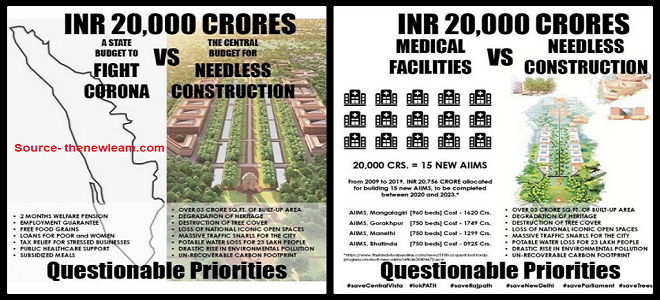
Another example of skewed priorities is the decision of the government to press ahead with the project to refurbish Parliament, the PM’s residence and adjoining buildings. According to a report in “The Wire” (24 March) – “the Ministry of Housing and Urban Affairs has gone ahead and issued a notification amending the land use of five plots for the Centre’s ambitious – and controversial – Central Vista project. After the Central Vista plan was announced a number of architects, urban planners, historians and conservationists had come together under the banner of Lokpath to denounce the move saying it not only unnecessary tinkered with historical buildings, but was result in wasteful expenditure running somewhere around Rs 20,000 crore. They had also questioned the opacity, silence and haste around the project.” Lokpath has come up with an online poster that shows how funds for this Central Vista plan could be utilised for the benefit of the people in these trying times.
Another worrisome aspect of our situation is the opaque communication framework established in the country in which those in the highest echelons of power thrive on almost zero accountability from probing and uncomfortable questions by members of the fourth estate and the public. We have a majoritarian democracy paying lip service to all constitutional rights and guarantees but diabolically crushing its spirit and value-system.
Zakat and the Welfare State
A welfare state is a concept of government in which the state plays a key role in the protection and promotion of the economic and social well-being of its citizens. It is based on the principles of equality of opportunity, equitable distribution of wealth, and public responsibility for those unable to avail themselves of the minimal provisions for a good life.
Islam has a system of wealth distribution through the process of ‘Zakat’ whereby the needs of the poor and the needy are met. The two main categories who receive Zakat are: (1) the poor (Fuqara) – This refers to someone who has no income. The sheer volume of Zakat funds collected centrally will help formulate a long-term plan for poverty alleviation and will help make the poor stand on their own feet. (2) The needy (Masakeen) – They may be who, for instance, may have a job, a house and means of transport but their income is not sufficient to meet all their financial requirements.
Zakat funds can run projects like employment guarantee schemes, minimum wage programmes, interest-free loans on cars and housing, thus improving the quality of life for its citizens. The system of Zakat has the capability of not only carrying out an equitable distribution of wealth but also leads to a welfare state where everyone avails of the minimal provisions of a good life. A quote by Benjamin Disraeli aptly captions our present aspiration – “Power has only one duty – to secure the social welfare of the people”. The first pre-requisite for that is of course to remedy our priorities.