

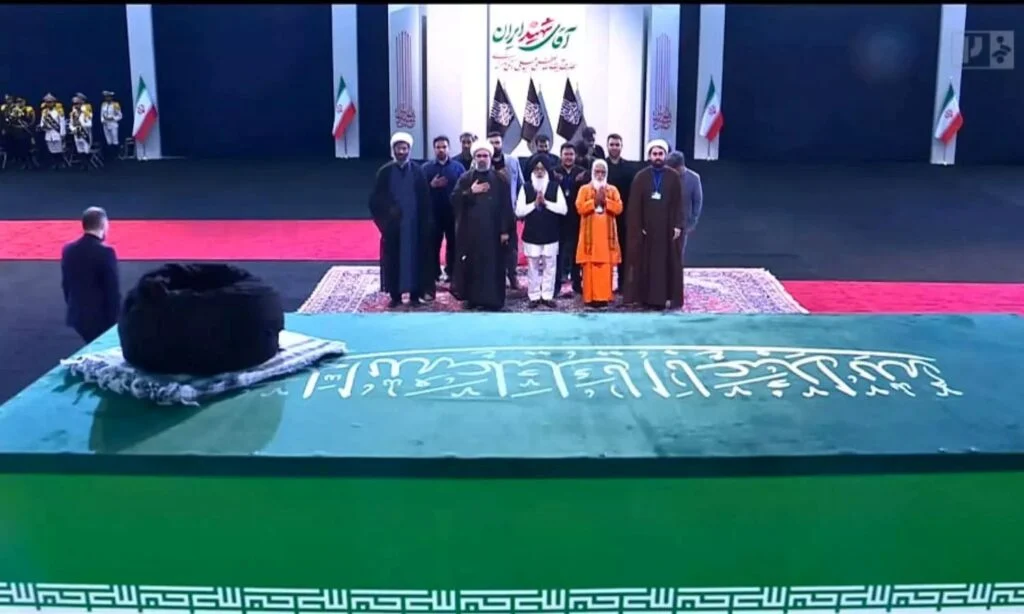
Diplomacy has a long memory. State funerals are seldom mere ceremonies; they are carefully choreographed moments of statecraft where protocol, presence and rank communicate political messages that official statements often can’t. The level of representation at such occasions reflects not only respect for the departed leader but also the importance attached to the bilateral relationship. It is, therefore, unsurprising that New Delhi’s representation at the funeral of Iran’s Supreme Leader Seyyed Ayatollah Ali Khameneihas prompted discussion among diplomats and political observers about the direction of India’s West Asia policy and the practical meaning of its much-invoked strategic autonomy.
India was represented in Tehran by Minister of State for External Affairs Pabitra Margherita and Governor of Bihar Syed Ata Hasnain. The decision stands in marked contrast to May 2024, when India sent Vice President Jagdeep Dhankhar to attend the funeral of Iranian President Ebrahim Raisi after he had been killed in a helicopter crash. The comparison is difficult to ignore. While the President is Iran’s elected head of government, the Supreme Leader occupies the country’s highest constitutional authority, exercising ultimate oversight over foreign policy, national security and the armed forces. If India considered the funeral of the Iranian President important enough to warrant representation by its Vice President, the decision to send a much lower-level delegation to the funeral of Iran’s highest authority inevitably raises questions about New Delhi’s diplomatic priorities.
Examining this decision is not an endorsement of Iran’s ideology, political system or regional policies. Rather, it is an assessment of India’s diplomatic consistency and whether its conduct reflects the strategic autonomy that successive governments have long projected as the cornerstone of Indian foreign policy.
For India, Iran is a strategic gateway to Afghanistan and Central Asia. Chabahar Port remains central to New Delhi’s regional connectivity ambitions, making strong political goodwill with Tehran not merely desirable but strategically essential.
The economic dimension is equally significant. Iran lies alongside the Strait of Hormuz, one of the world’s most critical maritime chokepoints. A substantial share of India’s crude oil and liquefied natural gas imports passes through these narrow waters, making their stability essential to the country’s energy security. Equally important, the Strait is the principal gateway for India’s exports to West Asian markets, carrying pharmaceuticals, engineering goods, textiles, chemicals, food products and other manufactured goods. Thousands of Indian manufacturers, exporters and micro, small and medium enterprises depend on uninterrupted shipping through this corridor. Stability in the Strait of Hormuz is therefore not merely a foreign policy concern but an economic imperative for India.
Viewed through this broader strategic lens, maintaining high-level diplomatic goodwill with Tehran is not a symbolic luxury but a practical necessity. A senior Indian representative at the funeral could have reaffirmed New Delhi’s commitment to one of its oldest strategic partners without signalling endorsement of Iran’s domestic or regional policies. Such a gesture would have strengthened political trust while reinforcing India’s long-term interests in Chabahar, Gulf stability, energy security and regional connectivity. By opting for a lower level of representation, India appears to have missed a relatively low-cost but potentially high-value opportunity to reassure a country that remains central to its geopolitical and economic interests.
The significance of this decision becomes clearer when viewed against the broader political context in which the funeral unfolded. Far from being a purely ceremonial occasion, the event quickly evolved into an important geopolitical spectacle. Political analysts across the region viewed the ceremonies as a demonstration of Iran’s resilience after months of heightened regional tensions. At a time when Tehran continued to face sustained political, economic and military pressure from the United States and Israel, the funeral became an opportunity to showcase the breadth of its diplomatic engagement and to demonstrate that it was not internationally isolated. In effect, the gathering became a geopolitical barometer, revealing which countries chose to stand visibly with Iran during a period of exceptional uncertainty.
This messaging began the moment foreign delegations landed in Tehran. At the airport, visitors were received amid displays featuring rows of school bags representing the victims of the Minhab girls’ school attack. Through this symbolism, Iranian authorities sought to draw international attention to the deaths of innocent schoolgirls and reinforce their narrative regarding the humanitarian consequences of the recent conflict. Whether one accepted or rejected Tehran’s framing, the message was unmistakable, the funeral was intended not only to honour a departed leader but also to shape international opinion.
Throughout the ceremonies, symbolism and diplomacy became inseparable. The participation of presidents, prime ministers, parliamentary leaders and senior delegations from numerous countries was widely interpreted as a public demonstration of political solidarity despite sustained Western pressure. Across regional television networks and political discussions, many commentators described the gathering as a moral and diplomatic victory for Tehran. Others argued that, despite months of military confrontation and unprecedented external pressure, Iran had demonstrated considerable political resilience by attracting broad international participation. While these remain interpretations rather than universally accepted conclusions, they underscore the political significance attached to the event and the diplomatic weight carried by the level of representation each country chose to send.
It was against this backdrop that India’s delegation acquired unusual significance. For decades, New Delhi earned international respect for maintaining productive relations simultaneously with Iran, Saudi Arabia, Israel and the United States, demonstrating that engagement with one need not come at the expense of another. This ability to work with competing regional powers without becoming captive to any single geopolitical bloc came to define India’s strategic autonomy and enhanced its credibility across West Asia.
The Ali Khamenei funeral has inevitably prompted questions about whether that delicate balance is beginning to shift. The relatively modest level of India’s representation has led some observers to wonder whether New Delhi has become increasingly cautious about actions that could be perceived as discomforting Washington or Tel Aviv. Whether this reflects bureaucratic caution, evolving strategic priorities or a broader policy recalibration remains open to debate. Nevertheless, in diplomacy, perceptions often become as consequential as intentions.
Funeral diplomacy has always carried significance beyond ceremonial protocol. Countries routinely send senior representatives to the funerals of leaders with whom they may have profound political or ideological differences because such occasions preserve channels of communication, reaffirm long-standing relationships and signal continuity during periods of political transition. Attendance at a state funeral is not an endorsement of every policy pursued by the departed leader; rather, it is recognition of the importance of maintaining engagement with the state itself.
Measured against India’s enduring interests in Chabahar, Central Asian connectivity, Gulf stability and maritime security, a higher-level presence in Tehran would have represented a modest diplomatic investment with potentially significant long-term returns. It would have conveyed respect for Iran’s constitutional hierarchy while reaffirming India’s commitment to an independent foreign policy guided by its own strategic calculations rather than by the preferences of competing power centres.
Supporters of the government’s decision may reasonably argue that the level of representation at a state funeral should not be overstated. Bilateral relationships are ultimately sustained by trade, strategic cooperation and continuous diplomatic engagement rather than ceremonial protocol alone. India and Iran continue to cooperate through multiple institutional channels, and one funeral cannot by itself define the future of a relationship.
That argument deserves consideration. Yet diplomacy has never been conducted through agreements alone. Protocol, symbolism and political messaging remain integral instruments of international statecraft. Nations carefully observe who attends, at what level and under what circumstances because such decisions often reveal priorities that formal statements deliberately avoid expressing. During moments of political transition, symbolic gestures help preserve goodwill, sustain confidence and reassure long-standing partners of continued engagement.
It is in this context that another increasingly discussed argument deserves attention. A growing number of political commentators contend that while India’s corporate sector, defence industry and high-technology partnerships have expanded in recent years, the everyday economic interests of millions of Indians remain deeply connected to the stability of the Gulf and constructive relations with Iran. Manufacturers, exporters, logistics companies, shipping firms and thousands of micro, small and medium enterprises rely upon secure maritime routes through the Strait of Hormuz. For these sectors, uninterrupted trade is not an abstract strategic objective but a daily commercial necessity. In that sense, maintaining robust political goodwill with Tehran complements rather than contradicts India’s broader regional engagements.
Ultimately, the debate surrounding India’s representation in Tehran extends beyond one funeral or one bilateral relationship. It raises larger questions about the future character of Indian diplomacy. Can New Delhi continue to preserve the careful balance that once enabled it to engage confidently with rival powers? Can it deepen strategic partnerships without allowing them to narrow its diplomatic options elsewhere? Can it protect emerging national interests while simultaneously safeguarding older geopolitical relationships that continue to underpin India’s connectivity, trade and energy security?
These questions have no simple answers. Foreign policy inevitably evolves in response to changing strategic realities. Partnerships deepen, priorities shift and governments recalibrate their external engagements. Yet credibility in international relations rests not only on military capability or economic strength but also on consistency, balance and the confidence to pursue national interests without appearing constrained by the preferences of competing powers.
History may therefore remember the Ali Khamenei funeral not merely as the passing of Iran’s Supreme Leader. It may instead be recalled as one of those quiet diplomatic moments that prompted a wider conversation about whether India’s celebrated strategic autonomy is entering a new phase – one in which the country must carefully reconcile expanding strategic partnerships with the independent, balanced diplomacy that has long been one of its greatest strengths.