

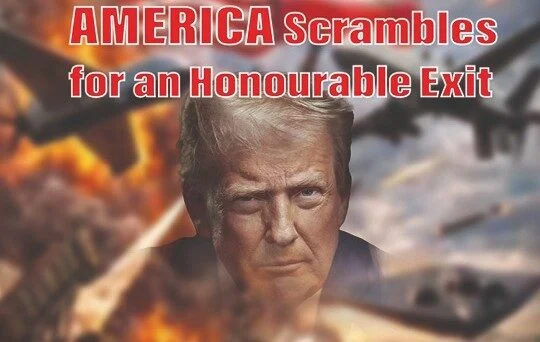
In boxing, there is a tactic called clinching. A clinch happens when a boxer grabs, embraces or hugs the opponent to stop punches. When a boxer figures out that he is hurt, tired, and heading for defeat, he starts clinching. This helps the badly bruised boxer to temporarily disrupt the opponent’s rhythm, waste time, and avoid the fury of his opponent’s knockout punches. Such a tactic is allowed, but the referee usually keeps breaking it up quickly. If you look at the war on Iran, initiated by the rogue US-Israel alliance, then, undeniably, it appears that America had started clinching.
After the Venezuela Maduro operation, President Trump was fed on the illusion that the Iranian regime would collapse if its top leadership was eliminated. He attacked Iran, thinking the Iranians would accept defeat within a few days and beg for a ceasefire by accepting all American-Israeli demands. However, we know that things did not exactly go according to the US-Israel plan, and today America stands battered, bruised, defeated, and humiliated.
How Wars Come to an End?
Wars rarely end purely by victory. Most wars end because of exhaustion that forces the warring nations to the negotiating table. The political costs of the war mostly determine the exit timing. Face-saving is critical as heads of state need to justify their decisions before their domestic audience. Then the human, economic, and strategic costs also impact the longevity of wars.
Mediation, alliances, and pressure from partners all add up to the build-up for bringing war to an end. Let us look at all these factors in the context of the war on Iran.
The Exhaustible American War Machine
Reports suggest that in just 16 days of the Iran war, the US used 6000+ of their fabled air power. For example, around 40% of THAAD missile interceptors, around 46% of ATACMS / Precision Strike Missiles and around 17% of Tomahawk cruise missiles.
Another report says, the US used more than 850 Tomahawk missiles in 4 weeks. Experts say that this shows a very high consumption rate relative to stockpiles, especially for “high-end” precision weapons. Further, the delivery time for a single Tomahawk cruise missile is two to four years.
Pentagon is worried about “rapid depletion” of precision weapons. There is talk about an emergency push to “quadruple production” of missiles.
The other worrying part of this fast depleting American firepower in the skies is their cost asymmetry. $ 3-4 million interceptors are being used against cheap drones being sent by Iran. Some reports suggesting that the Iranian Shahed-131 kamikaze drone costs as low as $20,000 to $50,000.
Unhappy MAGA Cadre
Trump rode back to power for his second term as US president through the committed support of his “Make America Great Again” (MAGA) cadre. Trump built his MAGA voter base by championing ending “forever wars” and avoiding Middle East entanglements. Thus, President Trump’s war on Iran was seen by many as a betrayal of the core principles of “America First” (anti-war identity).
A major flashpoint in the debates taking place within MAGA circles is the growing perception that the war on Iran was influenced and imposed by Benjamin Netanyahu. Thus, there is a growing unease in the Trump administration about the popularity of claims that the US is fighting someone else’s war that is adding nothing but more ignominy and misery to America and the world.
A Worried Wall Street
Major indices (Dow, Nasdaq, Russell 2000) have entered the correction territory. Oil prices have surged, with Brent Crude up 55%. This will likely lead to an investor pullback and a weak growth outlook for the American economy. There is a broad sell-off across equities and bonds, with even “safe” portfolios (60/40) losing value. There have been 5 straight weeks of losses on Wall Street, with the Dow down over 10% from its peak. There is a fear of rising inflation (OECD forecast increase of around 4.2%) and sustained equity and bond sell-offs.
The Federal Reserve is expected to increase the interest rate, and this will then translate to higher borrowing costs, slowing investment, and the overall economy. Finally, a Goldman Sachs estimate cited in Fortune warns that the oil shock linked to the war on Iran may lead to around 10,000 US job losses per month, particularly in consumer-facing sectors.
Negotiations as a Trojan Horse
President Trump revealed to the world that the US is already in talks with Iran to end the war, saying, “Talks are going very well.” Iran immediately denied being in negotiations with America but indicated willingness to talk if its demands are met and negotiations are carried out on Iranian terms.
Many market analysts have pointed out that President Trump turns hawkish and belligerent, making major escalation announcements like strikes, ultimatums on weekends, when global markets are closed. Then comes Monday, when markets open. He then turns dovish and sends positive signals like the US is in peace talks with Iran and that very soon “we can have a deal”. This is meant to calm investors and subsequently influence oil prices, investor sentiment, and global markets.
Will Iran Allow an Honourable Exit?
For Trump, an honourableexit will be a deal for a ceasefire. A ceasefire in which the US and Israel will stop their attacks on Iran. Regime change will no longer be pursued. Iran will have to reopen the Strait of Hormuz and stop its attacks on American bases in the Gulf. This will allow Trump to claim some sort of victory, claiming that he has weakened Iran and reserving the right to attack Iran if it does not give up its nuclear programme.
But it is very unlikely that Iran will accept such a deal. Today, Iran is calling the shots. It is in a position of strength. Naturally, it will dictate terms. The minimum Iran would accept is ending hostilities before any negotiations begin. Removal of all US sanctions. Continuation of the civilian nuclear programme under international law. Non-aggression and security guarantees that there won’t be any further Israeli-American attacks. Will the Trump administration accept these terms? If it does not, then it is very likely for war to enter a prolonged and escalatory stage, and this won’t help anybody.