

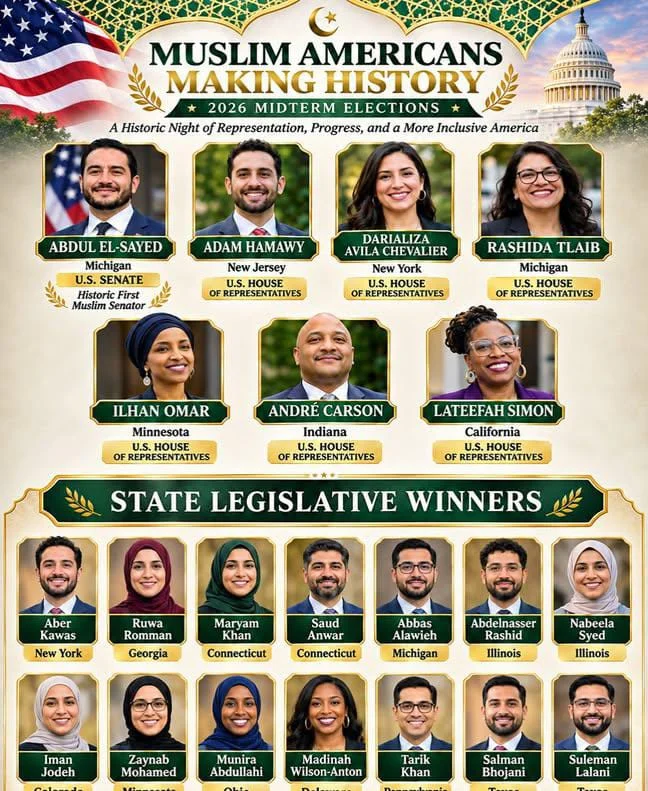
When Donald Trump called Abdul El-Sayed a ‘jihadist’ and warned Americans against electing him to the United States Senate, he was appealing to a fear that has haunted Muslim Americans for a quarter of a century. El-Sayed, a 42-year-old physician and former public health official, was campaigning in Michigan on healthcare, rising living costs and the influence of wealthy interests on politics. His opponents repeatedly questioned his faith and loyalty. On Nov. 3, Michigan’s voters delivered their answer. El-Sayed defeated Republican Mike Rogers and became the first Muslim elected to the US Senate.
The result was particularly striking because Michigan had voted for Trump in the previous presidential election. El-Sayed, the American-born son of Egyptian immigrants, had also challenged powerful interests over his opposition to US military support for Israel. His victory came amid wider Democratic gains, but it carried a significance of its own. Across America, Muslim candidates, including outspoken defenders of Palestinian rights, were winning seats in Congress and state legislatures. Their success challenged the assumption that Muslim identity or criticism of Israel must necessarily become an electoral liability.
For Bhatkal, a coastal town in Karnataka, the victory had a deeply personal connection. Dr El-Sayed’s wife, Dr Sarah Jukaku, a psychiatrist, belongs to a Bhatkali family. Her father, Dr Tayeb Jukaku, grew up in the town before settling down in America. As votes were counted in Michigan, relatives in India remained awake, praying for Abdul’s victory. The New Indian Express reported that Dr Tayeb had sent a message to the family WhatsApp group requesting prayers. By morning, the news was spreading through Bhatkal and among Bhatkali families abroad.
Indian newspapers and television channels soon began reporting the connection, interviewing relatives and recalling the family’s roots in Karnataka. Dr Aliya Nazneen Jukaku, Sarah’s aunt, spoke to the media about the family’s happiness and El-Sayed’s visits to India. For people in Bhatkal, watching a familiar family name appear in election coverage from America brought understandable pride. Yet the greater story was unfolding thousands of kilometres away, where voters had elected a man whose religion had been made a central target of his opponents.
When Prejudice Met the Ballot Box
El-Sayed’s campaign exposed an uncomfortable reality of American politics. Trump repeatedly described him as a dangerous extremist. Senator Ted Cruz raised allegations about supposed links to the Muslim Brotherhood, which El-Sayed denied. The president even invoked the September 11 attacks while urging voters to reject him. Such accusations placed an extraordinary burden on a candidate seeking to represent the people of Michigan. He was being asked, in effect, to defend his belonging to the country in which he was born.
The hostility extended to his criticism of Israel. The American Israel Public Affairs Committee, through its political action network, spent heavily against him during the Democratic primary. His positions also drew criticism from some Jewish voters and Democratic politicians. These disagreements were part of a contentious political campaign, but the attacks on his religion went much further. They sought to make the word Muslim itself a warning.
El-Sayed continued travelling across Michigan, meeting people in homes, churches, synagogues and community gatherings. He spoke about medical bills, the price of groceries, schools and the use of taxpayers’ money. His campaign did not persuade everyone; many voters disagreed strongly with his politics. But he earned enough support to win in a competitive state. In his victory speech, he reminded his opponents that the country was large enough to accommodate people of different backgrounds. He also thanked voters for welcoming him into their homes and places of worship.
For Muslim Americans who grew up after September 11, the result carried particular emotion. Many had experienced the discomfort of having their names, appearance or religious practices treated with suspicion. El-Sayed had faced that hostility in full public view and emerged victorious. Speaking to the Associated Press, he described the campaign against him as hateful and spiteful. Yet he was equally clear about what lay ahead: the real measure of his success would be what he accomplished with the Senate seat.
Another victory brought the election closer to Indian readers. Nabeela Syed, whose parents migrated from Hyderabad, defeated Republican incumbent Darby Hills to win an Illinois State Senate seat. Syed had entered the Illinois House of Representatives in 2022 at just 23. Her latest campaign addressed healthcare, education and the cost of living. Winning a Republican-held seat required support from voters across different communities. Her success was another reminder that the children of immigrant families are increasingly finding a place in American public life.
Gaza and the Courage to Speak
Perhaps the most revealing aspect of the elections was the success of candidates who had openly defended Palestinian rights. In American politics, criticism of Israel can invite fierce opposition, substantial campaign spending and accusations that sometimes blur the distinction between legitimate disagreement and hostility towards Muslims. Yet several candidates who spoke against the devastation in Gaza won the confidence of voters.
Dr Adam Hamawy’s victory in New Jersey was especially significant. An Egyptian-American trauma surgeon and former US Army combat surgeon, Hamawy had treated wounded American soldiers in Iraq and civilians in humanitarian crises. He also worked in Gaza, where he witnessed the suffering of Palestinians caught in the war. His testimony about wounded children, devastated hospitals and the desperate conditions facing civilians came from direct medical experience. Voters in New Jersey’s 12th Congressional District elected him to Congress despite attacks on his political positions and Muslim identity.
Hamawy’s campaign also addressed healthcare and the needs of ordinary Americans. His life offered an answer to those who questioned whether a Muslim could serve the country faithfully: he had already served it in uniform, cared for its wounded soldiers and spent years treating people in desperate circumstances. In his victory speech, he ended with Allahu Akbar, explaining that words some had tried to turn into a symbol of fear were, for him, an expression of gratitude and humility.
Rashida Tlaib, the Palestinian-American congresswoman from Michigan, and Ilhan Omar, the Somali-American congresswoman from Minnesota, also won re-election. Both have been among the most outspoken critics of Israel’s military campaign in Gaza. Both have faced years of political hostility, including attacks involving their faith and family backgrounds. Their constituents nevertheless returned them to Congress.
The victories extended to state politics. Palestinian-American community organiser Aber Kawas won a New York State Senate seat, while Iman Jodeh in Colorado and Ruwa Romman in Georgia also secured electoral success. Their political work has involved local concerns ranging from housing and healthcare to immigrant rights, alongside advocacy for Palestinian rights. They were elected to represent constituencies containing people of different faiths and political opinions.
These results deserve careful interpretation. We cannot assume that everyone who voted for these candidates supported their positions on Gaza. Americans choose candidates for many reasons, including party loyalty, economic concerns and local political circumstances. But the results demonstrate something important: openly defending Palestinian rights did not prevent these politicians from winning elections. In a political environment where support for Israel has long carried considerable influence, that is a development worth examining.
Nor were these isolated victories. André Carson of Indiana and Lateefah Simon of California retained their congressional seats, while Darializa Avila Chevalier won election from New York. Muslim candidates also succeeded in legislative races in Michigan, Ohio and other states. Religion News Service reported on Nov. 4 that at least seven Muslims had been elected to Congress, including El-Sayed in the Senate.
The wider Muslim political presence had been growing well before these elections. In August 2026, the Council on American-Islamic Relations (CAIR) and CAIR Action identified 255 Muslim elected officials across 26 states, including 110 women. They included 98 local council members, 63 education officials, 46 state legislators, 18 judges and 11 mayors. These figures predated the November election. They reveal how Muslim Americans have been entering public life through school boards, municipal councils, courts and other institutions where their work directly affects neighbours from every community.
The Response Across America
American news organisations gave considerable attention to El-Sayed’s victory. The Associated Press examined its emotional significance for Muslim Americans, particularly those who had lived through years of suspicion following September 11. The Guardian reported how his campaign had reached voters across Michigan while confronting attacks on his religion and opposition to his criticism of Israel. The coverage also reflected the political divisions surrounding his positions. His victory was celebrated by supporters, but it did not erase the disagreements that had made the contest so bitter.
Journalist Mehdi Hasan, who had followed the campaign closely, reacted with unmistakable emotion during election-night coverage on Zeteo. Addressing Trump, Mike Rogers and other prominent opponents of El-Sayed, he declared, “Cry more.” His defiance captured the anger and relief of those who had watched a Muslim candidate endure months of attacks and then defeat his critics at the ballot box. CAIR and CAIR Action also welcomed the results, noting that more than 160 Muslim candidates had sought office across the country. Their response reflected the satisfaction of a community whose political participation had continued to grow despite a hostile national climate.
The election offered no evidence that Islamophobia had disappeared from America. Indeed, the campaign against El-Sayed showed how easily religious suspicion could still be exploited. What the results revealed was that such appeals did not always prevail. Voters were willing to elect Muslim candidates who spoke about their communities’ needs, defended controversial positions and refused to conceal their identities.
A Lesson for Indian Muslim Politicians
The political circumstances of America and India are different, and electoral outcomes cannot be explained by a single factor. Nevertheless, these victories offer a useful lesson for Muslim politicians in India, particularly those seeking to represent constituencies where Muslims are a minority.
El-Sayed spent months visiting communities and discussing their problems. Nabeela Syed addressed the concerns of working families. Others developed their political careers through local institutions and years of public engagement. Their experiences suggest that religious identity need not prevent a candidate from earning the confidence of people belonging to other communities. But that confidence requires patient work. It cannot be created through election speeches alone.
For Indian Muslim politicians, the responsibility is to become dependable representatives of everyone in their constituencies. A farmer struggling with debt, an unemployed graduate, a mother seeking treatment for her child or a neighbourhood waiting for drinking water should be able to approach them without hesitation. Such relationships must continue between elections. They should continue even after defeat, when there is no office to hold and no immediate political reward.
The American results offer encouragement, particularly at a time when religious prejudice has become a familiar instrument of political mobilisation. They also remind us that people remember who listened to them, who helped them and who remained accessible when an election was over. A politician who hopes to represent a diverse constituency must first become someone its people can trust, whether they voted for the politician or not.