

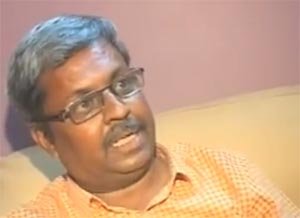
SOUMITRA DASTIDAR, a documentary filmmaker and columnist, during his recent visit to the national capital, shared his point of view of Bengali Muslims and recalled his interaction with Shubhradeep Chakravorty and underlined the need of having an anti-communal forum in Bengal, in an interview with MOHAMMAD NAUSHAD KHAN
How did the idea of making Musalmaner Katha come to your mind?
I had made a film on the Gujarat genocide in the year 2002 when the carnage was going on. After that I travelled to various parts of India to screen my film. I was in contact with Muslim intellectuals and the aam aadmi. There was a time when I came to realise that I knew nothing about my neighbour. My friends from Howrah, Malda and from various other parts of Bengal asked me why I didn’t make any film to highlight the problems in Bengal while I had travelled a lot and had made films at other places like in Bhopal and Gujarat. Then, in New Delhi, I met Justice Rajinder Sachar at a seminar organised by Insaaf. He encouraged me to make a film on the Muslims in West Bengal. Then, I decided that I must make a film on Bengali Muslims to highlight their problems and issues.
The subject was very big and I was a bit nervous. I searched in Google any film on Bengali Muslims but found none except some literature. To visualise some theoretical aspect into film was a huge task. It was a challenge but I was able to make it successful and the response I got from the people during its first screening in the Press Club Kolkata was overwhelming and it had tremendous impact.
Debesh Roy, who is a well-known literary person in Bengal, many other intellectuals and common people from various parts of West Bengal made the screening most successful. I have never seen the kind of emotion from the people during screening. The response of Muslims of West Bengal was ‘it is not Soumitra’s film; it is our film’.
What actually did you want to project in this film?
What I wanted to project was socio-economic conditions of Muslims in West Bengal after partition. I have touched partition and various ups and downs after partition in West Bengal. I have also highlighted the historical aspect of West Bengal Muslims and have found that history has been distorted and it requires to be written afresh. Basically, it was aimed at highlighting socio- economic conditions of Muslims.
What were your findings? How is the socio-economic condition of Muslims in Bengal?
The condition of Muslims in Bengal is really pathetic. Recently I met some intellectuals and civil society members; they too were convinced that the condition of Muslims in West Bengal is very bad. The condition of Muslims is very bad economically, socially and politically. They are subjected to second class citizens in West Bengal. And hatred and prejudices are also increasing against minorities and Adivasis.
So do you think the condition of Muslims in Bengal is exactly what Sachar Committee had said?
Of course, of course! Let me say it is even worse than what Sachar committee has said.
Any particular point of this documentary would you like to share with us?
The pains, sufferings and agony of Bengali Muslims is reasonably described and must be watched by people who are interested to know the condition of Muslims in West Bengal through ages. The film best describes the sentiments and pain and sufferings in their heart.
After having analysed the overall condition of Muslims, what according to you should be the measures to overcome the malaise?
There are two aspects. One, that you don’t hate your neighbours; you mingle with your neighbours; ghettoization must be stopped. The other aspect is to develop minorities through various governmental schemes and other benefits. Employment should be provided and everything must be done to uplift minorities in all walks of life.
So, do you think both the regime of Left and TMC are the same as far as the economic condition of Muslims is concerned?
Both the parties are more or less same for Muslims when we talk of economic condition of Muslims.
Have you made any attempt to reach out to the government to make them aware about your findings in Musalmaner Katha?
As a documentary maker, I believe it is a very important task in a democracy and therefore dialogue is very important. Both the central government and the state government should understand the conditions of Muslims in Bengal. Only infiltration and Hindutva is not the solution.
Would you like to share problems you faced during screening of Musalmaner Katha?
Initially, there were no problems. But I don’t know why it happened during Didi’s regime. To my mind, Didi was against it because somebody might have provoked Didi that Nazrul Islam is a man against her; this is why I believe I had to face problems. After screening of the film, one of my close friends broke all ties with me. Even in Bengal hatred is increasing.
Are you planning to make any other film?
Yes, on partition. I am really thinking and I must do a film on partition because it is a very important subject, maybe in 2014-015.
What is your experience while making a documentary on Assam?
It is also very painful because Assam is very close to West Bengal. What surprised me that there is ethnic cleansing but nobody bothers about it. The mainstream media is very much silent. It is very unfortunate that there is inhuman attitude towards Muslim people in some parts of Assam and nobody is there to question it. I must express my views and experiences through films.
Do you think tie up with the Left and TMC will be good for the people of West Bengal?
I don’t know exactly, but may be against Hindutva it is possible and it is important and good for the people. It may not be in the form of any party but in the form of any other organisation.
Do you think leaders of West Bengal must learn some lessons from Bihar bye-elections?
Definitely, now the fight is between the two ideologies. The battle lines have drawn between supporters of secular and non-secular forces.
What is the way forward?
It is very important to organise anti-communal forum with people from all walks of life, including intellectuals, media fraternity, civil society and human rights activists. A forum must be made against communalism.
As we all know Shubhradeep Chakravorty is no more. Have you ever met him? Do you remember anything about him?
For the first time, I met Shubhradeep at Godhra station when I was there to make another film on the Gujarat carnage and its aftermath. Suddenly, I heard one Bengali boy shouting Dada in front of Godhra station and he was Shubhradeep. He was there to make his first documentary. Actually, Shubhradeep was my family friend. Me, my wife and my daughter were very close to him. My daughter was very much upset when she came to know that he has died. I met him many times.
One particular instance I would like to share is that of last minute cancellation of a government hall booked for the screening of his documentary on Muzaffarnagar riots. I called a press conference at a place very close to that government building. I organised an alternative place to screen his film on Muzaffarnagar riots. Also, on numerous occasions we sat, ate together and talked with each other. I also discussed with Shubhradeep to have a common platform for solidarity and it is a very important task he was eager and was committed towards it. He was our weapon against communalism. Shubhradeep had left a government job for this cause and for the cause of the minorities. And people must know about it.
Anything you remember he told you about the documentary on Muzaffarnagar riots?
I had suggested him to reduce the length of the film. He shared with me that the message is one and that is secular India. We all know what is happening in the name of development. Sanskritisation is going on; people affiliated to the Right wing are holding important academic posts.
Wife of Soumitra Dastidar, Barnali Ghosh Dastidar, Associate professor of the Bengali Language & Literature (Narasinha Dutt College, Howrah), also shared her interaction with Shubhradeep.
“I have met him two times. But as far as my experience is concerned, Shubhradeep was a wide hearted person, very jolly and jovial. He used to meet with people very cordially. Just ten days before he died, he had visited our house; he entered shouting ‘Didi, Mani (my daughter’s nickname is Mani) what you all are doing?’. He was wearing very simple clothes. He entered our house with a packet containing a big cake. When I asked why he had brought it, he said we will all share it and have it and we all ate it. I also prepared tea and offered him some sweets. When I asked him why he had become so fat; it is not good; it will be a source for many diseases, he just laughed. After that we watched a few parts of the documentary on Muzaffarnagar riots made by him. While he was getting ready to move out, I asked him whether he would like to have launch; he refused. But when he came to know about Hilsa fish which I had prepared, he said ok he would have it. And after ten days I got the news. It was very painful and even today I cannot imagine he is no longer in this world,” Barnali Ghosh said.