

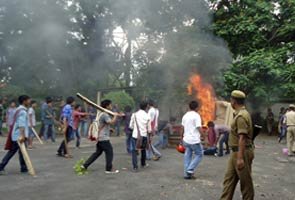
India was not at war with any neighbour countries. Foreign troops too had not infiltrated in Indian territories to occupy certain areas. Earthquake or other natural disasters (except flood) were also not reported in those areas in last few weeks. Bangladesh involvement is also not reported. Despite these naked facts, 3.78 lakh people were displaced; many more were killed; homes and properties were gutted and people were forced to live in relief camps. The number of displaced and homeless people is not a small number or one or two thousands only. More than three lakh people were displaced due to the violence which cannot be called terrorism because of certain elements.
Prime Minister Manmohan Singh visited the affected areas and shared grief and pain of affected people. He termed it as a blot on the nation. A sum of Rs. 300 crore was announced for the development and rehabilitation of the violence-hit areas. Army is camping there to restore peace and sense of security in those areas.
The same climate was witnessed in Gujarat in 2002. Though there is no comparison between Gujarat carnage and Assam violence yet there are certain similarities. Chief Minister of Assam blames delay in deployment of army while BJP and its other allies who couldn’t buy peace blamed illegal migrants for the unrest in Assam.
If we attempt to see this violence through the eyes of politics and communal minds, this issue would not be settled easily because a majority of affected people belong to a particular community.
This violence, however, raises a couple of questions. How were 3.78 lakh people displaced? Where was the state as well as central administration? Where were security agencies especially when the environment was being planned as a rehearsal for such carnage?
One fails to understand how India, which fought with China and Pakistan and which is busy in redevelopment process in Afghanistan and which uprooted terrorism from Punjab, how fails again and again in encountering the elements that causes violence and genocide within Indian territories, forcing Indians homeless and making them refugees inside India amid the lack of adequate action on the part of the government and police. What have the governments in Indian States learned from Gujarat to UP to Assam?
The climate of inaction from P.V. Narasimha Rao to Atal Behari Vajpayee to Dr. Manmohan Singh is the same without much change. The Government’s commitment to erasing terrorism embarrasses ordinary people when they see a majority of Indian people, who are killed or displaced, are victims of ethnic and communal clashes rather than an act of terrorism.
It is true that time will heal the wounds, and presence of army will help restore peace and confidence among the affected people but let’s not forget that time, sciences and invention of new technologies couldn’t eliminate or reduce hatred and discrimination that sometimes cause violent atmosphere in which people can be seen as blood-thirsty of each other, and the government appears the weakest institution to tackle this situation.
Years have passed but the government’s inaction in preventing ethnic and communal clashes reminds the gravity of the entire climate. A majority of those who were displaced during the Gujarat carnage are still unable to return to their homes even after the passage of ten years and the fear of repeating the same atmosphere is there in Assam too.
Blame-game is not the adequate reply to such violence. Governments must exhibit some courage in taking stern action against the elements who attempt to take law and order in their hands while the police remains biased.
These clashes are not a good sign at any rate for any society or for anyone. Indians have lost much of lives, properties and social bounds due to these clashes that leave unforgotten stories etched in minds.
It is upon governments to provide security and prevent these clashes before they take place. Politics with communal minds and action with communal thoughts are big hindrance in dealing with this atmosphere of hatred.
This violence once again shattered the dream of peaceful society. Governments must have the answers. Responsibilities and jobs cannot be ignored when demands to act fairly and honestly are being raised.