

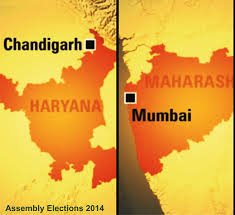
The outcome of the verdict in Maharashtra and Haryana has shown that linguistic and caste based politics is on a declining trend. The message for the regional parties is straight and clear: put your heads together or lose elections, one after another. The voting behaviour during assembly elections and Lok Sabha polls has got changed dramatically and if it is only for the sake of development then it is noteworthy transformation. But if it is for anything else then it is a dangerous sign.
The polarisation effect is challenging the coalition era and regional powers in their strongholds. Be it anti-incumbency, tradition based approach and the habit of taking the voters for granted and doing nothing in absolute terms for the benefit and welfare of the people, it has changed the mindset of the people that had been until yesterday traditional blocks of one or the other regional player. Most of the political observers believe that if the so-called secular forces failed to put their heads together in time then the doomsday is not far away. The political demography and the landscape will get completely changed. The message is perform or get perished.
Ram Puniyani, renowned social reformer and human rights activist, while talking to Radiance, said, “I think the message is very clear that all non-communal parties, not all parties are communal but nobody can be called total secular parties, have to join hands. There are a couple of parties that can be called communal and they are Shiv Sena and the BJP. All other parties have to come together as an electoral alliance by overcoming their selfishness and putting on the backburner their petty issues if they want to save democracy in the country. The political alliance in Bihar post-Lok Sabha elections is one good model. All the parties who believe in democracy and those who do not want Hindu nationalism and Hindu Rashtra have to come together and try to adjust each other. These parties have to overcome their egos and rise above personal interest for the larger goal. The political parties will have to see the larger picture otherwise we are heading for a Hindu nation which also means autocratic state and abolition of democracy.”
Taufique Aslam Khan, president JIH Maharashtra, told Radiance that in the last 10 years the NCP and the Congress did some work but there was anger for not doing the manner in which they were supposed to do. Because of the local body tax, the business community was angry. Prithviraj Chouhan had assured the business community to address their grievances but failed to do so. The opposition had promised to remove the local body tax if they form the government and therefore the business community voted in large numbers. Congress did not campaign very enthusiastically and the absence of tall leaders from the campaign demoralised the state cadre. As against Congress, the campaign of the BJP was highly aggressive.
“The breaking of alliance just before the assembly elections also harmed both the Congress and the NCP and of course there was anti-incumbency factor. Even the secular forces are not that secular. These secular alliances ruled for a decade but failed to do what they were supposed to do to address issues of the Muslims and innocent Muslims were arrested on continuous basis. Life here is as usual because people have got the experience of the Shiv Sena and the BJP regime in the past,” said Mr. Khan.
The BJP was quick to learn from the message from the bye-polls verdict particularly in Uttar Pradesh and did not allow Yogi Adityanath, whose hate speeches had adverse impact on the minds of the people: how can a party that came to power on the agenda of development resort to such hate speeches and divisive politics. Keeping these elements from the campaign to some extent might have also helped the BJP. The break-up of alliance between Congress and the BJP and likewise BJP and Shiv Sena confused the people and the votes got divided unevenly which helped the BJP. Although the BJP has gained handsomely in both the states, Maharashtra and Haryana, the party has been voted to power to test the promise of the BJP made to the electorates for all round development. The slogan of the BJP sab ka saath sab ka vikas will be closely watched by the voters.
The dramatic turning point of the assembly elections in Maharashtra was primarily the breakaway of the alliance in between Congress and the BJP. If we closely look at the poll arithmetic then we will come across that Congress got 18.3 per cent votes which were slightly less i.e. 3 per cent less than what the party had managed to get in 2009. The vote percentage of NCP was 17.9 per cent and together it adds up to 36.2 per cent which is absolutely more than the vote BJP got which is 26.8 per cent. Analysts believe that if the Congress and the NCP remained alliance partners then there could have been neck to neck to fight and much better than what they have got in the assembly elections.
Raj Thackeray’s Maharashtra Navnirman Sena (MNS) was the biggest loser as it could win only one seat. In 2009 the party had won 13 seats. In the last assembly elections the votes MNS pulled out from Shiv Sena indirectly had helped the Congress and NCP combine. The Marathi manoos politics has subsided for now and nobody knows when the Marathi politics will regain its strength or decline further from here.
As per findings of the post-poll survey conducted by the Centre for the Study of Developing Societies indicate that the BJP performed much better among educated voters. The party polled 45 per cent of the votes among the college-educated as compared to 24 per cent among non-literate voters. Even among school-educated voters, 34 per cent voted for the BJP, Congress and INLD. The gap between the Congress and the INLD is not substantial and the Congress could have performed much better had the election taken place at a different time. More than 40 per cent of the respondents felt that the condition of basic services like electricity, roads and hospitals had improved during the last five years. What seems to have hurt the prospects of the Congress is the negative perception of the voters about the work done by the Congress-led UPA government at the Centre. A large number of voters did not want to vote for the Congress as they blamed it for various corruption scandals.
For roughly two decades the political landscape was predominantly dominated by Jat politics and for the last 18 years, Jat CMs, BansiLal, Om Prakash Chautala and Bhupinder Singh Hooda, perused the Jat agenda vociferously which gradually alienated communities other than Jats. And this time around BJP managed to tap that anger and all non-Jat communities got consolidated and voted for the BJP.
In the 2014 assembly elections in Maharashtra nine Muslim MLAs have won as compared to 11 in 2009. Of the total 65 Muslim candidates contesting on various party tickets only nine were elected. In the last assembly elections five Muslim MLAs were from Congress, three from Samajwadi Party, NCP had two and Jan Surajya Shakti one Muslim MLA. The Muslims MLAs who got elected this time are: Imtiaz Jalil and Waris Yusuf Pathan (Byculla) of MIM; Abu Asim Azmi of Samajwadi Party and Mushrif Hasan Miyalal of NCP. Aslam Shaikh, Khan Mohd Arif , Shaiked Aasif Shaikh Rashid, Amin Patel and Abdul Sattar Abdul Nabi of Congress Party.
However, the performance of the MIM has surprised all political class. Many believe that the party is trying to fill the political vacuum created by mistrust between secular parties and the Muslims. And that is why the party has now decided to contest elections in other states as well to tap the anger and frustration of the Muslims. Two of its candidates Syed Imtiaz Jalil won from Aurangabad Central and Advocate Waris Yusuf Pathan from Byculla. Out of six cornered contest, other three candidates of the MIM came second while eight of them were on third position. This speaks volumes of the role the party is likely to play in the near future.