

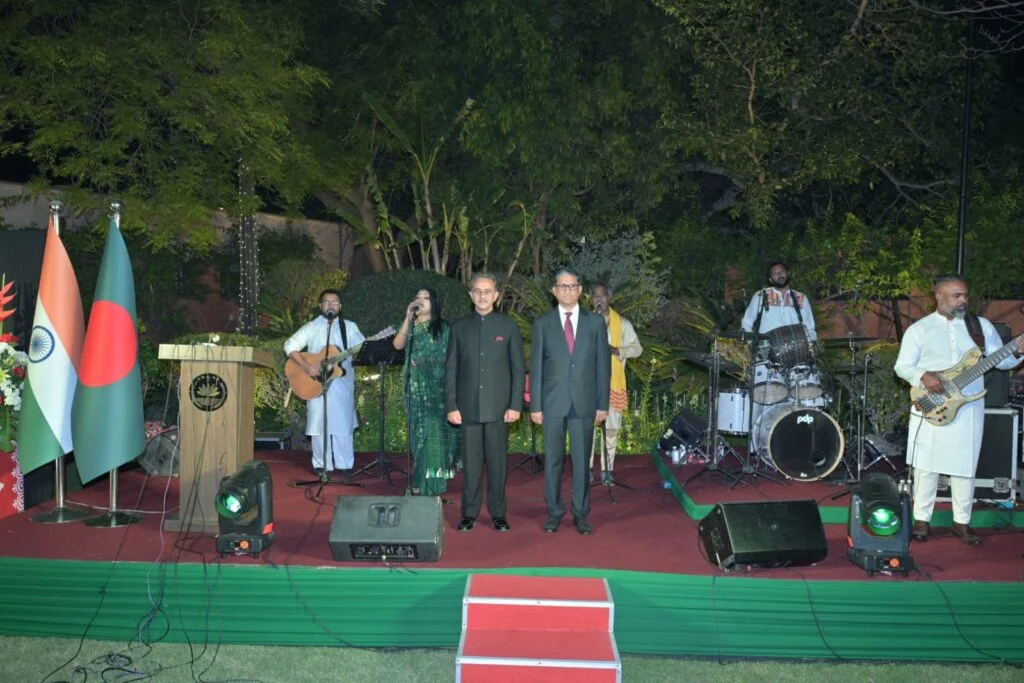
In a notable diplomatic outreach following the political transition in Dhaka, the Bangladesh High Commission in New Delhi, for the first time, invited representatives of prominent Indian Muslim organisations to its 55th anniversary of Bangladesh’s independence on March 26, signalling a calibrated engagement with India’s over 200 million–strong Muslim community.
The high-profile reception blended cultural celebration with subtle diplomatic messaging, drawing more than 400 distinguished guests from across India’s political, diplomatic and cultural spectrum. What marked a clear departure from past practice was the presence of key leaders from major Indian Muslim bodies, including Er. Mohammad Salim and Malik Moatasim Khan, vice-presidents of Jamaat-e-Islami Hind, and Maulana Mahmood Madani, president of Jamiat Ulama-i-Hind, alongside several Sufi figures.
Observers view this inclusion as reflective of a nuanced shift in Dhaka’s outreach strategy toward Indian Muslim organisations. While Jamaat-e-Islami Hind has no organisational links with Bangladesh’s Jamaat-e-Islami (BJI), its leaders were not typically invited to such events during the tenure of the Awami League government. The evolving political landscape in Bangladesh provides important context. In the recent parliamentary elections, BJI emerged as a significant force, securing 68 seats independently and 77 seats through alliances, accounting for nearly a quarter of the legislature. Meanwhile, the BNP-led alliance crossed the majority mark with 212 seats, forming the government.
This marks a dramatic turnaround for BJI, which had been banned under the Awami League government, with several of its leaders executed following controversial trials. Its resurgence as a principal opposition bloc underscores shifting domestic political dynamics that are now influencing Dhaka’s external engagement, particularly with communities of shared cultural and religious affinity.
Against this backdrop, the BNP-led government’s outreach to Indian Muslim representatives assumes added significance. India is home to the world’s second-largest Muslim population after Indonesia, and nearly a third of the global Muslim population resides across the Indian subcontinent – spread between India, Pakistan and Bangladesh. Engaging this demographic is increasingly seen as a pragmatic diplomatic avenue that complements state-to-state relations.
Diplomatic circles interpret the inclusion of Indian Muslim leaders at the reception as a gesture reflecting evolving outreach priorities by the Bangladesh mission, even as it continues to emphasise strong bilateral ties with India. The event highlighted not only the historical significance of Bangladesh’s liberation but also the expanding cultural and diplomatic engagement between the two neighbours.
Hosted by Bangladesh High Commissioner M. Riaz Hamidullah at Bangladesh House, the evening was attended by Kirti Vardhan Singh, India’s Minister of State for External Affairs and Environment, Forest and Climate Change, who graced the occasion as Chief Guest. The programme opened with the national anthems of both countries, performed live by visiting Bangladeshi musicians, setting a tone of shared history and goodwill. The venue showcased traditional Bangladeshi motifs, including Jamdani textiles, while guests were treated to cultural performances by artists. The culinary highlight was the famed DhakaiKacchi Biryani, prepared by a visiting team of chefs from Dhaka.
The outreach coincided with a significant diplomatic visit by Bangladesh’s Foreign Minister, Dr.Khalilur Rahman, to New Delhi on April 8 – his first since the BNP assumed power earlier this year. During his visit, he held talks with External Affairs Minister S. Jaishankar, Petroleum and Natural Gas Minister Hardeep Singh Puri, and National Security Adviser AjitDoval. He was accompanied by HumaiunKobir, adviser for foreign affairs to Prime Minister Tarique Rahman, and High Commissioner Hamidullah.
The visit gains added importance in the aftermath of the dramatic ouster of former Prime Minister Sheikh Hasina in August 2024, following a mass student-led uprising. Hasina has since taken refuge in New Delhi, adding a complex dimension to bilateral ties, particularly as Bangladesh’s interim leadership under Mohammad Yunus had sought her extradition over multiple criminal convictions – requests that India has thus far declined.
During the discussions, both sides reaffirmed their commitment to strengthening cooperation across key sectors such as trade, energy, connectivity and regional security.