


 In a pivotal moment for Bangladesh’s political landscape, the Bangladesh Nationalist Party (BNP), under the leadership of Tarique Rahman, has claimed a decisive victory in the 13th parliamentary elections held on February 12. According to the unofficial results released by the Election Commission (EC), BNP and its allies secured a total of 212 seats, with the BNP itself winning 209 seats out of 297 declared constituencies. This marks a significant electoral triumph for the party, which has spent years in the political wilderness after being sidelined by the then ruling Awami League (AL).
Bangladesh Jamaat-e-Islami (BJI), along with its allies, secured 77 seats. BJIalone won 68 seats, while its coalition partners, including the National Citizen Party (NCP) and Khelafat Majlis, earned a smaller share. The BJI-led alliance, though defeated, has raised concerns about electoral irregularities, while maintaining a position of constructive opposition in parliament.
Electoral Turnout and Voter Participation
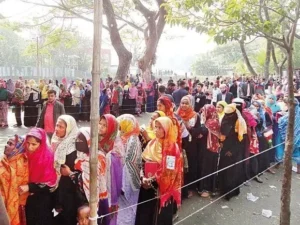
The election, widely considered crucial for Bangladesh’s democratic transition after years of political turmoil, saw significant voter engagement. With an estimated turnout of nearly 60%, the election was notable for its broad participation, particularly among women. Thousands of men and women, some with physical disabilities, queued patiently outside polling stations, a testament to the people’s determination to reclaim their right to vote. Women, in particular, turned out in large numbers, often voting in groups, reflecting the extensive involvement of both genders in shaping the nation’s political future.
The election was held concurrently with a referendum on constitutional reforms – another historic first for Bangladesh, with two votes being cast simultaneously.
Election Irregularities and Controversies
While the election process was largely peaceful, with law enforcement maintaining order and ensuring a secure atmosphere, there were notable accusations of electoral misconduct. Bangladesh Jamaat-e-Islami’s Assistant Secretary General, Ahsanul Mahboob Zubair, claimed that certain Election Commission officials deliberately delayed the announcement of results in several constituencies. He also alleged irregularities in the Dhaka-17 constituency, where he claimed result sheets were tampered with and votes were manipulated to benefit a specific party. Zubair further criticised the Election Commission’s alleged partiality, accusing the body of acting with authoritarian tendencies rather than impartiality.
Despite these allegations, the overall tone of the election was one of relative calm, with most of the country’s citizens expressing satisfaction with the process. The Election Commission’s efforts to prevent any major breaches of conduct and its stringent enforcement of electoral codes were lauded, although critics argue that digital security measures need strengthening to preserve electoral integrity in future elections.
International Reactions and Future Prospects
The victory of the BNP has not only reshaped the domestic political scene but has also drawn reactions from abroad. Indian Prime Minister Narendra Modi and Pakistani Prime Minister Shehbaz Sharif both extended warm congratulations to Tarique Rahman and the BNP, acknowledging the party’s decisive electoral win. Modi emphasised India’s continued support for a democratic, progressive, and inclusive Bangladesh, while Sharif expressed his hope for strengthened relations between the two countries.
As the BNP prepares to form the next government, its challenges are far from over. The party will be tasked with rebuilding institutions that have suffered under years of political strife, ensuring governance reforms, and addressing pressing issues such as corruption, unemployment, and economic inequality. While the victory is being hailed as a triumph of democracy, BNP will have to be vigilant to avoid the pitfalls of authoritarianism that have plagued its past.
A New Beginning for Bangladesh?
The 13th parliamentary elections represent a turning point for Bangladesh, restoring some measure of confidence in the country’s electoral system after years of tension and unrest. For the BNP, the victory is a moment to recalibrate its approach to governance, with the promise of reforms aimed at strengthening democratic institutions. However, the path forward is fraught with challenges, and the party’s ability to deliver on its promises will be closely scrutinised both domestically and internationally.
The Bangladesh Jamaat-e-Islami, although disappointed by its defeat, has vowed to remain a constructive force within parliament, continuing to push for reforms and holding the new government accountable. The peaceful conduct of the election, despite isolated incidents of violence and misconduct, has provided a hopeful framework for future elections. However, as one observer noted, the election’s success should not be taken as a signal of complacency. Rather, it is a call for continued vigilance to safeguard the integrity of the democratic process.
As Bangladesh embarks on this new chapter, the eyes of the world will remain firmly fixed on the country’s ability to navigate the complexities of governance, reform, and national unity. The BNP’s sweeping electoral victory may have restored faith in the democratic process but the true test will be whether the party can maintain that faith through action.