

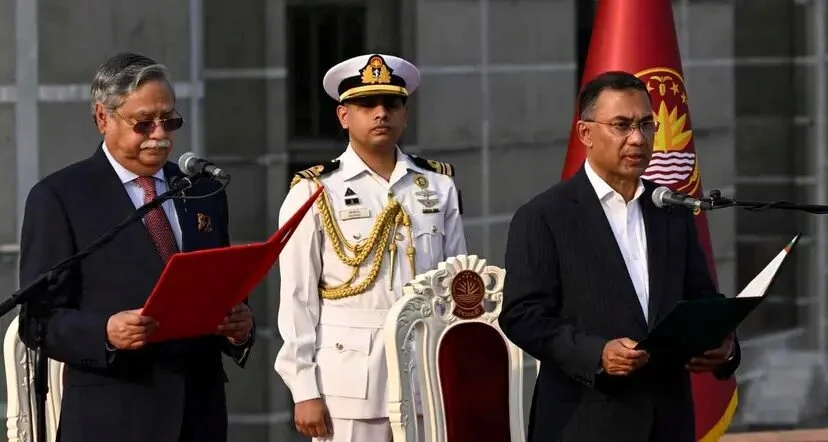
Dhaka: Bangladesh has entered a new political phase with the swearing-in of a government led by Tarique Rahman, chairman of the Bangladesh Nationalist Party (BNP). The oath ceremony on 17 February marked the formal commencement of the country’s 13th National Parliament and the beginning of what the ruling party describes as a “democratic transition in line with public aspirations” following the fall of the previous regime.
Yet even as the new administration consolidates power, tensions over constitutional reform and institutional authority continue to cast a shadow over what is otherwise being presented as a historic democratic restoration.
An Unprecedented Oath Ceremony
In a departure from tradition, the swearing-in ceremony was held not in the Durbar Hall of the presidential palace, Bangabhaban, but under open skies at the South Plaza of the JatiyaSangsad Bhaban (National Parliament Complex). Approximately 1,200 dignitaries, from home and abroad, attended the event, including representatives from South Asian countries.
Members of the 13th Parliament first took their oath in the morning, administered by Chief Election Commissioner A.M.M. Nasir Uddin, a constitutional deviation from the customary role of the Speaker, justified by authorities as necessary under post-uprising conditions.
Later in the afternoon, President Mohammad Shahabuddin administered the oath of office to Tarique Rahman as Bangladesh’s 11th Prime Minister. Ministers and state ministers were sworn in subsequently.
Immediately after the ceremony, the Prime Minister paid courtesy calls on the President and the outgoing Chief Adviser of the interim administration, Muhammad Yunus. In the evening, Rahman visited the graves of his father, former President Ziaur Rahman, and his mother, former Prime Minister Khaleda Zia, at ChandrimaUdyan– a symbolic gesture underscoring both political lineage and continuity.
The following day, he laid a wreath at the National Martyrs’ Memorial in Savar before presiding over his first cabinet and senior civil service meetings at the Secretariat.
Electoral Mandate and Parliamentary Composition
According to official results, the BNP secured a commanding majority in the 297 contested seats:
BNP: 209 seats
Bangladesh Jamaat-e-Islami: 68 seats
National Citizen Party (NCP): 6 seats
Independents: 7 seats
The electoral victory followed a period of mass mobilisation that culminated in what BNP leaders characterise as the ‘fall of fascism’. Party leaders argue that the election represents a decisive public mandate for democratic restoration. However, the reform question remains unsettled.
The Constitutional Reform Rift
A central controversy concerns the July Charter Implementation Order, which created a proposed Constitution Reform Council following a national referendum that reportedly endorsed reform.
While MPs from Bangladesh Jamaat-e-Islami and allied parties took dual oaths – as members of Parliament and as members of the Reform Council – BNP MPs declined to take the second oath. This refusal has sparked uncertainty regarding the implementation of the ‘July aspirations’.
In protest, lawmakers from an 11-party alliance led by Bangladesh Jamaat-e-Islami boycotted the cabinet oath ceremony. The divergence reveals emerging fault lines within the broader anti-incumbent coalition that had previously been united in opposition.
The episode underscores a deeper constitutional tension: whether reform should proceed through parliamentary supremacy or through a parallel institutional mechanism endorsed by referendum.
Cabinet Formation and Governance Priorities
The new cabinet comprises 25 cabinet ministers and 24 state ministers. Senior BNP figures hold key portfolios:
BNP Secretary General Mirza Fakhrul Islam Alamgir – Local Government, Rural Development and Cooperatives
Amir Khosru Mahmud Chowdhury – Finance and Planning
Salahuddin Ahmed – Home Affairs
The government also appointed 10 advisers with ministerial or state-ministerial rank, reflecting an attempt to balance party hierarchy with technocratic inclusion.
On his first working day, Prime Minister Rahman held separate meetings with cabinet members and secretaries, signalling an emphasis on administrative coordination and policy alignment at the outset of his tenure.
International Reactions and Diplomatic Signals
The new government has already begun receiving international attention.
India’s Prime Minister Narendra Modi extended congratulations and invited Rahman for an official visit, with the message conveyed by Lok Sabha Speaker Om Birla.
China’s Premier Li Qiang also sent a congratulatory message, reaffirming Beijing’s commitment to advancing Belt and Road cooperation and deepening the China-Bangladesh strategic partnership. These early diplomatic gestures suggest that both New Delhi and Beijing are keen to engage the new administration, mindful of Bangladesh’s strategic importance in the Indo-Pacific balance.
A Defining Test Ahead
Tarique Rahman’s premiership begins with both symbolic strength and structural challenges. The commanding parliamentary majority provides legislative leverage. Yet the unresolved constitutional reform question, combined with coalition tensions and institutional recalibration after a turbulent political transition, presents immediate tests.
The success of this government will likely hinge on three interlinked factors:Whether it can reconcile reformist expectations with constitutional continuity. Whether coalition partners remain aligned beyond electoral arithmetic. Whether governance reforms translate into tangible economic and administrative stability.
Bangladesh now stands at a pivotal juncture. The promise of democratic renewal has been institutionally affirmed but its durability will depend on how deftly the new leadership navigates the constitutional crossroads before it.