

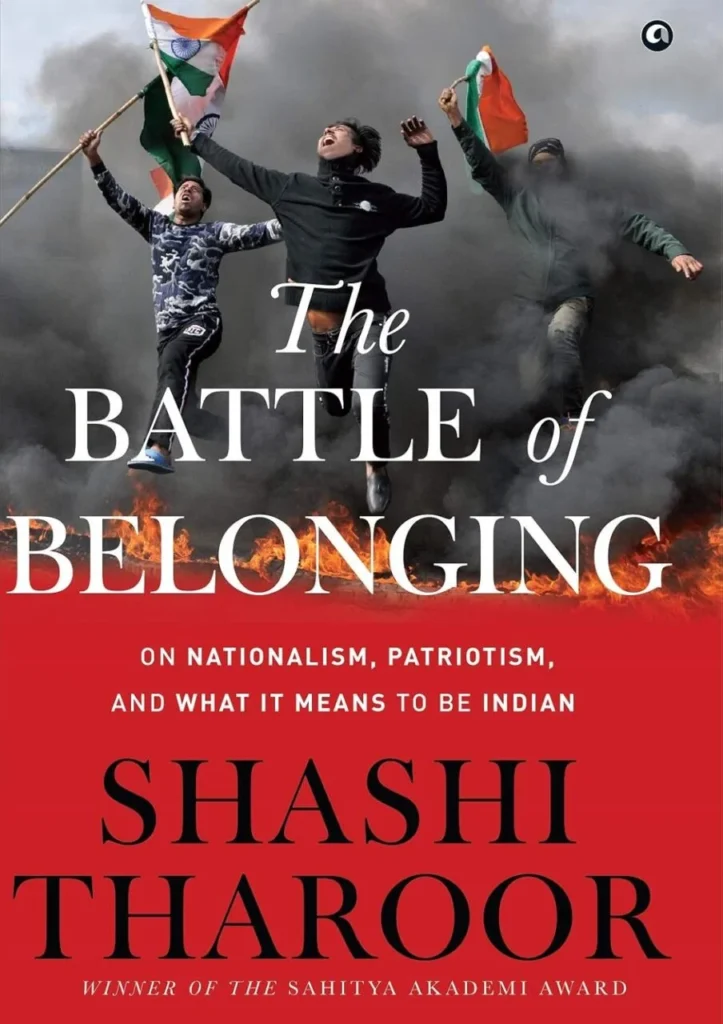
Book: The Battle of Belonging: On Nationalism, Patriotism, and What it Means to be Indian
Author: Shashi Tharoor
Publisher: Aleph Book Company
Year: 2020
Pages: 462
Reviewed by: Dr. Khan Yasir
Written largely in response to the increasing clout of Hindutva under the BJP and the fierce contestation over what it means to be Indian, Shashi Tharoor’s The Battle of Belonging is a passionate defence of a secular and pluralist vision of India, deriving its essence and ethos substantially from the freedom struggle led by Gandhi, Nehru, and Azad. In his view, the values of the national freedom movement are the very elements of Indian nationalism, including “inclusivity, acceptance of difference, celebration of diversity, respect for all religions, equality and fraternity, [and] concern for the poor” (p. 3). Tharoor, a Congress politician and former UN diplomat, offers a comprehensive and deeply personal account of what he calls ‘the battle’ for India’s soul. His central thesis is that India faces a choice between two incompatible forms of nationalism: civic nationalism, which he champions, and Hindutva-based ethnonationalism, which he critiques. The book’s architecture – spread across six sections and 38 chapters, sandwiched between a prologue and an epilogue – systematically builds this case.
The Idea of Nationalism
Section 1, “The Idea of Nationalism,” establishes the theoretical vocabulary, distinguishing critical patriotism from exclusionary ethnonationalism and introducing civic nationalism as the desirable ideal. Exploring in detail the primary literary treasures produced on nationalism by profound thinkers, Tharoor identifies five core elements of nationalism:
- the yearning for national unity (and even uniformity),
- the requirement of exclusive loyalty,
- the striving for national (rather than individual) freedom,
- the aspiration for exclusiveness and distinctiveness, and
- the quest for honour and prestige among nations. (p. 80)
He then distinguishes patriotism from ethnonationalism. Drawing on revolutionaries like Carl Schurz – “My country, right or wrong: if right, to be kept right; if wrong, to be set right” (p. 67) – Tharoor argues that true patriotism is critical and self-correcting, whereas ethnonationalism demands exclusive and uncritical loyalty, warning that these elements become toxic when tied to “blood-and-soil” myths. His case for civic nationalism can be summarised as follows:
In ‘civic nationalism’, ethnicity cedes primacy to shared citizenship, values, institutions, and constitutional rights and obligations. The patriotism of a civic nationalist is no less than that of a ‘blood-and-soil’ nationalist, but it emerges from a sense of belonging to a nation defined by such constitutional elements, rather than by mystical allegiance to an atavistic fatherland. The United States is the country most commonly portrayed as the epitome of civic nationalism, a ‘melting pot’ of diverse ethnicities united by their allegiance to the US Constitution and the values and practices developed under it over two-and-a-half centuries. (p. 91)
The Idea of India
Section 2, “The Idea of India,” defines India as an inherently pluralist constitutional project. For Tharoor, India is not a nation-state in the European mould but a “civilization-state” of a particular kind: one founded on a liberal Constitution, the acceptance of difference, and the principle that “we are all minorities in India” (p. 114). He concedes that “…the idea of India as a modern nation based on a certain conception of human rights and citizenship, vigorously backed by due process of law, and equality before law, is a relatively recent and strikingly modern idea. Earlier conceptions of India drew their inspiration from mythology and theology.” (p. 111) But reinforcing his central thesis, he asserts: “…if the USA is a melting pot… then to me India is a thali, a selection of sumptuous dishes in different bowls. Each tastes different, and does not necessarily mix with the next, but they belong together on the same plate, and they complement each other in making the meal a satisfying repast.” (p. 162) He contrasts this with the Hindutva vision: “Mohan Bhagwat’s construct is not that of my thali. It is, instead, a khichdi theory of nationalism: we are one dish, with many ingredients all mixed up and cooked together. Yes, individual pieces might stand out in the mash, a carrot here, a potato there, but they are nothing other than parts of the meal.” (p. 322) Through this memorable metaphor of a thali against khichdi, Tharoor insists that unity does not require uniformity. He emphasises, “Many observers abroad have been astonished by India’s survival as a pluralist state. But India could hardly have survived as anything else.” (p. 114)
Tharoor summarises his core idea as follows: “…Indian nationalism is the nationalism of an idea… emerging from an ancient civilization, united by a shared history, sustained by pluralist democracy under the rule of law.” (p. 130) He further elaborates:
…the fundamental DNA of India, then, is one land embracing many. It is the idea that a nation may incorporate differences of caste, creed, colour, culture, cuisine, conviction, consonant, costume, and custom, and still rally around a democratic consensus. That consensus is around the simple principle that in a democracy under the rule of law, you don’t really need to agree all the time – except on the ground rules of how you will disagree. The reason India has survived all the stresses and strains that have beset it for over seventy years, and that led so many to predict its imminent disintegration, is that it maintained consensus on how to manage without consensus. (pp. 130-131)
Pluralistic Idea of India
Tharoor acknowledges that sustaining this pluralistic idea of India is a considerable challenge. He particularly notes Ambedkar’s late-life pessimism:
The fact is that in the last years of his life Ambedkar was troubled about the majoritarianism inherent in the Constitution. ‘It was clear,’ he had said before becoming chairman of the Drafting Committee, ‘that if the British system was copied it would result in permanently vesting executive power in a communal majority.’ As a member of the Constituent Assembly, he went along with its majority view, but in a 1953 interview to the BBC, he reiterated in more negative terms something he had already warned against in that Assembly: ‘Democracy will not work,’ he declared gloomily, ‘for the simple reason we have a social structure which is totally incompatible with parliamentary democracy.’ (p. 136)
Unlike Ambedkar, Tharoor remains remarkably optimistic about the Indian Constitution, describing it as a “self-generating and self-correcting entity” (p. 141). Similarly, he argues that, “Democracy takes time to evolve and deepen; its imperfections are not cause to dismiss it, but rather to affirm the rival importance of improving and strengthening it.” (p. 145) He continues, “This healthy spirit of acceptance of difference, of constitutional encouragement of debate and discussion, fuelled by a thriving free media, contentious civil society forums, energetic human rights groups, assorted autonomous institutions, and the repeated spectacle of our remarkable general elections, are all assets for India’s civic nationalism.” (p. 147)
Tharoor is also careful to distinguish his position from narrower civilizational claims: “Some have argued that India is a ‘civilization-state’ rather than a ‘nation-state’, but they anchor the idea of Indian civilization solely in the Hindu dharma, with no regard for the multiple non-Hindu influences that have undoubtedly helped shape contemporary Indian civilization.” (p. 150) Tharoor painstakingly builds the case that India is not the product of any single community but rather a composite civilization to which people of numerous religions and languages have all contributed across millennia….