

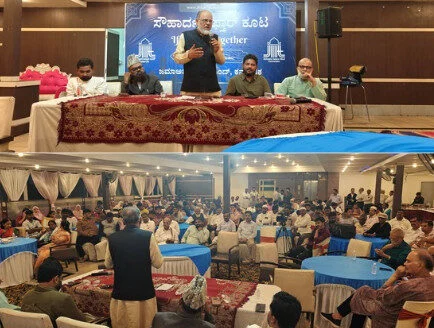
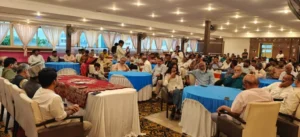
 Bengaluru:As the evening light softened over the city, a modest hall briefly resembled a small map of India itself – people of different faiths, professions and civil society organisations seated side by side, waiting for the call to prayer and the moment of Iftar.
Nearly two hundred representatives of non-governmental organisations, social activists, teachers and community leaders gathered for an interaction over Iftar hosted by Jamaat-e-Islami Hind (JIH) Karnataka, where a shared meal became an occasion for conversation about inclusion, civic responsibility and the challenges facing India’s plural society.
Notably, the hall was already nearly full well before the programme began, with many participants arriving early and engaging in informal conversations even before the formal proceedings started.
The programme opened with a recitation from the Holy Qur’an. In his introductory remarks, JIH Karnataka Secretary Mohammed Kunhi welcomed the participants and said the gathering was intended to create opportunities for people from different backgrounds to meet and understand one another.
“Knowing one another is not a one-time exercise. Communities must continue meeting and interacting regularly,” he said, explaining that such Iftar interactions were organised each year to sustain dialogue across communities.
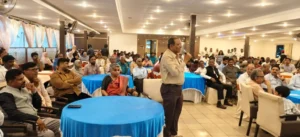 Presiding over the programme, JIH Karnataka President Dr. Mohammed Saad Belgami spoke about the importance of cooperation among communities, referring to the Qur’anic principle “Ta‘awanu ‘alalbirri wat-taqwa” – cooperate in goodness and righteousness. He said societies become stronger when communities support one another in constructive efforts.
He also referred to outreach initiatives, including mosque visits and public lectures, which he said were intended to encourage dialogue and mutual understanding between communities.
The gathering included an interaction session in which participants exchanged views on social and civic concerns. Among the issues discussed were the implications of SIR (Special Intensive Revision of electoral rolls), the role of civil society in safeguarding constitutional values, and the need to strengthen solidarity between communities in a polarised public climate.
Participants emphasised that spaces for dialogue across social and religious lines remain essential for preserving India’s plural character. Many participants shared reflections during the discussion; a few of them are reproduced here.
Reflecting on the atmosphere of the evening, Tara, a teacher, said: “In this small hall, it feels as though the spirit of India has gathered. This is the India many of us recognise – where people of different faiths meet and speak to one another. Preserving that spirit requires effort.”
Social activist Moorya observed that religion should deepen humanity rather than create divisions. “Religion is meant to promote compassion. Yet it is sometimes used to divide people. Here we are sitting together as human beings, trying to understand each other’s beliefs and experiences,” he said.
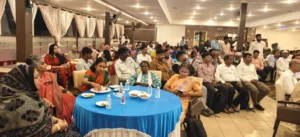 For Father Augustine from Ashirwad, who attended the gathering for the first time, the experience was encouraging. “It is my first participation, and I am glad to have come. Seeing people from different backgrounds meet in this way is reassuring,” he said.
Among those present were several well-known public figures and civil society voices, including N. Mukundaraj, President of Karnataka Sahitya Academy; Mavalli Shankar, State President of Dalit Sangharsha Samiti; C.S. Dwarakanath, former Chairman of Karnataka State Commission for Backward Classes; Arun Jatti, President of BasavaSamithi; and MudnakuduChinnaswamy, noted Dalit poet and thinker. Representatives from a range of social and legal organisations were also in attendance.
During the discussions, some participants also referred to international developments, including concerns surrounding Israel-U.S. tensions with Iran, which surfaced in conversations about peace, justice and the wider global climate.
The programme was moderated by Mohammed Peer, whose measured anchoring guided the evening’s proceedings and helped maintain a reflective tone.
As the call for Maghrib prayer was heard, conversation paused and the fast was broken. For a brief moment the hall fell quiet – people sharing dates and water across the same table, a simple gesture that quietly reflected the possibility of conversation and coexistence even in divided times.