

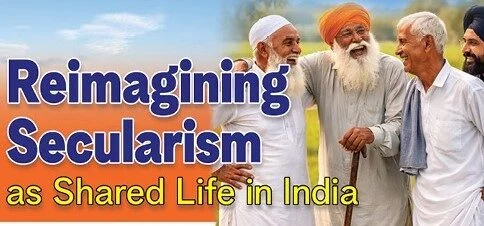
Secularism in India must be reimagined as a vehicle for communal harmony – one that actively brings religious communities together in a shared civic life.
In the bustling lanes of India’s cities and villages, many families live with a quiet unease. A child hesitates before entering a neighbour’s home during a festival. Parents choose schools not only for quality but also for the religious composition of classmates. Elsewhere, a mother discourages her child from attending a birthday nearby – not from experience, but inherited apprehension.
Such moments rarely make headlines, yet they reveal a deeper fracture. Communities retreat into familiar circles, children grow up in social silos, and neighbourhoods subtly reorganise along religious lines. Yet there are inspiring counter-examples – shared festivals, mutual aid in crises, and everyday acts of solidarity – that show harmony, though fragile, endures.
It is within this contrast that the debate on secularism unfolds. Too often, it is reduced either to rigid separation of religion and state or a political accusation – labelled as appeasement or majoritarianism. Such framings obscure its deeper democratic purpose.
At the National History Conference (11-12 April) at India Islamic Cultural Centre, New Delhi, organised by the Indian History Forum, Dr. Ajay Gudavarthy, a political theorist, analyst and columnist, and Associate Professor in Political Science at Centre for Political Studies, JNU, offered a simple yet profound reminder: “Secularism must be reimagined as a vehicle for communal harmony – one that actively brings religious communities together.”
This insight reframes the debate. In a diverse democracy like India, secularism cannot be limited to preventing religious domination. It must actively cultivate trust, mutual respect, and shared everyday life – so that every citizen, irrespective of faith, lives with dignity, security, and belonging.
Why Traditional Secularism Needs Re-imagining
India’s constitutional vision of secularism has never mirrored the strict Western model of separation. Articles 25 to 28 guarantee freedom of belief and practice, reflecting the ethos of equal respect for all faiths. The state maintains a principled distance, intervening when necessary to uphold justice and equality.
Yet, lived reality has often diverged. Intrusive communal rhetoric since Independence has shaped parallel social worlds – communities living side by side, yet seldom together. This has fostered ghettoisation, limited interaction, and a persistent mistrust. The situation has further deteriorated in recent years, particularly with the ascent of communal forces to positions of power.
The democratic cost is significant. Democracy rests not only on institutions but on trust among citizens. When communities view each other with suspicion, participation weakens, and voting patterns are shaped by fear rather than shared aspirations.
The humanitarian consequences are deeper still. Ordinary citizens, especially women and children, bear the burden. Fear restricts movement, narrows opportunities, and erodes social bonds. A child who never befriends someone from another faith inherits prejudice unquestioned. A woman who hesitates to cross into another locality loses not just mobility, but freedom.
Scholarly ideas like “principled distance” have refined the model, yet their impact remains limited when confined to policy. The core limitation lies in its top-down nature: laws can regulate conduct, but cannot create trust.
The need, therefore, is to move from managing diversity at a distance to nurturing it through everyday human connection.
Secularism as Active Trust-Building
It is here that Dr. Ajay Gudavarthy’s intervention becomes both timely and transformative. By asserting that secularism must bring communities together, he reframes it as a lived social ethic rather than a constitutional abstraction.
In a plural society, equality must be experienced – not merely proclaimed. It must take shape in shared spaces, everyday interactions, and common concerns. When citizens meet as neighbours, classmates, and co-workers rather than as isolated religious identities, democracy gains depth and resilience.
From a humanitarian perspective, this shift is crucial. Repeated, positive interaction dissolves fear. The “other” ceases to be an imagined threat and becomes a familiar presence – a fellow human being with shared aspirations for dignity, safety, and opportunity.
A key dimension of this engagement is understanding one another’s beliefs and traditions. Misunderstanding breeds suspicion; informed familiarity fosters respect. In this regard, meaningful interfaith dialogue, grounded in openness and mutual regard, can play a vital role. Such dialogue need not be theological debate, but spaces for listening, learning, and appreciating the ethical and cultural richness of different traditions. When people understand not only who their neighbours are but what shapes their values, trust becomes deeper and more enduring.
This perspective moves beyond purely legal or electoral models of secularism. Laws remain essential safeguards, but they cannot substitute for social cohesion. A society may be constitutionally secular yet socially fragmented.
This formulation thus restores secularism to its moral core: not merely the absence of dominance, but the presence of trust.
Practical Starting Points: Neighbourhoods and Common Schooling
- Neighbourhood-Level Action: If secularism is to be lived, it must begin where life unfolds – neighbourhoods.Local interactions shape perceptions more deeply than political rhetoric. Shared concerns – water, safety, sanitation – often transcend identity in ways abstract debates cannot.
Reviving mohalla committees can be a practical starting point. Bringing together residents from diverse backgrounds, such forums can address civic issues while fostering dialogue. They can also host informal interfaith exchanges, where neighbours learn about one another’s traditions in a spirit of curiosity rather than contestation.
Joint initiatives – cleanliness drives, cultural programmes, sports, or shared celebrations such as iftars, Eid and Dipavali Milan gatherings – create spaces for organic connection. Urban planning also matters: inclusive housing policies that encourage mixed neighbourhoods can prevent segregated enclaves.
The humanitarian impact is immediate. Familiarity reduces fear; relationships weaken rumours. Democratically, citizens become active participants in shaping their shared environment rather than passive recipients of political narratives.
- Common Schooling as the Foundation: If neighbourhoods shape the present, schools shape the future.Childhood experiences leave lasting impressions. A child who studies and grows with peers from diverse backgrounds develops a natural ease with difference.
Strengthening government and municipal schools is therefore crucial. When public education ensures quality infrastructure, safety, and strong teaching, it attracts children across communities, creating genuine spaces of social mixing.
Curricula must go beyond instruction to cultivate constitutional values – equality, liberty, and fraternity – alongside an empathetic understanding of India’s plural traditions. Age-appropriate exposure to different religions and cultures, focusing on shared ethical values, can deepen this understanding.
Classroom practices are equally important. Mixed-group activities, sports, and cultural programmes foster daily cooperation, while the sensitive celebration of diverse traditions builds appreciation. Teachers, too, must be equipped to handle diversity, with training that enables them to address bias, encourage dialogue, and draw upon a basic, informed understanding of different religions in the classroom.
Evidence from inclusive schooling and interfaith youth initiatives shows that such environments reduce prejudice. Concerns around identity or safety must be addressed transparently, ensuring inclusion strengthens belonging.
The long-term democratic dividend is clear: a generation capable of empathetic citizenship, less vulnerable to polarisation.
Supporting Measures for Sustainability
Sustainable harmony requires broader institutional and social support.Civil society organisations can facilitate dialogue and document positive examples. Religious leaders can emphasise shared moral values – compassion, justice, and coexistence – while also encouraging constructive interfaith engagement grounded in respect and knowledge rather than polemics. The media, by highlighting stories of cooperation rather than conflict, can reshape public imagination.
Economic integration also matters. Joint livelihood initiatives, cooperative ventures, and community service projects create shared stakes that transcend identity divisions.
Policy measures can act as enablers – through incentives for inclusive practices, educational reforms, and mechanisms to track social trust. However, credibility depends on ensuring that such efforts remain non-partisan and rooted in citizen participation.
Challenges and a Balanced Path Forward
Reimagining secularism must proceed with realism.Concerns about cultural erosion, safety, or political misuse are genuine and must be addressed respectfully. No community, majority or minority, should feel threatened or marginalised in the process.
The democratic response lies in balancing individual rights with collective well-being. Integration must not mean assimilation; diversity must be preserved even as connections are strengthened.
From a humanitarian standpoint, the principle is clear: dignity and security for every citizen. Social harmony does not dilute identity; it protects it by creating conditions of trust.
A Hopeful Vision for Indian Democracy
India’s diversity is not a problem to be managed, but a reality to be lived.Reimagined through a more engaged and dialogic lens, secularism becomes a bridge – connecting communities through shared experience rather than separating them through cautious distance. It finds expression not only in constitutional guarantees but in everyday life: in neighbourhoods, classrooms, public spaces, and in the willingness to understand one another’s beliefs with sincerity.
The path forward does not demand grand transformations overnight. It begins with steady, everyday efforts – building local trust, fostering meaningful dialogue, strengthening inclusive schools, and creating spaces for genuine engagement.
When people of different faiths learn to live, understand, and grow together, democracy deepens. It becomes not merely a system of governance, but a lived ethic of coexistence – resilient, compassionate, and true to the nation’s plural spirit.
The task is demanding, yet deeply worthwhile. In nurturing these human connections, we do not merely preserve secularism – we give it life.