

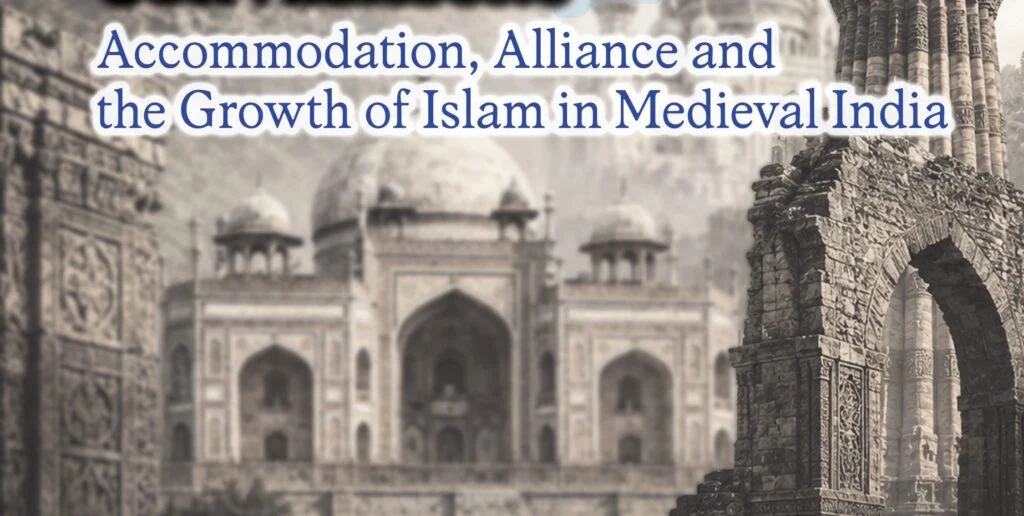
For generations, medieval India has often been portrayed in popular political discourse as an age of conquest, religious persecution and forced conversion. In recent decades, this narrative has been vigorously promoted by Hindutva ideologues, reducing nearly six centuries of Muslim rule to a simplistic story of conflict between two supposedly irreconcilable civilisations. Yet mainstream historical scholarship presents a far more nuanced picture – one in which political accommodation, administrative continuity and cultural interaction proved more significant than religious coercion.
Few scenes illustrate this better than Emperor Akbar’s court at Fatehpur Sikri, where Muslim jurists engaged in dialogue with scholars of other faiths. His marriage to Harkha Bai, daughter of Raja Bharmal of Amber, likewise symbolised a broader political vision. Rather than relying solely on military conquest, the Mughal Empire forged enduring alliances with Rajput rulers, integrating them into the imperial structure while respecting their traditions and identity.
In a recent podcast, political historian Professor Shamsul Islam observed that many popular perceptions of medieval India owe more to ideology than to historical evidence. Whether or not one agrees with all his conclusions, his call to examine history critically rather than through communal stereotypes is a timely reminder.
The historical record suggests that Muslim rulers generally governed through cooperation rather than wholesale cultural transformation. Existing institutions were largely retained, Hindu elites remained integral to administration, and Islam spread through a combination of spiritual, social and economic processes rather than any sustained policy of state-sponsored coercion. Recognising this complexity neither romanticises Muslim rule nor ignores episodes of conflict; instead, it restores historical perspective to a period too often reduced to political slogans.
Governing a Diverse Civilisation
When the Delhi Sultanate emerged in the 13th century, Muslims formed only a small minority within an immensely diverse society. Effective governance therefore depended upon cooperation with existing institutions rather than their destruction. Village administration continued largely unchanged, while Brahmins remained influential as scholars, revenue officials, village accountants and custodians of customary law. Existing land-revenue systems were adapted rather than dismantled, allowing political continuity despite dynastic change.
This pattern extended across different regions. Sultan Zain-ul-Abidin of Kashmir, remembered as Bud Shah, invited Hindu scholars to return to the valley, restored temples and encouraged Sanskrit learning alongside Persian culture. In the Deccan, the Bahmani rulers and their successors relied extensively on Hindu administrators and commanders, while temples and centres of learning continued to receive patronage in many areas.
Such policies reflected political necessity but were also consistent with classical Islamic principles of governance. Muslim jurists emphasised justice (adl), public welfare (maslahah) and prudent statecraft (siyasa), requiring rulers to protect the lives, property and lawful religious practices of non-Muslim subjects. Although individual rulers differed in applying these principles, they provided an ethical framework that favoured stable governance over arbitrary persecution.
The Mughal Model of Accommodation
The Mughals refined this approach into one of the most sophisticated systems of imperial governance in early modern Asia. Recognising that military victories alone could not secure lasting authority, Akbar cultivated enduring partnerships with Rajput kingdoms. His marriage to Harkha Bai in 1562 inaugurated an alliance that brought Rajput rulers into the highest ranks of imperial administration while allowing them considerable autonomy within their own territories. Raja Man Singh became one of Akbar’s foremost generals, and later emperors continued to rely heavily on Rajput nobles.
These alliances did not require cultural assimilation. Contemporary chronicles indicate that Rajput princesses retained their religious identity, Hindu festivals continued within sections of the imperial household, and Rajput chiefs maintained close links with their ancestral traditions. Jahangir himself, born to Akbar’s Rajput consort, embodied this political partnership between Mughal and Rajput elites.
Akbar reinforced these alliances through important administrative reforms. He abolished the pilgrimage tax in 1563; surprisingly, a form of pilgrimage tax was introduced in independent India in 1954 during the first Kumbh Mela after Independence. Akbar suspended the jizya the following year and articulated the principle of Sulh-i-Kul, peace with all, which sought to ensure that merit and loyalty, rather than religious affiliation, determined advancement within the imperial system.
The emperor’s Ibadat Khana at Fatehpur Sikri became a unique forum where Muslim scholars, Hindu pandits, Jain monks, Jesuit priests and Zoroastrian representatives debated questions of religion and ethics before the emperor. Although the experiment was short-lived, it remains one of history’s earliest examples of organised interfaith dialogue under state patronage.
This openness extended to scholarship. Under Abu’l Fazl’s supervision, Sanskrit classics such as the Mahabharata and Ramayana were translated into Persian with the active participation of Brahmin scholars. Prince Dara Shikoh later continued this intellectual engagement through his celebrated Persian translation of the Upanishads, Sirr-e-Akbar, convincing that India’s spiritual traditions didn’t threaten Islamic thought.
Imperial patronage was equally pragmatic. Documentary evidence preserved in the Ain-e-Akbari and other records demonstrates that Mughal emperors granted lands to Brahmin scholars, temples and religious institutions as part of established systems of royal patronage. Even Aurangzeb, who is often criticised for his more orthodox religious policies, issued a number of documented grants to temples and Brahmins, illustrating that political realities frequently shaped policy alongside religious considerations.
The result was an extraordinary Indo-Islamic civilisation in which Persian and Sanskrit scholarship interacted creatively, Mughal architecture absorbed Rajput aesthetics, Hindustani classical music flourished, and artistic, literary and culinary traditions blended into a cultural heritage that remains integral to India’s identity.
The Conversion Debate: Evidence Beyond the Myth
No aspect of medieval Indian history has been more politically contested than the question of religious conversion. A widely circulated narrative claims that Islam spread across India primarily through force and that Muslim rulers pursued systematic campaigns of mass conversion. While isolated instances of coercion have been reported, as they occurred under rulers of many civilisations, serious historical research offers little support for the claim that forced conversion was a consistent policy of Muslim states.
The demographic record itself raises important questions. After nearly six centuries of Muslim political rule across large parts of the subcontinent, Hindus continued to constitute an overwhelming majority of the population. Had successive dynasties pursued systematic conversion as an instrument of state policy, India’s religious landscape would almost certainly have looked very different.
The late historian Richard M. Eaton, whose work on medieval India is widely regarded as authoritative, argues that there is no credible evidence of empire-wide campaigns of forced conversion. Instead, the spread of Islam varied from region to region and resulted from a combination of social, economic, political and spiritual processes. Significantly, the greatest growth in Muslim populations occurred not in the principal centres of imperial power but in frontier regions such as Bengal, Kashmir and parts of Punjab. Agricultural expansion, the settlement of previously uncultivated lands and the emergence of Sufi networks played a far greater role than military conquest in shaping these demographic changes.
Among the most influential agents of Islam’s spread were Sufi saints. Their khanqahs welcomed people irrespective of caste, ethnicity or occupation, offering spiritual guidance, education, charity and community service. Saints such as Khwaja Moinuddin Chishti of Ajmer, Hazrat Nizamuddin Auliya of Delhi and Shah Jalal of Bengal won followers through compassion, personal example and moral authority rather than political power. Their appeal lay in the universality of their message and their accessibility to common people.
Social realities also mattered. The rigid caste hierarchy left millions excluded from dignity and opportunity. Islam’s emphasis on the equality of all believers before God offered many among the marginalised an alternative social and spiritual vision. For numerous converts, embracing Islam represented not merely a change of faith but an affirmation of equality, fraternity and human worth.
Trade provided another peaceful avenue for Islam’s expansion. Arab and Persian merchants had established commercial settlements along India’s western and southern coasts centuries before the Delhi Sultanate emerged. Through commerce, intermarriage and sustained cultural contact, Muslim communities gradually took root in regions such as Kerala and Gujarat without military intervention.
Religious change, therefore, cannot be explained by a single factor. Personal conviction, social mobility, economic opportunity, regional politics and cultural interaction – all contributed to the gradual growth of Islam in the subcontinent. Reducing this complex process to a simplistic narrative of ‘conversion by the sword’ ignores both historical evidence and the diversity of regional experience.
Equally important is the normative position of Islam itself. The Qur’an declares, “There is no compulsion in religion” (2:256), while another verse affirms, “For you is your religion, and for me is mine” (109:6). These principles shaped mainstream Islamic jurisprudence and informed the ethical understanding of governance in religiously diverse societies, even if individual rulers did not always live up to these ideals.
Reclaiming a Shared Heritage
The history of medieval India offers lessons that extend beyond academic debate. Muslim rulers maintained authority not by attempting to erase India’s diversity but by learning to govern it. Political partnerships with Rajput kingdoms, the continued participation of Brahmin scholars and administrators, patronage extended to institutions across religious communities, and the flowering of Indo-Islamic culture all point to a civilisation built through interaction rather than isolation.
This does not mean that medieval India was free from conflict or injustice. Like every pre-modern civilisation, it witnessed wars, political rivalries and episodes of religious intolerance. Yet these cannot define an entire era stretching across six centuries. To focus exclusively on conflict while ignoring sustained traditions of interfaith cooperation produces a distorted understanding of the past.
Recovering this complexity is especially important today, when medieval history is increasingly invoked to deepen contemporary social and political divisions. Responsible scholarship neither romanticises Muslim rule nor demonises it. Instead, it recognises that historical realities are invariably more nuanced than ideological narratives allow.
India’s composite civilisation, its celebrated Ganga-Jamuni Tehzeeb, emerged through centuries of dialogue, shared institutions and cultural exchange. That legacy resonates with the constitutional ideals of equality, religious freedom and pluralism that define modern India. Understanding this shared inheritance honestly is therefore not merely an academic exercise; it is essential for strengthening mutual trust in an increasingly polarised society.
History rarely conforms to political slogans. Medieval India was neither an age of uninterrupted harmony nor one of relentless persecution. It was a civilisation shaped by negotiation, adaptation and cultural exchange. The evidence suggests that Muslim rulers generally relied on political partnership rather than religious coercion, while Islam spread principally through persuasion, Sufi spirituality, trade, migration and voluntary acceptance.
Recovering that history does not diminish the experiences of any community. Rather, it reminds us that India’s greatest civilisational achievements emerged when diversity was accommodated rather than suppressed. In an age of growing polarisation, that may be the most enduring lesson the medieval past has to offer.