

 Dawn had barely broken over Bhatkal when the town stirred with quiet purpose. Soon after the Fajr prayer, streets filled with men in white, moving from every corner towards a single destination – the Eidgah. Some walked, most arrived on two-wheelers, and a few in four-wheelers – yet all moved with the same shared intent.
No announcements. No urgency. Only a shared rhythm, as if the entire town moved with one heartbeat.
From the Eidgah ground, a voice began the Takbeer – Allahu Akbar, Allahu Akbar – and the crowd responded in unison. What followed was not merely a recitation, but a rising wave of sound that spread across the open ground, filling the air with a rare serenity.
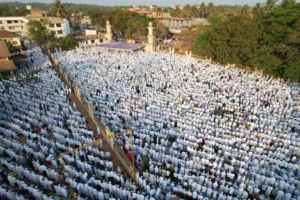
The Eidgah, already brimming with thousands, continued to receive more. Rows formed and extended beyond what the eye could measure. There was order without instruction, discipline without enforcement.
In that moment, Bhatkal was not merely preparing for Eid. It was gathering as one.
Moon Sighting & A Unified Voice
The rhythm of Eid in Bhatkal begins not at the Eidgah, but with the sighting of the moon, and the voice that declares it.
On the 29th of Ramadan, reports from Calicut in Kerala’s Malappuram district confirmed the crescent sighting. The message reached Bhatkal, and soon after, the town’s Qazi – after consulting and confirming with the Hilal Committee of Malappuram district, headed by the Malappuram Qazi – formally announced Eid. The declaration spread swiftly – through mosques and word of mouth – settling into homes with quiet certainty.
What stands out is not just the acceptance of the moon sighting, but the absence of confusion that often accompanies such moments elsewhere.
Bhatkal has two Qazis – a situation that, in many places, might lead to division. Here, however, both religious authorities work in coordination, maintaining mutual respect and a shared understanding. Their alignment ensures that the community receives one clear decision.
There are no competing announcements. No separate celebrations. No fractured calendars.
In an age where even religious observances can become points of disagreement, Bhatkal demonstrates another possibility, where leadership chooses harmony over assertion. The result is visible the very next morning: a town that celebrates one Eid, together.
The Walk to Eidgah
At the heart of this gathering is a long-standing tradition. The congregational walk begins from the City Jamia Masjid, where people assemble and move together towards the Eidgah, accompanying the Khateeb.
As the procession advances, people from different mohallas join in lane by lane, street by street until the walk becomes a steady flow of worshippers, united in purpose.
There is something deeply symbolic in this act. It is not merely about reaching a destination; it is about arriving together. In that shared movement, distinctions of status and profession fade, leaving only one identity – that of a worshipper.
Elders recall when the Eidgah stood on the outskirts – open, expansive, and reached through a longer journey. Today, as the town has grown around it, space has narrowed, but the tradition endures.
Along the way, words are few. The air is filled instead with the rhythmic recitation of the Takbeer, rising in unison, turning the journey itself into an act of worship.
One Gathering, One Prayer
By sunrise, the Eidgah transforms into a vast sea of humanity. Rows stretch across the ground in careful alignment, expanding steadily as more worshippers arrive. There are no reserved spaces. No visible hierarchies. Only a quiet, collective discipline as thousands prepare to stand before their Creator. What makes this gathering remarkable is not just its scale, but its composition.
In Bhatkal, Muslims from different schools of thought – Sunni, Barelvi, Deobandi, and Salafi – come together to offer the Eid prayer in a single congregation. In many places, such differences lead to separate prayers. Here, they do not divide. They stand shoulder to shoulder.
In a town with over a hundred mosques and more than ten Juma Masjids representing different makaatib-e-fikr, not a single mosque holds a separate Eid prayer, ensuring that everyone gathers at the Eidgah. It is a rare and remarkable expression of unity.
As the rows straighten, differences quietly dissolve. What remains is a shared direction and a shared moment.
The Imam calls the prayer. In an instant, thousands move in unison – bowing, prostrating, rising. It is not coordination; it is collective submission, expressed with remarkable harmony.
To an observer, the sight is deceptively simpleyet profound.Here, unity is not an idea.It is a visible reality.
Khutbah, Administration and the Unseen Effort
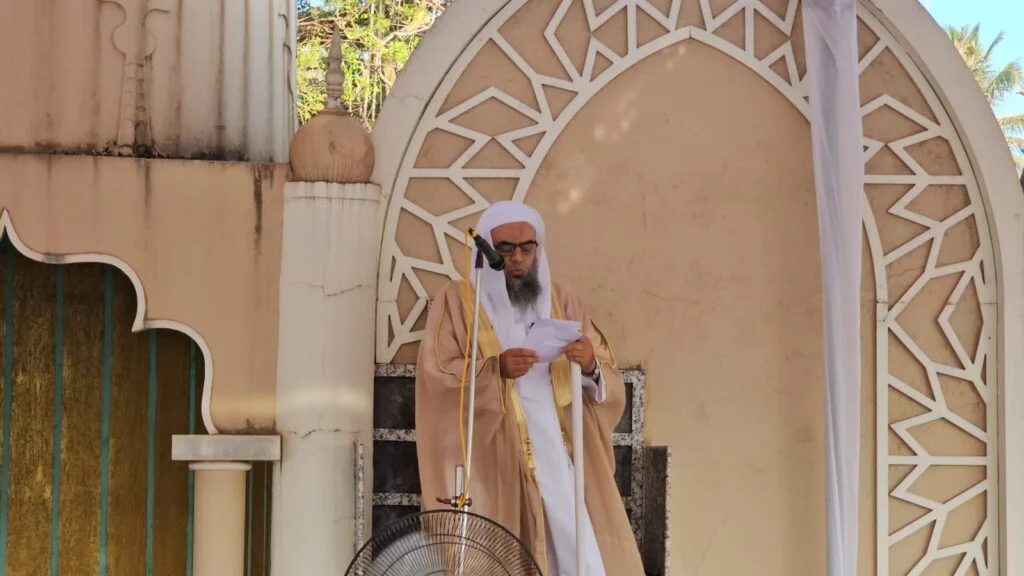
As the prayer concludes and the rows settle, attention turns to the Eid Khutbah.The Khatib, Maulana KhaujaAkrami Nadvi Madani, addresses the gathering with a message that is both spiritual and social. He reminds the congregation that Eid is not the end of Ramadanbut its continuation. The values of discipline, patience, and compassion must extend beyond the month.He calls for stronger bonds of brotherhood and a renewed commitment to justice, humility, and service.
The address also acknowledges the effort behind such a gathering. Gratitude is expressed to local authorities for maintaining security, and to volunteers whose quiet coordination makes the event possible.From the early hours, volunteers guide the crowds, align the rows, and maintain order. The sound system carries the Takbeer across the Eidgah, synchronising thousands into a single rhythm.
Despite the scale, the arrangements remain calm and orderly, reflecting not just planning, but a community accustomed to functioning together.The success of the gathering lies not only in numbers, but in cooperation – between leadership, volunteers, and the people.
Bhatkal: The Roots of Unity
To understand this gathering, one must understand Bhatkal itself.Located along Karnataka’s coast, Bhatkal is a town where community life is closely woven into identity. A significant portion of its population is Muslim, with a strong presence of the Navayath community, known for its maritime history and Gulf connections.
Over generations, Bhatkal has developed into a centre of education, religious learning, and social organisation. Mosques and madrasas serve not only as places of worship, but as spaces where a shared identity is nurtured.
Economic mobility has brought relative prosperity. Yet what distinguishes Bhatkal is not its economy, but its unity.Despite internal diversity, the community has preserved a culture of consultation, respect for religious leadership, and collective decision-making.This is visible in everyday lifebut most clearly on occasions like Eid.
The ability of different sections to come together without friction is not accidental. It is the result of a long-standing social discipline, where unity is consciously valued and protected.In Bhatkal, differences existbut they do not divide.
A Unity That Outgrows Its Space
Yet within this powerful display of unity lies an emerging concern.The Eidgah that once seemed vast now appears increasingly constrained. Year after year, as participation grows, the space struggles to accommodate the swelling congregation. Rows stretch further, edges tighten, and the ground approaches its limits, with people now praying on roads and sidewalks.
Elders recall a time when the Eidgah stood on the outskirts – open and expansive. Today, urban growth has brought the town around it, turning what was once the edge into the centre.And yet, the commitment to pray together remains unchanged.It is this commitment that now calls for reflection.
If not addressed, space constraints could gradually lead to separate arrangements – not by choice, but by necessity. For a town that has preserved a single Eid congregation, such a shift would be significant.
There is a growing sentiment that Bhatkal must reimagine its Eidgahby identifying a larger space, once again on the outskirts, where this unity can be sustained.Such a step would not merely solve a logistical issue.It would safeguard a tradition.
For in Bhatkal, the Eidgah is more than a ground; it is a symbol: of unity across differences, of discipline across diversity, and of a shared identity.To preserve that symbol is not just a matter of space.It is a matter of vision.
A Lesson Beyond Bhatkal
As the formalities conclude, the Eidgah transforms once again. Rows dissolve into embraces. Smiles replace stillness. Voices rise in greeting – Eid Mubarak echoing across the ground.Children move through the crowd with excitement. Elders exchange warm handshakes. For a brief moment, the entire space feels like an extended family.Yet what lingers is not just celebration.It is the memory of standing together.
In a time when divisions often dominate public discourse, Bhatkal offers a quiet counter-narrative. Here, unity is not enforced, nor performed. It is chosenand practised.From the coordination of its Qazis to the shared moon sighting, from the walk through its streets to the single congregation – every step reflects a simple truth:
Diversity need not lead to division.It can strengthen the collective.
The message of Bhatkal is simple, yet profound.What is debated elsewhere is practised here – quietly, consistently, without spectacle.Unity does not begin with slogans.It begins with practice.In Bhatkal, Eid is not merely celebrated.It is livedtogether.