

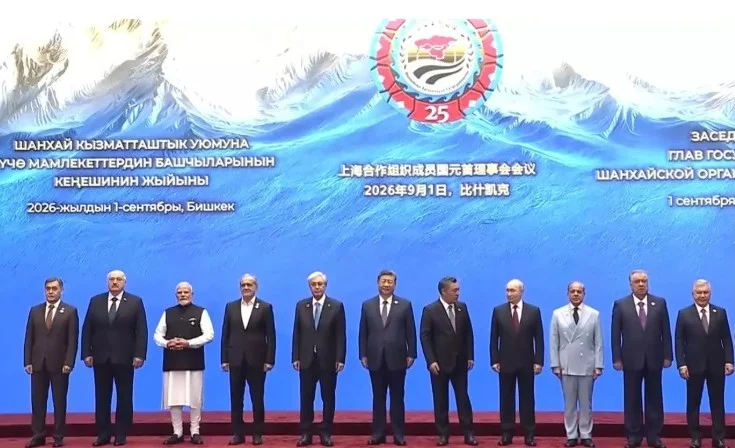
India’s endorsement of the Bishkek Declaration at the recently concluded Shanghai Cooperation Organisation (SCO) Summit in Kyrgyzstan may signal a subtle recalibration of New Delhi’s position on the ongoing West Asian conflict.
The significance becomes apparent when the language of the declaration is read against India’s increasingly close strategic relationship with Israel. Prime Minister Narendra Modi joined the leaders of the SCO member states in adopting a statement that contains unusually strong language on the military action against Iran, the Palestinian question and the principles of international law.
The declaration states that SCO member states ‘express deep concern over developments in the Middle East and around Iran’ and reiterates their position ‘condemning military strikes on the territory of the Islamic Republic of Iran, which have resulted in numerous civilian casualties and significant damage to the country’s economy’.
It goes further:“Such actions violate the principles and norms of international law and the UN Charter and create serious risks to international peace, security and stability.”
The declaration also reaffirms Iran’s sovereignty and territorial integrity and calls for an exclusively diplomatic solution:“Member States, reaffirming their support for the sovereignty and territorial integrity of the Islamic Republic of Iran, advocate a resolution to the conflict solely through political and diplomatic means.”
India’s signature on such language is noteworthy. New Delhi has cultivated a close defence and strategic partnership with Israel and has generally avoided taking positions that could be seen as directly confronting Israel or Washington. Yet at Bishkek, India endorsed a collective statement that condemns military strikes on Iranian territory and characterises such action as contrary to international law.
The declaration’s language on Palestine is even more direct. Referring to the consequences of Israel’s actions, it states that Israel’s attacks on Palestine have contributed to the destabilisation of West Asia. It then declares:“Member States note that the only possible way to ensure peace and stability in the Middle East is a comprehensive and just settlement of the Palestinian question.”
The declaration also supports Iran’s right to peaceful nuclear development, affirming its ‘inalienable right’ to research, produce and use atomic energy ‘for peaceful purposes’ and stating that measures restricting this right are ‘contrary to international law’.
These are significant formulations for India. They do not mean that New Delhi has abandoned its strategic partnership with Israel. Nor does India’s participation in a multilateral declaration necessarily amount to a fundamental foreign-policy reversal. India continues to maintain important relations with Israel, the United States, Iran and the Arab world.
But diplomacy is often communicated through carefully calibrated signals. By putting its signature to the Bishkek Declaration, India has associated itself with a position that places international law, Iran’s sovereignty, diplomacy and a just settlement of the Palestinian question at the centre of the West Asian crisis.
The shift, therefore, may not be dramatic or openly proclaimed. But compared with an unequivocally pro-Israel reading of India’s West Asia policy, Bishkek suggests a quieter return to strategic balanceand perhaps a cautious distancing from Israel’s position on the conflict.