

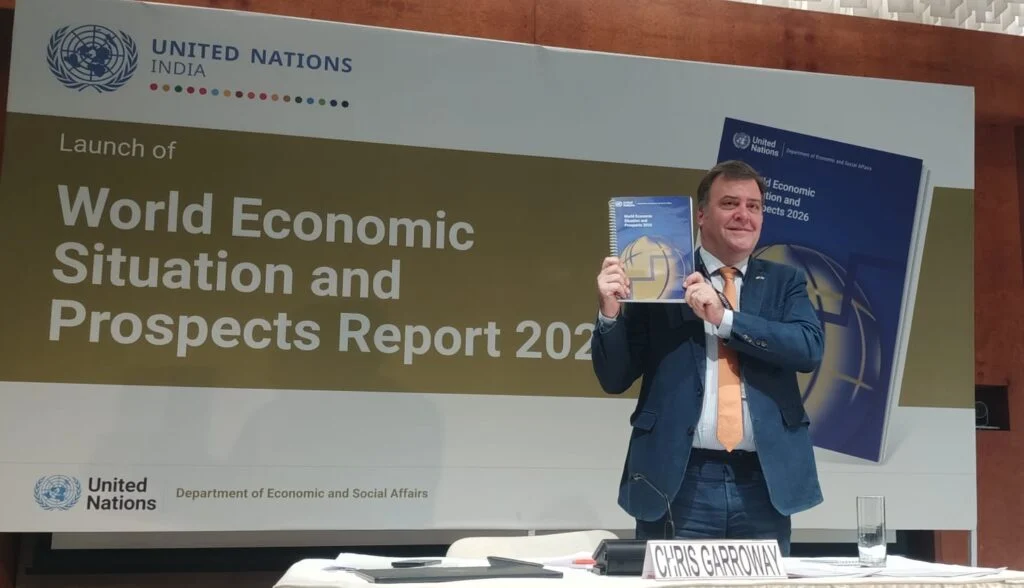
global economy is showing cautious resilience but faces deepening uncertainties, according to the United Nations’ World Economic Situation and Prospects (WESP) 2026 report. Launched at We the People’s Hall, UN House, New Delhi, Christopher Garroway de Coninck highlighted risks from rising trade barriers, high public debt, and persistent policy uncertainty that could derail sustainable growth.
Globally, economic growth is projected at 2.7% in 2026, slightly down from 2.8 per cent in 2025 and below the pre-pandemic average of 3.2%. The 2025 resilience was largely driven by strong consumer spending and easing inflation, despite U.S. tariff hikes. The UN cautioned that weak investment, limited fiscal space, and structural vulnerabilities could slow the global economy further.
Secretary-General António Guterres noted that economic, geopolitical, and technological tensions are reshaping the global landscape, exacerbating social vulnerabilities in developing countries struggling toward the Sustainable Development Goals.
Asia’s outlook remains positive but moderating. East Asia’s growth is expected to slow from 4.9% in 2025 to 4.4% in 2026–27. Export boosts from front-loaded shipments are fading, though domestic demand remains stable, supported by accommodative fiscal and monetary policies. Inflation in East Asia is projected at 1.1% in 2026. China’s growth is forecast at 4.5%.