

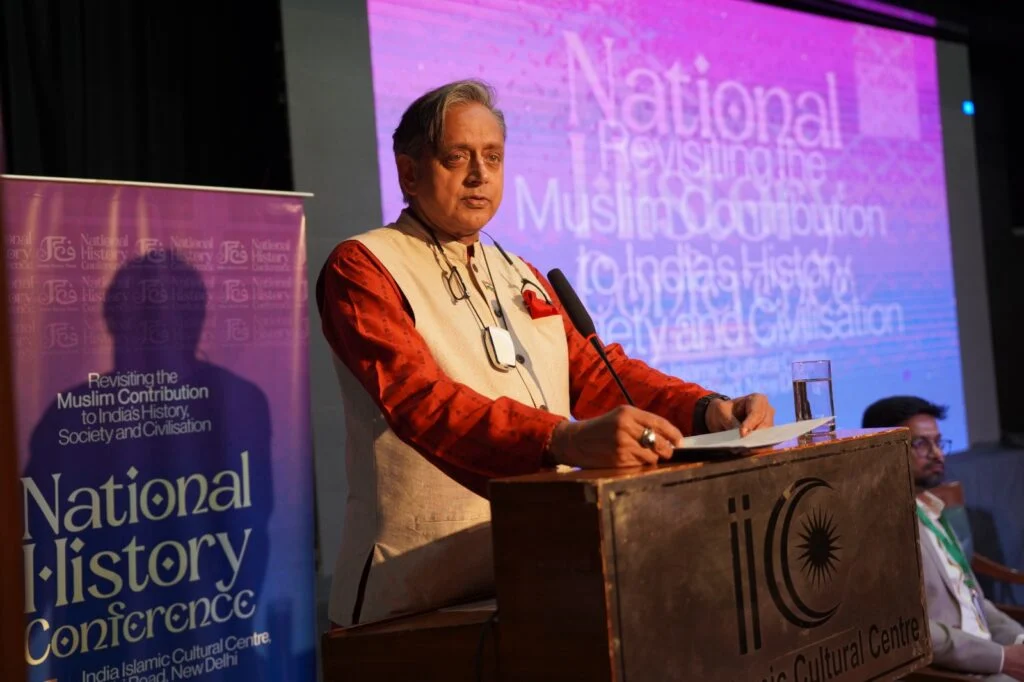
At a time when historical debates are increasingly shaping political and cultural discourse in India, senior Congress leader and Member of Parliament Shashi Tharoor delivered a wide-ranging address that challenged dominant narratives and called for a more plural, layered understanding of the past. Speaking at the National History Conference organised by the India History Forum in New Delhi, Tharoor emphasised that history is not a fixed record but an evolving interpretation shaped by power, perspective, and purpose.
Framing his talk around the theme, “Who Writes Our Past? Reclaiming History, Interpretation, and India’s Plural Identity,” Tharoor argued that historiography, the writing and interpretation of history, is as significant as history itself. He noted that debates about the past are no longer confined to academic spaces but have spilled into legislatures, media platforms, and public consciousness, influencing how nations define themselves.
“History is not simply a record of what happened,” Tharoor said, “it is a field of ongoing research and interpretation. What changes is not the past itself, but the meaning we attach to it.” He stressed that the struggle over history is ultimately a struggle over identity and belonging, warning against narratives that simplify India’s inherently diverse past into a singular story.
A significant portion of his address focused on the evolution of national narratives and how they shape collective identity. Tharoor invoked the idea of India as a “palimpsest” – a layered manuscript where new writings coexist with traces of the old, rather than erasing them. This metaphor, associated with Jawaharlal Nehru, underscores India’s civilizational complexity, where multiple cultures, faiths, and traditions have interacted over centuries.
Tharoor also drew upon the vision of Rabindranath Tagore, who saw India not as a uniform entity but as a space defined by coexistence and plurality. According to Tharoor, reducing India’s past to a single religious or cultural narrative is not only historically inaccurate but undermines the foundational idea of the nation itself.
However, it was his remarks on the advent of Islam in India that drew particular attention for offering a counterpoint to commonly circulated narratives. Addressing the widespread perception in northern India that Islam arrived through conquest often linked to the 8th-century invasion of Muhammad bin Qasim, Tharoor presented an alternative account rooted in the experience of southern India, particularly Kerala.
“I will speak as a Keralite,” he said, explaining that Arab traders had been visiting Kerala’s western coast for centuries before the advent of Islam. These traders, he noted, were familiar figures who engaged in commerce, settled temporarily, and formed social ties, including intermarriage with local communities.
According to Tharoor, when the news of Prophet Muhammad [ﷺ] reached Kerala, it did not come through military conquest but through these long-standing trade networks. “Islam came to us as news, not through a sword,” he said, emphasising that the religion was introduced organically by traders who were already integrated into local society.
He recounted a popular historical tradition involving a local ruler, identified as Cheraman Perumal, who was inspired by reports of the Prophet and is said to have undertaken a journey to the Arabian Peninsula to meet him. While many of the ships in his fleet reportedly failed to complete the journey, Tharoor highlighted the symbolic significance of the story as evidence of early cultural curiosity and exchange.
Tharoor further pointed to connections extending beyond India’s shores, mentioning regions such as Oman and areas near Salalah, where traces of early interactions such as the presence of Kerala coconut trees are believed to exist. He also referenced maritime routes that passed through Lakshadweep and the Maldives, underscoring the long history of Indian Ocean trade networks.
One of the most striking examples he cited was the establishment of one of the earliest mosques in India. According to Tharoor, when Muslim communities in coastal towns such as Kozhikode and Kochi grew large enough to require a place of worship, they sought permission from the local ruler, known as the Zamorin.
He highlighted the historic mosque at Kodungallur, often cited as one of the oldest mosques outside the Arab world. “Can you imagine,” he said, “there is a mosque in India going back within a few decades of the lifetime of the Prophet.”
Through these examples, Tharoor sought to challenge monolithic narratives about Islam’s arrival in India, arguing that the reality is far more nuanced and regionally varied. His account emphasised peaceful exchange, coexistence, and mutual adaptation rather than conflict and imposition.
Returning to his broader theme, Tharoor warned that selective interpretations of history can have profound implications for contemporary society. “If the past is presented as singular and homogeneous, the nation too begins to be imagined in those terms,” he said. Conversely, recognising the diversity of historical experiences allows for a more inclusive vision of national identity.
He concluded by reiterating that history should be seen as an “ongoing conversation” rather than a fixed inheritance. The responsibility, he suggested, lies not only with historians but with society at large to engage with the past critically and inclusively.
In an era marked by intense debates over identity and heritage, Tharoor’s address served as a reminder that how a nation tells its story can shape not only its understanding of the past but also its vision for the future.