

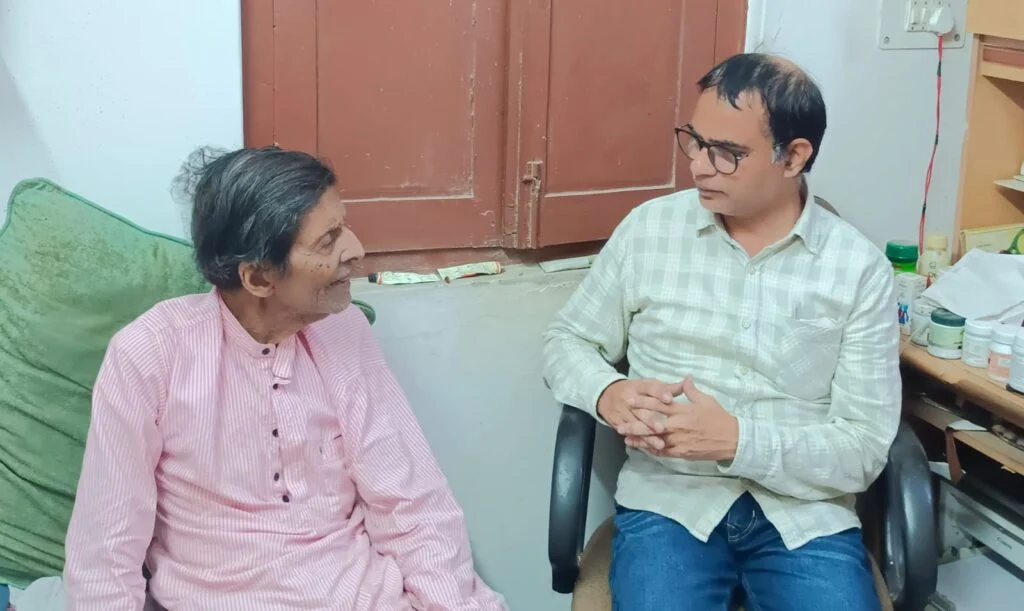
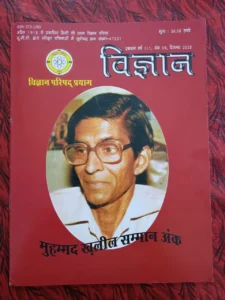
 Mohammad Khalil is the most prominent name in Urdu scientific literature. Hehas rendered invaluable services in cultivating scientific awareness among the new generation. Over the past 50 years, more than three hundred of his articles and nine books on the various aspects of science have been published. Heserved for 27 years as editor of Science Ki Duniya, the Urdu science magazine published by the UnionGovernment’s Council for Scientific and Industrial Research (CSIR). Mohammad Khalil was born in 1944 in the historic city of Jaunpur, Uttar Pradesh. He received his early education at Mohd. Hasan Inter College, Jaunpur, and went on to Aligarh Muslim University for higher education, where he obtained a master’s degree in Biology. Science has always been Mohammad Khalil’s favourite subject, and in children’s literature he is recognised as a creator of scientific literature. The country’s old scientific institution, Vigyan Parishad Prayag (established 1913) has published a special journal in recognition of Mohammad Khalil’s extraordinary services to the field of scientific literature. Senior journalist Mushtaq Aamir spoke with Mohammad Khalil at his residence in Delhi. Excerpts:
During the era of the Nizam of Hyderabad, higher education in contemporary subjects like medical science, science, mathematics, and engineering was conducted in Urdu at Osmania University. But what was the reason that after the fall of Hyderabad, the teaching of scientific and technical subjects in Urdu declined?
Mohammad Khalil: You see, the formal beginning of the scientific mission in Urdu was made by Baba-e-Urdu Maulvi Abdul Haq, and before him by Sir Syed. Maulvi Abdul Haq brought out the first magazine named “Science” in Urdu. This magazine was first quarterly, and later became bimonthly. It was printed using type printing. But in this regard, the greatest work is that of Osmania University. The Nizam of Hyderabad, Mir Osman Ali Khan, made Urdu the medium of instruction and successfully started medical science education in Urdu. But unfortunately, after the fall of Hyderabad, this came to an end. If we talk about science, or specifically about popular science, which is my field, then I am working along these same lines to popularise scientific articles in Urdu and to cultivate this among the new generation.
 Why did work on scientific literature in Urdu come to a halt after Osmania University?
M.K.: The biggest reason for this was that Urdu speakers themselves did not value their own language. Even those whose mother tongue was Urdu did not have their children educated in Urdu. By removing Urdu from basic education, an entire generation became distanced from Urdu, the result of which is before us. Sir Syed and Maulvi Abdul Haq understood the importance of scientific and technical education in the Urdu language, but later this mission was forgotten.
Who is responsible for this, government policy or the Urdu speakers themselves?
M.K.:Both are responsible for it. But Urdu speakers bear greater responsibility. If Urdu speakers had maintained this continuity and had their children educated in Urdu, Urdu would not have been in the state we are discussing here.
You had beenEditor of Urdu’s largest scientific magazine, “Science Ki Duniya,” for 27 years. You wrote hundreds of articles and editorials in it. How did you come into this field?
M.K.:In 1975, CSIR decided to bring out a magazine on scientific subjects in three languages –Science Reporter in English, Vigyan Pragati in Hindi, and Science Ki Duniya in Urdu. I had been formally interviewed for Science Ki Duniya. The interview panel included the famous Urdu poet and writer Pandit Anand Narain Mulla and the renowned scientist Professor A. Rahman. That is how my scientific journey in Urdu began.
Were you writing scientific articles in Urdu even before Science Ki Duniya? When did you start writing scientific articles?
M.K.:I started writing scientific articles in Urdu during my college days in Jaunpur itself. I had a senior classmate in college, Syed Ghulam Samdani, who encouraged me toward scientific subjects, and that is where I began writing articles.
Why did you choose science? Because generally, Urdu writers give preference to writing in the more prevalent literary genres.
M.K.:I had an interest in science from the very beginning. During my college days in Jaunpur, I had very good teachers from whom I received my basic education in science and Mathematics. Mr. Ishtiaq was my first science teacher, from whom I learned what science actually is. These teachers nurtured my abilities and made me capable of gaining admission to an institution like AMU. I did my M.Sc. in Biological Science from Aligarh Muslim University. At Aligarh, I had the opportunity to benefit from internationally renowned teachers, among them Professor Habib, and Professor Shafiq, who had twice served as Vice-President of the Royal Society of London, and Professor Abrar Mustafa, who was internationally renowned in botanical science. I studied Botany under Professor S.K. Saxena. In this way, science became ingrained in my temperament, and I began writing on various aspects of science.
Why did you choose the Urdu language for writing scientific articles, since scientific articles are generally written in English?
M.K.:I have also written scientific articles in English and Hindi. My Hindi articles were appreciated by Professor Namvar Singh and Vishnu Prabhakar. My articles written in Hindi have been published in leading children’s magazines. My editorship of Science Ki Duniya gave me recognition in the Urdu world, although I had already started writing articles before that. In this way, my identity as a scientific writer was established in children’s Urdu literature. Language has no religion. Based on this very principle, I continued writing in other languages alongside Urdu.
You were editor of Science Ki Duniya for a long period. Besides this, you have also written books on various scientific subjects. Are the readers of these books only children, or older people as well?
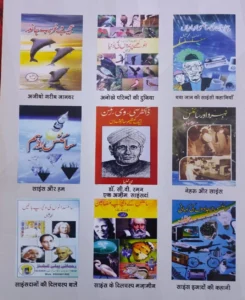
M.K.:You see, I have had numerous books published in Urdu. These include Ajeeb-o-GhareebJanwar, AnokheParindon Ki Duniya, Chacha Jaan Ki Science Kahaniyan, Science Aur Hum, Dr. C.V. Raman, Nehru Aur Science, Scientistdanon Ki DilchaspBaatein, Science Ke DilchaspMazameen, and Science Ki Ijadon Ki Kahani. Several editions of some of these books have been published. Since I have written a good deal on popular science, my books have remained popular among people of all ages. My goal has been to bring scientific knowledge to the Urdu-reading community, and I have largely succeeded in this.
When you started Science Ki Duniya, what was the outline in your mind? What kind of readers did you have in view?
M.K.:I focused on children, because children are the future of the country. I wrote and published articles that would increase interest in science among children of the Urdu-speaking community. I also felt that, compared to other languages, scientific material for children in Urdu was very scarce, almost non-existent. Whatever articles did exist were quite old or were translations of originals. What I did was have certain scientists write articles in Urdu, so that the new generation could benefit from the latest developments in science. Science Ki Duniya also published interesting scientific articles that were informative not only for children but for general readers as well. It also had a section for women. There was news on new scientific inventions, letters were published, and so on. I encouraged writers to write articles on science in Urdu. In this way, we began to get scientific articles in Urdu as well.
You wrote hundreds of scientific articles and authored numerous books, but other Urdu writers did not pay much special attention to this. What was the reason for this?
M.K.:I tried to draw the attention of several Urdu writers toward this. But they said, what benefit would come of it? Once I asked Ali Sardar Jafri and Kaifi Azmi to write something for children, and they jokingly replied that if they wrote for children, they would become minor essayists. But there are also several people who encouraged me. Among them, the name of former Governor Professor Akhlaqur Rahman Kidwai is the most important. He encouraged me a great deal in this regard and also wrote articles. I also had the economist Professor M. Khusro write articles for Science Ki Duniya. Professor Muhammad Shafi was an expert in geography. The scientist M.A. Qureshi also wrote articles for Science Ki Duniya.
Did those who are known as writers of children’s literature also not pay much attention to scientific articles for children?
M.K.:Writers associated with children’s literature gave me a great deal of appreciation, but they stayed away from writing scientific articles. One problem was also that those who knew science could not write Urdu, and those who were Urdu writers had no interest in science. Whereas my effort was always to publish original articles rather than translations.
The publication of Urdu books has also been a major problem. What difficulties did you face in publishing your books?
M.K.:About 18 books have been published so far in various languages. Four books are currently in press. But quite a lot of difficulties have arisen in publishing these books. Previously, official Urdu institutions used to provide financial assistance for the publication of books. But now Urdu institutions do not have enough funds to provide assistance for others’ books. My books are waiting for financial assistance from the NCPUL. Let’s see when the time comes for them to be printed.
The common perception is that Muslims are very far behind in science. Even in schools, Muslim children are unable to demonstrate outstanding performance in scientific subjects. To what extent do you agree with these views?
M.K.:This is not correct. When we started writing popular science in Urdu, it had a considerable effect on the Urdu-reading community. Three editions each of several of my books have been published. My first book,Ajeeb-o-GhareebJanwar, which is very famous, has had numerous editions published. The basic point is that science is not understood by rote memorisation; science advances through understanding.
How do you see the future of the Urdu language and scientific literature?
M.K.:We have been hearing since childhood that Urdu is disappearing from India. Whereas the reality is that Urdu is not only the language of Muslims, nor can it be eliminated. Language has no religion. In fact, my experience is that science becomes easier in Urdu. Scientific terminology can be explained very easily in Urdu. It only needs to be put into practice. Basic science should be taught in one’s mother tongue.
To what extent are you satisfied with the science curriculum being taught in Urdu-medium government schools?
M.K.:The curriculum is very good. But there are no competent teachers to teach it. Urdu-medium schools do not have teachers as capable as those found in convent schools. Urdu teachers should not suffer from an inferiority complex. They should first study the curriculum themselves and teach science to children with full preparation. At the same time, emphasis should be placed on practicals. I am confident that there will be a positive change in the environment surrounding science education in our schools.
[This interview first appeared in Dawat Urdu Weekly]