

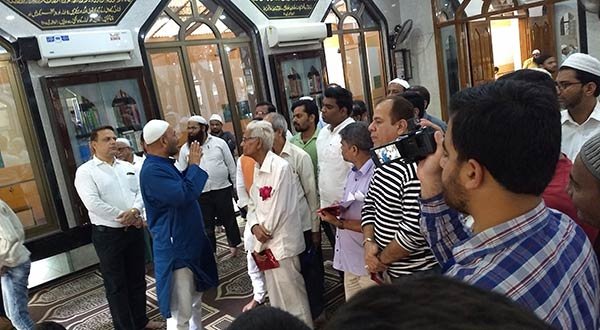
What comes to your mind when you think of a mosque? Domes and minarets, rows of pious men praying in unison or something sinister? A group of men in Kalyan got their answers first hand when they visited Jama Masjid at Doodh Naka in Kalyan, Maharashtra on Sunday afternoon (February 10).
The visitors, like many of the non-Muslims in the city, had never seen the interiors of a mosque. They curiously roamed around various parts of the building, including the sanctum sanctorum where an imam leads the prayers, the water pool for performing pre-prayer ablution (known as wudu) and the library of the Quran and other religious texts, helpfully guided by local Muslims. And when the sun set, they watched the muezzin recite adhaan or the call to prayers, followed by a congregational prayer (namaz) performed by a large gathering of believers on rows of mats.
The visit was organised by Kalyan chapter of Jamaat-e-Islami Hind (JIH), one of the most known Islamic organisations in India, as part of its ‘Masjid Parichay’ initiative. The unique activity was aimed at quelling misconceptions about Islam and its places of worship among non-Muslims, by offering them a ring side view of some of the most recognisable symbols of the faith.
“The mosques hold a central position in the Islamic faith and five timely prayers (namaz) during the 24 hours long day, is one of the basic pillars of the religion. However, a large population of our countrymen remains ignorant about mosques and the activities taking place inside them. Despite the negativity that has come to be associated with the mosques, many non-Muslims are curious to learn more about these places. Masjid Parichay provides them with an immersive learning experience,” said Mishal Choudhary, Kalyan president, JIH.
The visitors at over 170-years-old Jama Masjid, one of the oldest and largest in the city, marvelled at the simplistic elegance of Islamic architecture and prayers. Wajid Ali Khan, an Aurangabad-based Islamic scholar, explained to them the significance of wudu, namaz and mosque. He also provided satisfactory responses to the participants’ queries about other aspects of the religion.
“Islam is not merely a religion, it’s a way of life. In that regard, a mosque is more than a place of worship. Its objective is to be a centre to resolve pressing problems facing society. It’s a shelter for the entire humanity and everyone can come here,” said Khan.
JIH has been organising similar activities in various parts of the state such as Pune, Mumbai, Amravati, Latur, to name a few, for the last one year, as this initiative has helped bridge the gap between different communities. “Despite coexisting for centuries, proponents of different faiths in the country have made little efforts to understand each other. We hope that Masjid Parichay paves the way for more such cultural exchanges and efforts to understand each other to usher in peaceful co-existence. After all, we are all a family of One God,” said Choudhary.
Jamaat-e-Islami Hind (JIH) formed in 1941 was the first organised Islamic reformist movement in the Indian subcontinent. Ever since, the organisation has been engaged in numerous philanthropic, welfare and religious activities across the length and breadth of the country. It runs a number of mosques, madrasas, schools, colleges, hospitals, orphanages, vocational training centres, interest-free loans, relief activities and housing projects.
In Kalyan, JIH runs an educational centre as well as a healthcare centre. The organisation regularly holds inter-faith dialogues and campaigns to address important issues in the society.