

MOHAMMAD NAUSHAD KHAN comments on the rising pace of communal violence in the various parts of the country.
Believe it or not, riot incidents are a blot on the civilized society. The pattern of communal flare-ups and the percentage of the members of various communities killed therein may vary from one period to another but the motive remains the same. The difference in percentage increase or decrease from one regime to another cannot be termed as the criteria to claim high moral ground. The difference can only be gauged by the measures announced and their implementation before or after riots. On those parameters, neither Congress nor NDA can claim high moral ground.
Comparison is going on the number of communal violence incidents that took place during the given periods under UPA and NDA. For any logical comparison, all the determinants and factors must be equal. Now, with respect to minorities, the claims made by the two governments, their perceptions, their ways of looking at issues confronting the minorities in general and the Muslims in particular and their claims for minority cause are distant apart.
The comparison must be made while considering all the parameters. When former Prime Minister Manmohan Singh said that minorities have the first claim on the resources of the nation and the UPA was the sole protector and champion of the cause of minorities then their responsibilities were even greater as compared to others; during their regime even a single riot should not have been expected and permitted but the world knows what happened then. For Narendra Modi the percentage increase goes against the developmental rhetoric and the call for Sab ka Saath Sab ka Vikaas. Hilal Ahmed, Assistant Professor at CSDS, in reply to a question, told Radiance that there is “a clear reflection of the intentionally unclear policy of the government as violence seems to acquire the media space unprecedentedly”.
Notably, in India, communal violence has increased by 24 per cent and related deaths too by 65 per cent in the first five months of 2015 as compared to the same period last year when UPA government was in power. As per latest data gathered by the Home Ministry, 287 communal incidents were reported from entire India this year until 31 May, as compared to 232 over the same period in the year 2014. Deaths due to communal violence during January-May 2015 came to 43 from 26 and the number of the injured was also higher at 961 from 701 in the first five months of 2014. The percentage increase has been further described by various experts.
Professor Yogendra Yadav, a renowned political scientist, told Radiance that there has been no big riot but communal clashes have gone up by 24 per cent and deaths by 65 per cent in the first five months of 2015. “Crowd sourcing of communal violence is the new model of Narendra Modi.”
Irfan Engineer, Director, Centre for Study of Society and Secularism in Mumbai, told Radiance that “the percentage increase is because the Hindu Nationalist organisations are feeling emboldened and there is sense of impunity and therefore large numbers of small incidents are occurring throughout the country”.
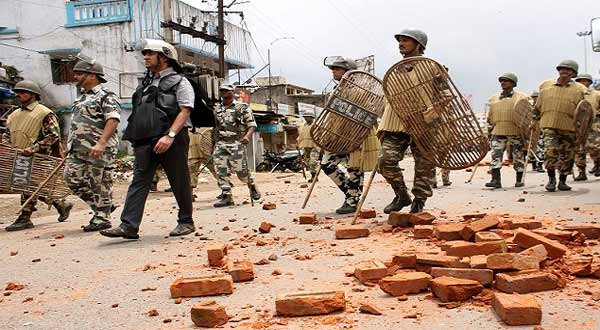
Recently, incidents of communal violence reported from various places like Saharanpur, Kasganj, Faizabad and Muzaffaragar, Ghaziabad, Bulandshar in Uttar Pradesh, Atali and Palwal in Haryana, some places in Maharashtra, Jammu & Kashmir and in Southern States. And the most recent one reported was from Mango in Jamshedpur, following an eve teasing incident. Many believe that the bandh next day called by the BJP and VHP provoked the violence to flare up. More than 100 people have been arrested so far.
According to a report published in Prabhat Khabar on 23 July, ADG SN Pradhan, during his investigation in Mango violence, said that the police officials on duty did not play their role in the desired manner in the first hour. Initially the number of police force was less but even then, if they had acted, they could have controlled it in a better way.
Mohammad Abdullah from Mango in Jamshedpur, while speaking to Radiance, said that the police failed to reach the spot on time otherwise things could have been controlled earlier. Slowly and steadily the situation here is returning to normalcy but suspicion, doubt, fear and anger is still there. People’s movement began when curfew was lifted for the whole day on 24 July. Like all other places, here too the role of police was not satisfactory for they failed to contain the nefarious designs of the anti-social elements. If the police had acted on time, the violence could not have escalated further.
Be it communal violence or anything like that, Muslims are made to stand at the receiving end. According to a US State Department report released last year, religion-based societal violence in India was the “most significant” human rights problem in the country in 2014, besides “widespread corruption” and abuses by police and security force. Earlier, a report was submitted to the government by three senior police officials from Maharashtra, UP, Tamil Nadu, and an IB representative entitled ‘Strategy for Making Police Forces More Sensitive towards Minority Sections.’ “This report acknowledged bias within the police force against Muslims and reported the Muslim perception of police as ‘communal, biased, and insensitive’,” it said.
The announcement by the Supreme Court to install CCTV in jails and all police stations across India is a welcome step and a way forward towards transparency as it can stop bias against Muslims in particular and the rest in general at least to some extent if it functions properly and is managed effectively.