

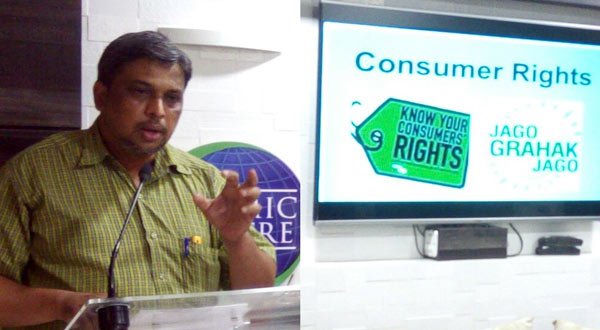
To mark International Consumer Rights Day, JIH Mira Road organised a lecture elucidating the rights of consumers and prevalent consumerism in the light of Islamic teachings and contemporary state laws.
The programme began with recitation of two passages from Surah A’araf and Surah Hud of the Holy Qur’ān detailing the struggle of Prophet Shoaib عليه السلام against socio-economic problems of corruption and unfair trade practices.
Following the translation of these passages, Shaikh Naeem explained that a consumer is any person who purchases goods or services from someone in exchange of money. While President John F. Kennedy laid down consumer rights on 15 March 1962 and the Indian Consumer Protection Act was passed in December 1986, the history of Consumer Rights can be traced back to the Mercy unto mankind صلى الله عليه وسلم and Shoaib عليه السلام (in the 7th century CE and around the 20th century BC respectively)
Some contemporary rights of consumers provided by the Constitution of India are:
1. Right to Safety;
2. Right to be Informed (as regards the product’s purity, standard, weight, volume, date of expiry, etc.);
3. Right to Choose;
4. Right to Consumer Education (e.g. Contact details of company ombudsman);
5. Right to be Heard; and
6. Right to be Redressed.
For redress of grievances, the Government has established a three-tier system:
1. District Consumer Dispute Redress Forum (dealing with cases involving ₹20 lakh);
2. State Consumer Dispute Redress Commission (dealing with cases ranging from ₹20 lakh to ₹1 crore); and
3. National Consumer Dispute Redress Commission (dealing with cases involving ₹1 crore).
Aggrieved consumers can easily approach these forums instead of heading towards civil courts.
Apart from these forums, wise use of the Right to Information (RTI) can also prove beneficial.
The learned speaker averred that availing oneself of these forums and protesting against malpractices is very much required to pull the reins on corruption in society. The ‘chhodo-yaar’ attitude of the affluent class wreaks havoc in the society at large.
Moving onto contemporary Consumer Culture, Naeem delved upon the marketing strategies of retailers and how the innocent consumer is lured into buying things on discount he does not need in the first place. Moreover, purchasing branded products to flaunt our status is not only against Islamic guidelines but also a waste of money. He highlighted the fallacy of this culture by citing certain everyday examples.
A few clips of the ‘Jago Grahak Jago’ campaign were also shown to the audience.
The programme concluded with a solemn prayer asking Allah for patience, forgiveness and mercy.