

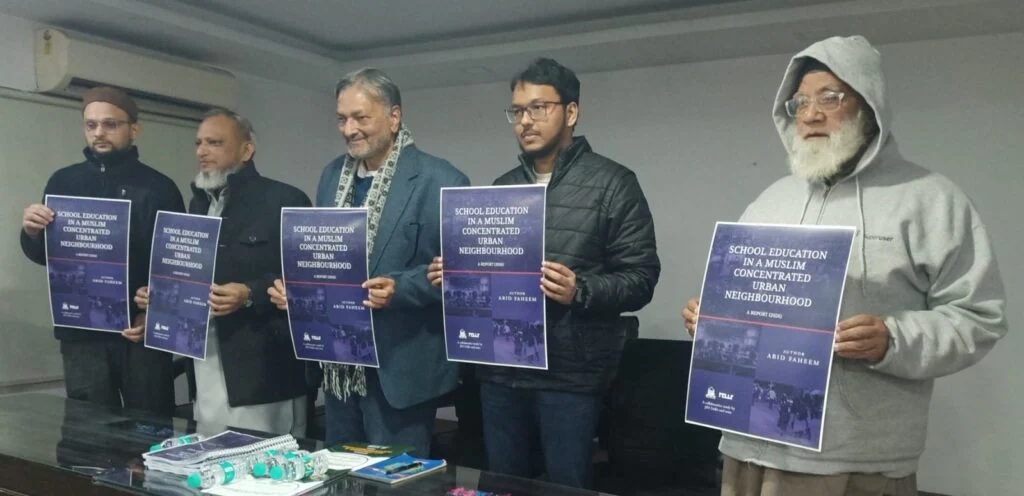
 A joint report released by Jamaat-e-Islami Hind (JIH) Delhi and NOUS has revealed deep-rooted socio-economic deprivation, systemic barriers in schooling, and sharp educational inequalities in Jamia Nagar, one of Delhi’s largest Muslim-concentrated neighbourhoods. Titled “School Education in Muslim Concentrated Neighbourhoods: A Case Study of Jamia Nagar, South-East Delhi,” the report is based on a household-level survey examining children’s schooling, learning outcomes, and socio-economic backgrounds.
The report was released on Jan. 25 at the conference hall of Jamaat-e-Islami Hind headquarters in Delhi, in the presence of academics, educationists, civil society members, and community leaders.
Releasing the report, Salimullah Khan, President Jamaat-e-Islami Hind Delhi, said the idea for a comprehensive educational survey of Jamia Nagar emerged from a decision taken by the JIH Delhi Advisory Council in April 2023. He pointed out that despite Jamia Nagar’s dense population and the presence of multiple educational and social organisations, there was no scientific, data-based understanding of the area’s population and educational realities.
“Most discussions were based on assumptions or fragmented information. A formal, scientific study was necessary to guide policymakers, NGOs, educational institutions and even government bodies,” Khan said. Following the JIH Delhi Advisory Council’s decision, the task was entrusted to Ali Javed and his organisation NOUS, which began the survey on 1 March 2024 and completed it in less than a two-year period.
Emphasising education as a key driver of social and economic mobility, Khan drew global comparisons, including China’s investment in education and innovation, to underline how learning directly impacts productivity and technological advancement. He stressed that the report should be seen as a starting point, adding that its real value lies in how stakeholders use the findings for concrete action.
Presiding over the programme, Professor Dr.Aejaz Masih from the Department of Education, Jamia Millia Islamia, stressed that education cannot be examined in isolation from broader social and economic conditions. Appreciating the report’s transparency about its own limitations, he noted that Jamia Nagar presents a complex urban reality where premier institutions coexist with households lacking basic amenities such as toilets and kitchens.
Dr. Masih argued that studies on Muslim-concentrated areas should be viewed as part of national development discourse. “No country can progress by leaving any community behind,” he said. He recommended follow-up institutional surveys to link learning outcomes with teacher characteristics, school ecology and institutional profiles, while also pointing out that the report calls for teacher training without sufficiently analysing teachers themselves.
The household-level survey covered 2,648 Muslim minority households, offering a detailed snapshot of demographic, socio-economic, and educational conditions. Nuclear families dominated the sample at 80.6%, while joint families constituted only 2.8%, reflecting a strong trend toward nuclear living arrangements. 61.8% of households lived in owned dwellings, while 36.7% resided in rented accommodation. Household leadership remained predominantly male, with 87.2% male-headed households, compared to 12.8% female-headed households.
Migration emerged as a defining characteristic, with 51.7% migrant households, primarily from Uttar Pradesh (56.5%) and Bihar (32.5%). Civic integration remained partial, as 21.9% of respondents did not possess a Delhi voter ID, despite 44.6% of them residing in Delhi for 5–10 years.
Housing and basic amenities showed notable deficits. 14% of households lacked a separate kitchen, and 6.7% did not have an in-house toilet. Digital access was limited, with 61.8% of households not owning a computer or laptop. Asset ownership was low, as 82.3% did not own a four-wheeler, indicating constrained mobility and material resources.
Parental education levels revealed persistent educational disadvantage. 27.8% of fathers and 27.1% of mothers had no formal schooling. Madrasa education was minimal, reported by only 1.3% of fathers and 2.4% of mothers. English-medium education was reported by 59.5% of fathers and 52.5% of mothers, suggesting partial exposure to formal schooling systems.
Employment patterns reflected economic vulnerability. Among fathers, 41.3% worked in the private sector, 37.9% were self-employed, and only 7.0% held government jobs. Income distribution showed that 41.7% earned ₹20,000 or less per year, while 24.0% earned above ₹50,000. Mothers were largely outside the labour force, with 90.6% identified as homemakers. Among working mothers, 48.4% were in private employment and 19.1% were self-employed. Income dispersion was high, as 34.2% earned up to ₹10,000 per month, while 18.3% earned above ₹50,000.
Caste and wealth stratification revealed inequality within the community. 56.3% of households belonged to the General category, and 37.1% to OBCs. 47.0% of General category households were classified as rich, compared to 33.4% of OBC households.
A total of 3942 children aged 3-18 were identified, educational participation data covered 3,872 children aged 3-18, with a near-equal gender split (50.6% boys, 49.4% girls). 94.% were currently enrolled in school, while 3.7% had never been enrolled, and 2.3% had dropped out. Never enrolment was concentrated in early childhood, while dropouts occurred mainly at ages 17 and 18. Boys formed 52.9% of dropouts, and migrant households accounted for 61.6% of all dropout cases. Poverty was the most frequently cited reason, followed by academic difficulty and low interest.
Educational aspirations were exceptionally high, with 97.4% of children aspiring to higher education. 20.8% attended private coaching, primarily for academic support (79.1%), while 16.5% prepared for competitive or professional exams. Coaching participation rose sharply with wealth, while gender differences were minimal.
Schooling patterns showed 56.7% enrolled in private schools and 40.2% in government schools. 84.3% studied in English-medium schools. Wealth disparities were stark: 57.6% of the poor attended government schools, while nearly 51% of the rich attended private schools. 68.8% of General category children attended private schools compared to 28.4% of OBC children.
Access indicators showed 64.2% travelled less than 2 km to school, while 13.9% travelled over 5 km, more commonly among wealthier households.
School mapping identified 125 institutions across twelve localities, with 84.8% concentrated in five areas, led by Abul Fazal Enclave (24.8%) and Shaheen Bagh (18.4%). 58.4% were established after 2013. Notably, Shaheen Bagh had no government school. While 52.8% offered only primary education, only 17.6% provided senior secondary education, and 65.6% of institutions were privately managed.
Learning outcomes were weak across subjects. In Urdu, only 3.6% of Class 3 students could read a story, rising to 49.1% in Class 8. In English, 0% of Class 3 students could read a sentence, 50.5% in Class 5, and 52.7% in Class 8, below the ASER national average of 67.5%. In Mathematics, division proficiency stood at 19.0% in Class 3, 45.5% in Class 5, and declined to 30.9% in Class 8, indicating stagnation at higher grades.
Author Abid Faheem highlighted the report’s key findings and recommendations, calling for expanded scholarships, migrant-friendly welfare delivery, stronger government schools, digital access, hostels, and effective anti-discrimination mechanisms. Ali Javed, founder of NOUS, underlined the importance of such evidence-based studies in shaping targeted interventions and long-term policy responses.
Overall, the report exposes deep structural inequalities while underscoring the resilience and ambition of Jamia Nagar’s students, making a compelling case for urgent, targeted and inclusive educational reforms.