

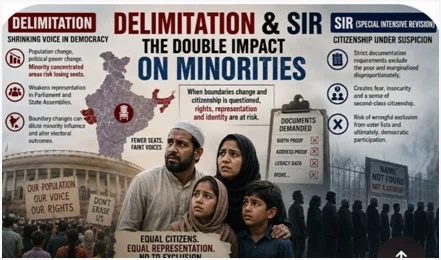
The delimitation of parliamentary constituencies and the Special Intensive Revision (SIR) of electoral rolls have emerged as two of the most debated political and constitutional questions in contemporary India. While the government has maintained that both exercises are administrative and constitutional necessities aimed at ensuring fair representation and accurate electoral rolls, critics argue that their implementation could significantly alter India’s political landscape, particularly affecting minorities, regional parties, and opposition politics.
Although delimitation and SIR are distinct exercises, their simultaneous discussion has generated concerns about representation, electoral fairness and democratic inclusiveness. Political parties, constitutional experts, civil society organisations and minority groups have raised questions about their possible long-term implications for India’s electoral democracy.
Delimitation refers to the redrawing of the boundaries of parliamentary and assembly constituencies based on changes in population. Under Articles 82 and 170 of the Constitution, Parliament is empowered to undertake delimitation after every Census through a Delimitation Commission.
India has not conducted a nationwide delimitation since 2008, based on the 2001 Census. The number of Lok Sabha seats has remained frozen since the 1976 constitutional amendment, later extended until after the first Census conducted following 2026. With the next delimitation expected after the Census process resumes, the issue has acquired immense political significance.
The primary objective of delimitation is to ensure that every elected representative represents roughly an equal number of citizens. Over decades, demographic changes have created significant population imbalances among constituencies, making a fresh exercise constitutionally necessary.
However, critics argue that demographic realities also raise political challenges.One of the strongest criticisms surrounding delimitation comes from southern states. States such as Tamil Nadu, Kerala, Karnataka and Andhra Pradesh have successfully controlled population growth over several decades through investments in education, healthcare and family planning.
If parliamentary seats are redistributed solely on the basis of current population, northern states such as Uttar Pradesh, Bihar, Madhya Pradesh and Rajasthan may gain a substantial number of Lok Sabha seats due to higher population growth.
Southern political parties contend that such a redistribution would effectively penalise states that successfully implemented population-control policies while rewarding states with higher fertility rates. They argue that their influence in national policymaking could diminish despite making greater contributions to economic growth and social development.Several Chief Ministers and regional parties have demanded safeguards to ensure that federal balance is not disturbed during any future delimitation exercise.
Minority organisations have expressed apprehension that delimitation could alter constituency boundaries in ways that dilute the electoral influence of religious minorities.
Muslim-concentrated constituencies could be reorganised by combining them with larger populations where minorities constitute a much smaller percentage. Such changes may reduce the likelihood of minority-backed candidates being elected, even in areas where minority communities have historically played a decisive electoral role.
Political analysts note that delimitation itself is not intended to target any community. However, they emphasise that the manner in which constituency boundaries are drawn can substantially influence electoral outcomes.
Concerns have also been raised regarding SC and ST reserved constituencies. Since reservation is linked to demographic distribution, any changes in population patterns may alter which constituencies become reserved, thereby affecting existing political equations.
Several minority organisations have called for greater transparency, public consultation and judicial oversight during the delimitation process to ensure that constituency boundaries are not perceived as politically motivated.
Alongside delimitation, the Election Commission’s SIR of electoral rolls has generated significant political debate.The SIR aims to identify duplicate entries, remove deceased or shifted voters and ensure that only eligible citizens remain on electoral rolls. Election authorities argue that accurate voter lists strengthen electoral integrity and reduce the possibility of fraud.
However, opposition parties and civil society organisations have questioned the implementation of such exercises, particularly where large numbers of voters are required to furnish documentation within limited timeframes.
Critics fear that documentation requirements could disproportionately affect economically weaker sections, migrant workers, homeless citizens, women whose documents may not reflect marital changes, tribal communities and religious minorities who often face documentation gaps.
While the Election Commission has repeatedly stated that no eligible voter should be excluded and that adequate safeguards exist, concerns continue regarding the practical implementation of largescale verification exercises.
For political parties, both delimitation and SIR carry major electoral implications.
National parties with stronger support in densely populated northern states could potentially benefit if those states receive additional parliamentary seats after delimitation. This possibility has prompted several regional parties to seek constitutional safeguards preserving the federal balance.
Regional parties, especially in southern India, worry that their bargaining power in coalition politics could decline if their states’ relative representation in Parliament decreases.
Opposition parties have also argued that electoral roll revisions conducted close to elections may create perceptions of bias if transparency is lacking.
Meanwhile, the ruling BJP maintains that both delimitation and voter-roll revisions are constitutional processes that should not be politicised. Party leaders argue that equal representation based on population is fundamental to democratic fairness and that clean electoral rolls enhance public confidence in elections.
Several constitutional scholars emphasise that democratic legitimacy depends not only on legal compliance but also on public trust.
Even if delimitation follows constitutional procedures and SIR adheres to Election Commission guidelines, insufficient transparency could fuel political polarisation and litigation.
Experts have suggested several safeguards:
- Publication of detailed delimitation criteria,
- Public hearings before finalising constituency boundaries,
- Independent scrutiny of electoral roll revisions,
- Accessible appeal mechanisms for voters whose names are deleted, and
- Adequate time for document verification and corrections.
Such measures, they argue, would strengthen confidence across political parties and communities.
The Constitution of India guarantees equality before law, universal adult franchise and equal political participation regardless of religion, caste or language.
Minority groups argue that electoral reforms should not unintentionally reduce their political voice. They emphasise that representation is not merely about numerical strength but also about ensuring that diverse communities continue to have meaningful participation in democratic institutions.
Human rights organisations have similarly stressed that voter registration procedures must remain inclusive and should avoid creating unnecessary barriers for vulnerable populations.At the same time, supporters of electoral reforms contend that accurate voter rolls and equitable constituency sizes ultimately benefit all citizens by improving the credibility of elections.
The debate over delimitation and SIR reflects broader questions about the future of India’s democracy. While both exercises are grounded in constitutional and administrative objectives, their political consequences are likely to be significant.For regional parties, the challenge lies in preserving federal balance. For minority communities, the concern is maintaining effective political representation. For the Election Commission and the government, the responsibility is to conduct these exercises in a manner that is transparent, impartial and widely accepted.
Ultimately, the legitimacy of any electoral reform depends not only on constitutional authority but also on public confidence. Open consultation, independent oversight and procedural fairness will be essential to ensure that delimitation and voter-roll revision strengthen rather than weaken India’s democratic fabric.
As India prepares for major electoral and constitutional milestones in the coming years, the manner in which these exercises are implemented will play a crucial role in shaping both the country’s political landscape and citizens’ faith in representative democracy.