

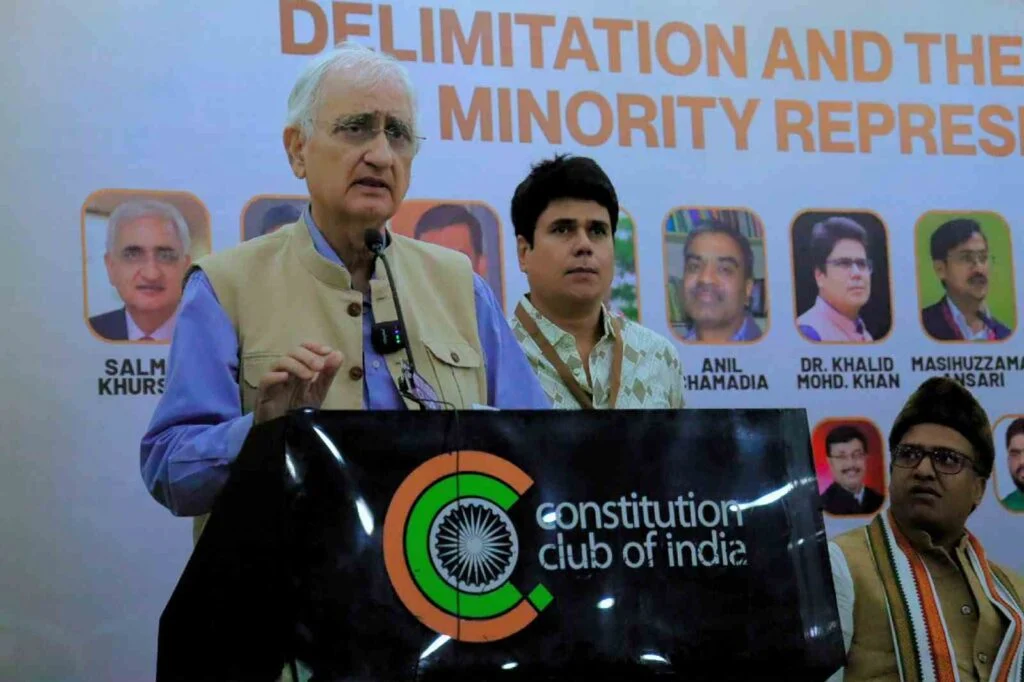
Concerns over the proposed delimitation exercise and its potential impact on minority and regional representation dominated a national conference held at the Constitution Club in New Delhi on June 23. Organised by Hum Bharat Ke Log, the event brought together political leaders, lawyers, journalists, activists, and representatives from different parts of the country to discuss the implications of the upcoming delimitation process and the issue of Muslim political representation.
Participants raised questions about the manner in which constituency boundaries may be redrawn in the future and whether the exercise would adequately reflect constitutional principles of fairness and representation. They repeatedly referred to the recommendations of Sachar Committee, which examined the socio-economic and educational status of Muslims, and urged policymakers to ensure that those recommendations are taken into account during any future delimitation exercise.
Former Union Minister and senior Congress leader Salman Khurshid highlighted the legal dimensions of the issue. Referring to the constitutional framework governing delimitation, he noted that courts traditionally have limited scope to intervene in such matters. However, he pointed to the Supreme Court’s notice in relation to the Assam delimitation exercise as an indication that judicial scrutiny may still be possible under certain circumstances. Khurshid expressed hope that legal remedies could be explored if concerns emerged during the forthcoming delimitation process and stressed the importance of closely monitoring of developments.
Senior journalist Anil Chamadia broadened the discussion beyond electoral boundaries, arguing that democratic participation and social unity should not be left solely to governments or political parties. He said citizens themselves must resist any attempts to divide society and defend democratic rights. Chamadia also emphasised the need to strengthen social interaction and inclusivity as a means of countering polarisation.
Senior advocate Shariq Abbasi focused on the technical and political challenges surrounding delimitation. He argued that the current framework contains several shortcomings and noted that debates over representation are not limited to minority communities. Questions have also emerged regarding the balance of parliamentary seats between northern and southern states, particularly in light of differing population growth trends.
Congress National Secretary Shahnawaz Alam drew attention to the findings of Sachar Committee Report. The report highlighted concerns that constituencies with Muslim concentration were sometimes reserved in a manner that reduced opportunities for Muslim political representation. He said the committee had recommended that future delimitation exercises take this issue into account.
Alam called upon secular political parties that had previously supported the Sachar Committee’s recommendations to actively demand that the upcoming delimitation process be conducted in accordance with those recommendations. He argued that political parties have both a moral and political responsibility to ensure that representation remains inclusive and equitable.
Rajya Sabha MP Akhilesh Prasad warned that any reduction in seats allocated to southern states due to demographic changes could have far-reaching consequences. He argued that states that successfully implemented population-control measures should not be penalised through a reduction in political representation, adding that such a move could affect national cohesion.
Journalist Masihuzzama Ansari emphasised that representation should not be confined to electoral politics alone. He urged political parties to improve representation within their own organisational structures and provide opportunities to members of different communities in proportion to their presence in society.
The conference concluded with the adoption of seven resolutions. One of the resolutions demanded that constituencies with more than 40% Muslim population should not be reserved in cases where the Dalit population is lower, that constituencies with more than 40% Dalit population should not remain unreserved, and that southern states should not lose representation because of their success in controlling population growth.
Participants also opposed any proposal to carve out separate Union Territories from Muslim-majority regions of Seemanchal and West Bengal. The resolutions further urged secular political parties to reaffirm their commitment to the recommendations of Sachar Committee and Ranganath Mishra Committee, both of which addressed issues of minority representation and inclusion.
Another significant resolution called upon the Supreme Court to effectively implement its 2024 observations regarding judicial review of delimitation exercises that may be inconsistent with constitutional principles. The conference additionally urged secular parties to field Muslim candidates from Muslim-majority constituencies to ensure adequate political representation.
Participants announced the formation of India Against Unfair Delimitation, a platform that will conduct awareness campaigns and advocacy efforts on issues related to delimitation and political representation.