

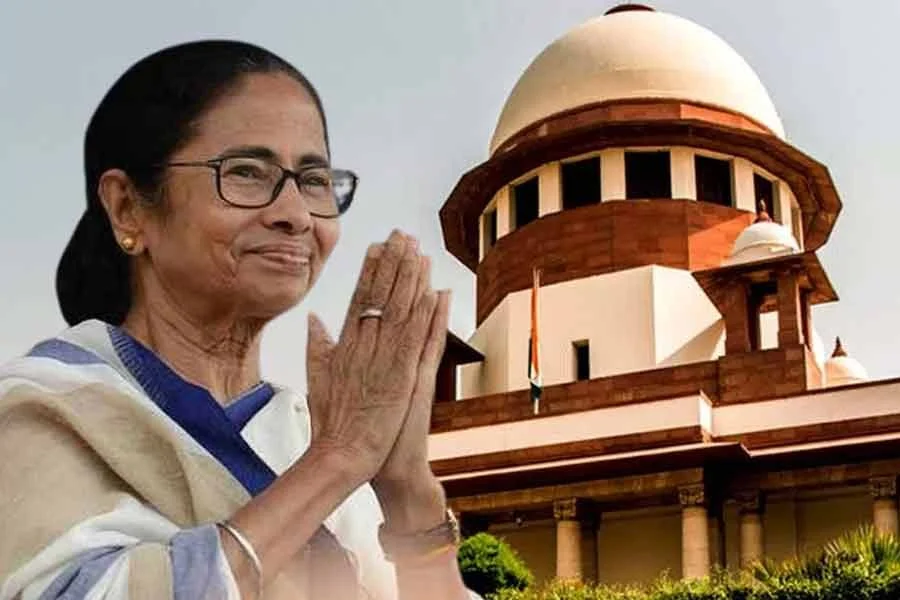
In early February 2026, Mamata Banerjee, Chief Minister of West Bengal, took the rare and bold step of appearing in person before the Supreme Court to challenge the Special Intensive Revision (SIR) of electoral rolls conducted by the Election Commission of India (ECI).
Her appearance, unprecedented for a sitting chief minister to plead her own cause in the apex court, sparked a complex debate about the nature of democratic safeguards, institutional trust, and the role of judiciary as referee in constitutional crises. While political allies hail her move as courageous, critics see it as blurring the institutional boundaries between politics and legal adjudication. This article aims to critically analyse what Mamata’s challenge signifies for Indian democracy and its judiciary.
The SIR exercise, mandated by statute, is intended to ensure that voter rolls are up-to-date by removing duplicates and deceased persons while allowing eligible citizens to register. The ECI maintains that such revisions carried out periodically across states are vital for maintaining the integrity of electoral rolls. However, in West Bengal, it became the focal point of a bitter dispute between the state government and the poll body.
Mamata Banerjee argued that the manner in which SIR was being conducted in West Bengal risked mass disenfranchisement of genuine voters, alleging that logistical and procedural errors exacerbated by algorithmic flags for common spelling discrepancies were unfairly deleting names of eligible citizens. She has claimed that these technical processes were being weaponised politically, describing the ECI mockingly as “WhatsApp Commission” and accusing it of bias favouring the BJP ahead of upcoming state elections.
The ECI responded by highlighting its legal duty to maintain clean rolls and pointed to documentary scrutiny across districts; it also suspended several officers in West Bengal for alleged misconduct during the SIR process – a move that further heightened tensions.
What makes the case legally and institutionally significant is the Supreme Court’s response. Citing a “trust deficit” between the state government and the ECI, the Court took the extraordinary step of directing the Calcutta High Court to appoint serving and retired judicial officers to oversee adjudication of claims and objections in the SIR process.
This judicial oversight, unprecedented in the context of voter roll revision, was framed by the Bench, led by Chief Justice Surya Kant, as necessary because neither the state nor the ECI could agree on the appropriate rank and deployment of officers to conduct the exercise. According to the judgment: “We are left with little option but to involve the judiciary” to ensure fairness. While many within the ruling party of Bengal have welcomed this as a vindication of Mamata’s constitutional challenge, central political opponents called it a blow to the state’s governance and a necessary enforcement of federal duty to maintain electoral integrity across India.
One of the central constitutional principles in India’s democracy is the independence of judiciary, its autonomy from executive and legislative influence. This principle ensures dispute resolution and constitutional enforcement based solely on merits and rule of law, not political pressure.
The Supreme Court’s intervention by appointing judicial officers to oversee an ongoing voter roll revision can be seen as a robust assertion of this independence in a context where political tensions risked derailing a constitutional process. It demonstrates that the judiciary is willing to step in when institutional trust erodes, and inject neutrality in functions critical to democratic participation. This action underscores the judiciary’s role as guardian of constitutional processes.
However, critics worry about overreach: that judicial oversight of executive electoral functions could set a precedent where courts are drawn into the everyday administration of electoral processes roles constitutionally entrusted to specialist bodies like the ECI.
Mamata Banerjee’s decision to argue her own case in court aside from its procedural legality had political resonance. Her supporters saw it as a symbolic stand for the disenfranchised, directly contesting what they see as bureaucratic overreach. Her critics, including a legal petition that called her appearance “constitutionally improper and institutionally untenable,” argue that such direct involvement from a sitting CM is atypical and risks blurring institutional roles.
This raises a broader question: at what point does vigorous political advocacy enter the realm of institutional erosion? While politicians have the right to use the legal system, their direct courtroom appearances in politically charged matters can risk conflating political narratives with judicial processes.
At stake is not just a procedural revision of electoral rolls, but the perception of democratic legitimacy how citizens view electoral fairness, institutional trust, and participatory rights. The SIR dispute has already triggered widespread anxiety, social media virality, and political polarisation much of which stems from conflicting narratives around voter deletion and institutional integrity.
The Supreme Court’s intervention attempts to mediate that polarisation by ensuring adjudication is overseen by neutral judicial officers rather than politically appointed observers. Such safeguards are essential in contested democracies, where the credibility of elections underpins public faith in governance.
Mamata’s SIR challenge to the Supreme Court is more than a legal dispute over administrative procedure; it is a lens through which to examine the health of Indian democracy. It highlights a complex interplay between political strategy, institutional accountability, and judicial oversight.
The judiciary’s response, stepping in to mediate and restore confidence, reinforces its role as the constitutional bulwark in times of institutional strain. Yet, this case also serves as a reminder of the delicate balance required to protect democratic processes without overstepping institutional boundaries.
In a functioning democracy, conflicts between constitutional bodies are inevitable. What matters is how these conflicts are resolved transparently, impartially, and with a steadfast commitment to the rule of law and equal political rights for all. Mamata’s challenge and the Supreme Court’s extraordinary intervention underscores the fragility and resilience of India’s democratic framework in equal measure.