

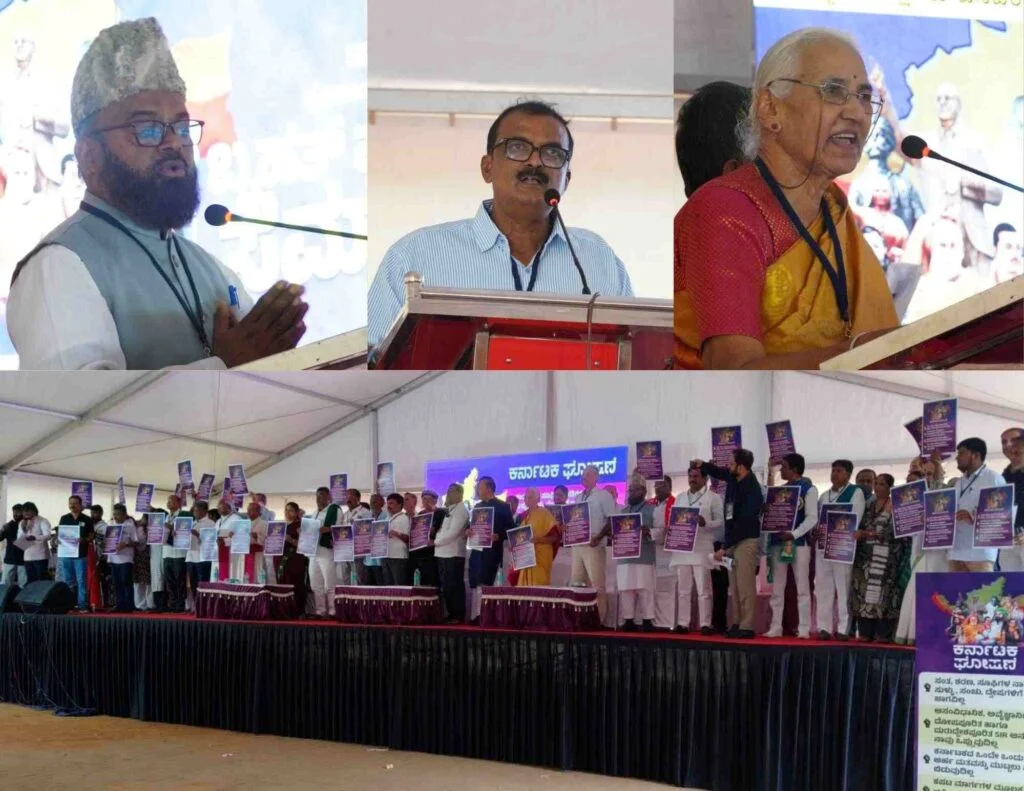
Weeks of mobilisation across Karnataka reached their climax on Saturday, June 20, as thousands gathered at Bengaluru’s Freedom Park for a Mass Resistance Convention against the proposed Special Intensive Revision (SIR) of electoral rolls. In the run-up to the convention, and as announced during earlier programmes, five awareness caravans crisscrossed the state during a 10-day campaign, travelling through districts, cities and smaller towns to educate citizens about SIR and its possible implications for voting rights. The caravans finally converged in Bengaluru, bringing together activists, social organisations, political leaders, writers and concerned citizens from different parts of Karnataka.
The convention, organised under the banner of a broad coalition of civil society groups and people’s movements, reflected growing concerns over the manner in which the proposed electoral revision is being carried out. While speakers represented different political and social backgrounds, they were united in their demand for greater transparency, public consultation and safeguards to ensure that no eligible voter is excluded from the electoral rolls.
Among those who addressed the gathering were KPCC President B.K. Hariprasad, former minister and noted writer B.T. Lalitha Naik, social activist Noor Sridhar and Mohammed Yusuf Kanni, State Secretary of Jamaat-e-Islami Hind Karnataka.
For many participants, the issue was not merely about revising voter lists. The concern repeatedly voiced throughout the convention was whether ordinary citizens, particularly the poor and vulnerable, would face difficulties in proving their eligibility and retaining their place on the electoral rolls.
Mohammed Yusuf Kanni: ‘The Election Commission Must Answer’
One of the most forceful speeches came from Mohammed Yusuf Kanni, who questioned reports of largescale deletions from electoral rolls in states where similar exercises have already been undertaken.
Referring to reports that nearly 6.5 million names had been removed during SIR-related processes in different states, Kanni asked the Election Commission to explain who these individuals were and on what basis their names had been deleted.
“Are they all infiltrators? Are they all deceased? If millions of names are being removed, the Election Commission must clearly explain who these people are and why they were excluded,” he said.
Recalling India’s democratic journey since Independence, Kanni noted that the country had steadily expanded participation in the electoral process over the decades. He warned against any exercise that could create uncertainty among genuine voters.
“The concern today is that citizens are being pushed into uncertainty in the name of electoral roll purification,” he observed.
Kanni also questioned why concerns repeatedly raised by citizens and civil society groups over the past several months had not received clear answers from the authorities.
Noor Sridhar: ‘Questions Remain Unanswered’
Noor Sridhar of the Eddelu Karnataka movement described the convention as the culmination of a statewide campaign that had taken activists to every region of Karnataka. The five awareness caravans, he said, were organised not only to explain the implications of SIR but also to listen to concerns being expressed by ordinary citizens.
According to him, questions raised by citizens, lawyers, activists and democratic organisations have so far remained unanswered.
Sridhar also expressed concern over the reported use of the ‘Logical Discrepancy’ software in electoral verification exercises. Any technology that could affect voting rights, he argued, must be transparent and open to public scrutiny.
He announced plans to establish Vote Protection Committees across gram panchayats and urban wards to assist citizens during the revision process and monitor possible irregularities. He reiterated the convention’s key demands, including public access to draft electoral rolls, review through Gram Sabhas and Ward Sabhas, adequate time for appeals and corrections, and the non-use of software systems whose functioning has not been publicly explained.
B.T. Lalitha Naik: ‘A Citizen Without a Vote Has No Voice’
Former minister and senior writer B.T. Lalitha Naik focused on the impact that the exercise could have on ordinary citizens, particularly the poor, migrant workers, elderly persons and marginalised communities.
“A citizen who loses the right to vote effectively loses a voice in democracy,” she said.
She expressed concern that many people who have voted for years may struggle to produce documents now being demanded during verification exercises. Such citizens, she argued, should not be made to feel insecure about rights they have long enjoyed.
Lalitha Naik also appealed to the media to play a more active role in spreading awareness. “If the media acts responsibly, awareness can reach every village and every household,” she said.
She warned that citizens could feel helpless if institutions entrusted with protecting democratic rights fail to respond to their concerns.
Key Concerns Raised at the Convention
Several concerns surfaced repeatedly during the day-long convention:
- The possibility of eligible voters being excluded because of documentation requirements.
- Lack of clarity regarding verification procedures.
- Concerns over technology-driven deletions without adequate transparency.
- Limited public awareness about the implications of SIR.
- Difficulties that may be faced by poor, elderly, migrant and marginalised citizens.
While speakers acknowledged the need for accurate electoral rolls, they insisted that the process must remain transparent, inclusive and fair.
Congress Signals Support
KPCC President B.K. Hariprasad assured participants that the concerns being raised by citizens would not be ignored. He said discussions were underway within the government and party leadership regarding the issue and stressed that democratic rights and voting rights must be protected.
His participation was seen by many attendees as a sign that concerns over SIR have moved beyond activist circles and entered mainstream political discussion in Karnataka.
Demands Placed Before Authorities
The convention adopted a set of demands addressed to both the Election Commission and the Karnataka Government.
Demands to the Election Commission
- The proposed “Logical Discrepancy” software should not be used without transparency and public scrutiny.
- Draft electoral rolls should be made available in machine-readable formats for public verification.
- Draft rolls should be placed before Gram Sabhas and Ward Sabhas for public review and correction.
- Citizens should be given adequate time, including a minimum six-month appeal period, to challenge exclusions and rectify errors.
Demands to the State Government
- Electoral roll revision should be conducted through a simple, transparent and citizen-friendly process.
- Smart voter cards should be issued to all eligible voters.
- Citizens who are required to provide documents should receive administrative assistance in obtaining them.
- Special measures should be taken to ensure that vulnerable communities are not excluded from the electoral process.
A Larger Democratic Conversation
The Freedom Park convention underscored a growing debate over voting rights and electoral transparency in Karnataka. Speakers stressed that electoral roll revision must be carried out in a manner that is transparent, inclusive and free from arbitrary exclusions.
With the SIR process expected to commence shortly, organisers said their awareness campaign would continue through local monitoring committees and public outreach programmes. Whether the concerns raised at Freedom Park receive an official response remains to be seen, but the convention has undoubtedly brought the issue of voter rights to the centre of public discussion in Karnataka.