

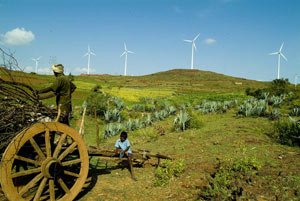
India desperately needs development but certainly not at the cost of peace and tranquillity and her composite culture, observes MOHAMMAD NAUSHAD KHAN.
The Indian polity is standing at the crossroads. It is in a transitional phase and the outcome of general elections will draw the line as to what would be the nature of India and her polity in due course of time. Inferences are being drawn and perceptions being created in the minds of people as to how important their vote is in shaping the destiny of India and how their irresponsible voting will harm the very spirit of India and her composite culture.
The campaign of political parties is aimed at creating hype on the issue of development, corruption, secularism and communalism in the minds of people. For every issue there are arguments for or against and one party is claiming high moral grounds than others by using political connotations based on the issues put forward.
Development is all important but not at the cost of others’ peace. Development for some is injustice to others. Development on the basis of caste, religion and political will disintegrates the idea of inclusive growth and paves the way for hatred among communities and political parties. Development has got wider connotation and it should encompass the entire population in equal magnitude in all respect. The very logical definition of India in today’s perspective is that India has developed for many, to some it is still developing but for a larger chunk it is still underdeveloped. This definition is derived from the level of income and standard of life. The vast urban and rural divide and comparison of cities with villages and from cluster to slums cast shadow on our developmental model.
For BJP, Gujarat is a model of development but for Muslims it is a model of suppression and isolation. Gujarat riots have pushed the minority community in the state of bewilderment and the silence created in the aftermath of the riots is now mistaken as peace and cordial atmosphere for development. Needless to say, ghettoisation of Gujarat’s Muslims still continues in one way or another. But whenever there is talk of the Gujarat Model, another competitive model in the form of the Bihar Model comes into picture.
If we take the Gujarat Model, we can say that it has become better from good and if it is the case then certainly it is not a big achievement. If a state becomes better from downward then it is indeed a remarkable achievement. And by that yardstick it is Nitish Kumar who deserves praise for really driving his state towards betterment and not Narendra Modi. Gujarat, either for Muslims or for Hindus, was a flourishing state and the 2002 Gujarat riots subverted the process of growth otherwise it could have witnessed more impressive growth. And Muslims were worst affected.
The ‘clean chit’ of Modi has been questioned by many. But has he got ‘clean chit’ from his own conscience? If he was so clean then why then Prime Minister Atal Behari Vajpayee had to say that Modi failed in raj dharma and asked him to quit, which was strongly opposed by the party at that point of time. Atal Behari Vajpayee’s niece Karuna Shukla, who has quit the party, in an interview with NDTV in November, said Modi can’t wash his hands off Godhra. Ms Shukla said that when the riots erupted, her uncle was livid with Mr Modi. As Prime Minister at the time, Mr Vajpayee had famously written to Mr Modi, reminding him of his duties of raj dharma – to deliver good governance and justice without any discrimination on the basis of caste or religion. Getting ‘clean chit’ in the absence of (or should we say in spite of) credible evidence is not new. Very recently the National Commission of Minorities is searching for a missing report on the 2002 Gujarat riots after the retired IAS officer who was NCM secretary at the time claimed that her original submission, which she says was damning and recommended President’s rule in the state, has vanished from the records.
There is also a perception that Modi as a leading figure would be more harmful for the BJP and RSS combine than for India and her plural society. Even during the election campaign and selection process there are visible sign of how the second generation leaders of the BJP have been pushed to corner or have been forced to toe Narendra Modi’s way of thinking. Much so that RSS chief also asked its cadres not to ‘NaMo NaMo’ all the time. Is RSS worried from the one man show of Narendra Modi and what about other leaders in the BJP?
India desperately needs development but certainly not at the cost of peace and tranquillity and her composite culture. There are different views for India under Narendra Modi. Some believe that it would be disastrous; some feel he is decisive, but very recently another view has come up that says if Modi becomes Prime Minister… aag lag jayegi. Let peace prevails under all circumstances. It would only be in the greater interest of India and her peoples.
The aggressive posture of Arvind Kejriwal against Narendra Modi in particular and BJP in general reveals that 2014 polls will be closely fought and watched between AAP and the BJP. There is great deal of pressure on Arvind Kejriwal by the party to take on Narendra Modi from Varanasi. The decision of Narendra Modi to contest from Varanasi is to charge the political atmosphere in Uttar Pradesh and neighbouring Bihar. These two states are most likely to decide the fate of 2014 polls. The possibility of hung parliament is much on the cards and under such circumstances even smaller parties with fewer seats will twist in government formation.