

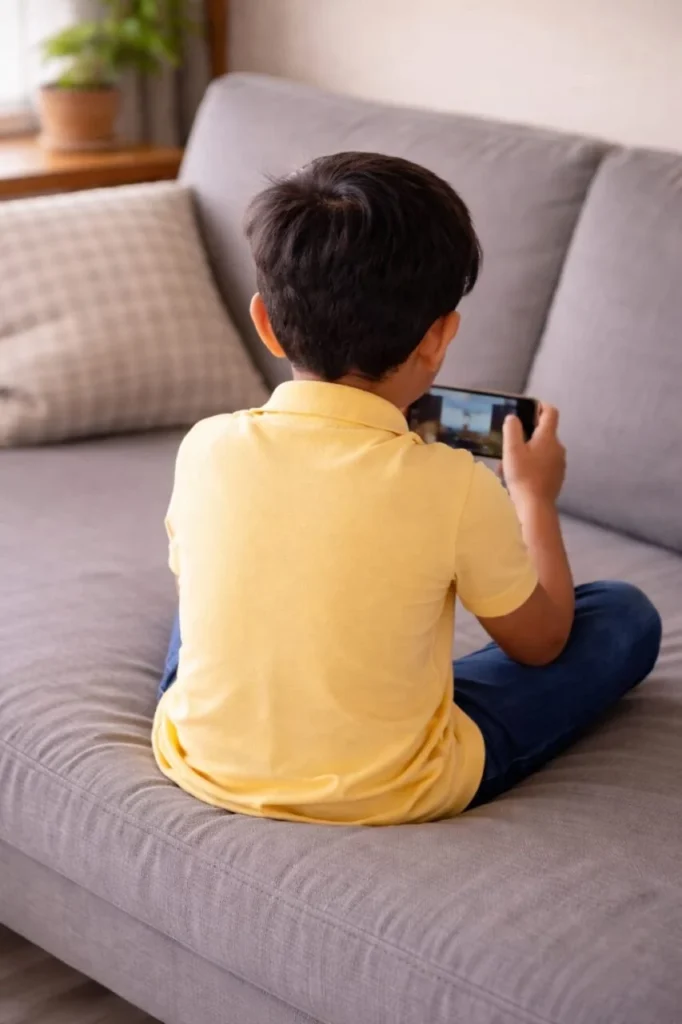
The typical warning of ‘don’t speak to strangers’ or ‘don’t take a chocolate from anyone’ that we have been giving children has now become heavily inadequate, as every child is exposed to the world and its strangers, and neither the child nor their parents are yet aware of the intensity of such an exposure through the social media. It has revolutionised study, work, and the community within its first decade, both positively and negatively, and many of us are still learning to adapt to its pace. But the generation that was born right into it has effects rooted in their very upbringing.
Many studies such as the economic Survey of 2025-2026 point to the link between high screen time and deteriorating mental health in the 15-24 age group. But children below 16 also show just as many, if not more extreme, adverse effects of regular consumption of social media or mobile games. A study conducted by Brian P. Dunleavy on 160,000+ children of age 12 and younger cited an up to 20% higher risk of behaviour problems for children associated with higher screen time.
Another systematic review based in India by Ashish Khobragade and Swathi Shenoy showed the average screen time of a child under five: In India as 2.22 hours a day, and children under two years as 1.23 hours a day, which is almost double the guidelines of 1 hour per day (for five-year olds) and no screen time below two years given by the Indian Academy of Paediatrics (IAP) in 2021 or the WHO.
Almost every psychological work on social media exposure to children states the direct effect on their mental health, listing issues like depression, anxiety, social stress, and lower emotional regulation. It might expose children, who already have no general awareness or digital understanding, to misleading information, explicit content or violence, without access to any form of cyber security.
Globally, only 51% of users have used parental controls. For more younger ages, it could reduce attention and cognitive control, increase difficulty to learn motor skills or vocabulary, as well as negatively affect creativity and problem-solving behaviour.
Jonathan Hiadt in his book ‘The Anxious Generation: How the Great Rewiring of Childhood is Causing an Epidemic Illness’ writes about the rise in mental health diagnosis in children since the 2000s, when the smartphones were first available. He speaks of children as ‘anti-fragile’ who require some level of physical adversity for healthy development, hence referring the arrival of screens and phones as the ‘great rewiring of childhood’. At a later interview at the Future of Everything Festival for the Wall Street Journal, he suggests banning smartphones in schools, or the use of “Dumb Phones” with less features.
Though not smartphones directly, many countries such as Australia, Spain, France or China do have a functional ban on social media for users below the age of 16, restricting platforms like TikTok, Instagram or Youtube. Australia took down 4.7 million accounts of children under 16 in March 2026.
The government of Karnataka also proposed a state-level ban on social media for children under 16 under the “uttamakalike, ujjwalabhavishya” education reform programme on March 6, 2026.
Such an action does have the potential to curb the physical and mental negative effects that open media is currently producing. As the first state in India to propose such a ban, it can be a strong policy precedent for the rest of the country, bringing major developmental issues to the mainstream, and has already been a subject of heated discussion since its announcement. The central influencing factor that stands in the way of achieving its planned results is the nature and method of imposition. Age verification and enforcement is difficult for a large and varied population.
Also, a blanket ban on all the mainstream social media sites may also increase the likelihood of teens turning to VPNs, Fake IDs, or alternate less safe platforms that could be more difficult to monitor, and expose them to the very harm that the ban was intended to protect against.
The required action then is also additional safety measures, spread of digital literacy and awareness not just among policymakers and parents but also the children, along with looking for other age appropriate alternatives that do not include entire dependence on digital sources. It must be taken into consideration that the social media and use of smartphones have become a major resource for educational material as well, especially for marginal and rural families. But at the end, though the issue is complicated but urgent, it is up to the parents and the authorities to draw a clear red line on the use of social media and smartphones.