

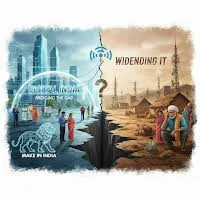
Over the last decade, Digital India has emerged as one of the country’s most ambitious national missions. From online banking and digital classrooms to telemedicine and e-governance, technology has steadily woven itself into everyday life. With India, home to the world’s second-largest adolescent population, digital access is no longer a luxury; it is increasingly a necessity.
Yet, amid this rapid transformation, an important question demands attention: Is Digital India truly bridging social and economic gaps, or is it quietly widening them?
The Promise of Digital India: Bridging Long-Standing Divides
At its best, digitalisation has acted as a powerful equaliser. Access to government services has become faster, more transparent, and less dependent on intermediaries. Initiatives such as digital identity systems, online ration services, and Direct Benefit Transfers have significantly reduced leakages and corruption. For economically weaker sections, this shift has meant something crucial – benefits reaching the rightful beneficiaries directly.
In the economic sphere, digital payment systems and e-commerce platforms have opened new doors for small businesses, street vendors, and rural entrepreneurs. With little more than a smartphone and an internet connection, individuals can now sell products, receive payments, and reach customers far beyond their immediate surroundings.
For women and young people, particularly in semi-urban and rural areas, digital platforms have enabled access to free educational resources, remote work, freelancing, and home-based enterprises opportunities that were once limited by geography and social barriers.
Education and healthcare have also seen meaningful shifts. Online learning platforms have expanded access to quality content, while telemedicine has brought medical consultations to regions lacking specialists. In theory, Digital India reduces distance, lowers cost, and expands opportunity.
The Other Side of the Screen: Where Gaps Begin to Widen
Despite its promise, digitalisation has also exposed and in some cases intensified existing inequalities. The most visible challenge is the digital divide between those who can access technology and those who can’t. Internet connectivity, reliable devices, and stable electricity remain unevenly distributed, particularly in rural and marginalised communities.
Access alone, however, is not enough. Digital literacy is an equally serious concern. Many first-time users – senior citizens, daily wage earners, and individuals unfamiliar with formal education – struggle with online forms, apps, and digital procedures. For them, technology often feels intimidating rather than empowering.
There are also growing concerns around data privacy, surveillance, and cybercrime. As personal information increasingly moves online, the risks of identity theft, fraud, and online harassment rise. Women and children, in particular, face heightened vulnerability in digital spaces that lack adequate safeguards and awareness.
Moreover, rapid digitisation can sometimes replace human systems too quickly. When essential services become only digital, those unable to adapt are left excluded not because they are unwilling, but because they are unprepared. In such cases, technology becomes a barrier instead of a bridge.
India at a Crossroads
The reality is clear: Digital India is neither entirely inclusive nor inherently exclusive. It reflects the society in which it operates. Technology itself is neutral; its impact depends on how it is designed, implemented, and governed.
For India’s youth, especially those who enjoy digital access and privilege, this moment carries responsibility. Digital privilege must come with digital responsibility to use technology ethically, promote inclusive innovation, share knowledge, and resist misuse. The future of Digital India depends not only on consumption but on thoughtful participation and responsible creation.
The internet offers opportunity, but true progress requires discipline, learning, and empathy. The real question is not whether India needs digitisation; it does but whether digitisation can be carried out in a way that empowers rather than excludes.
A Bridge Still Under Construction
Digital India holds immense promise to narrow gaps in governance, economy, and opportunity. Yet without a strong focus on accessibility, literacy, and equity, the same digital revolution risks deepening the divides it seeks to erase.
The future of Digital India will not be shaped by technology alone, but by the choices made today – choices about inclusion, protection, and education. For young Indians, the goal must be more than access; it must be empowerment with purpose.
Whether Digital India becomes a bridge or a barrier ultimately depends on how well this generation is equipped – not just to use technology, but to guide it with understanding, responsibility, and compassion. When technology is driven by empathy and shared learning, it empowers. When it isn’t, it intimidates.
The bridge is still under construction. The direction it takes is in our hands.