

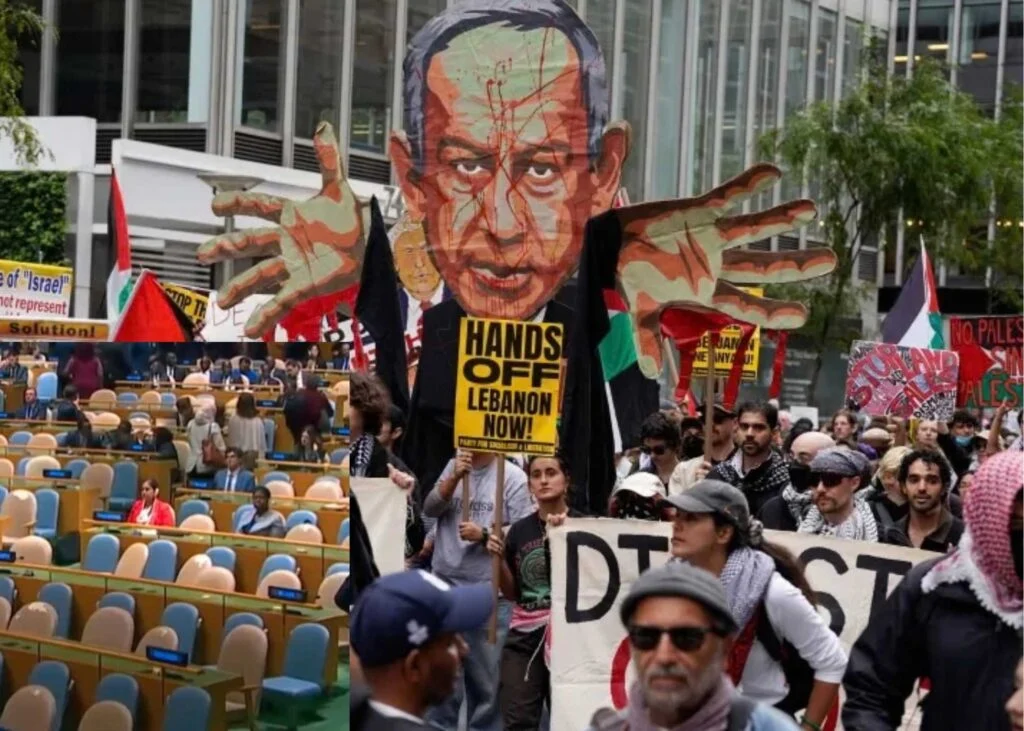
Benjamin Netanyahu got the podium he came to New York for. But as the Israeli prime minister began his address to the United Nations General Assembly on September 24, diplomats representing dozens of countries rose from their seats and walked out. Large sections of the hall were left visibly empty. Outside the UN headquarters, hundreds of protesters were already on the streets against Israel’s war in Gaza. Netanyahu had the microphone, but he did not control the larger story unfolding around him.
The walkout was more powerful because it needed little explanation. Delegates were not merely disagreeing with Netanyahu; they were leaving while he spoke. The Israeli prime minister had come to one of the world’s most important diplomatic platforms to defend his government’s actions in Gaza. Instead, the cameras also recorded rows of empty chairs and diplomats heading towards the exits.
Netanyahu remained defiant. He called those who walked out ‘moral cowards’, defended Israel’s military operations and rejected accusations of genocide. But the words could not change what was happening in the hall. Representatives of sovereign countries had made their protest without delivering a speech of their own.
There was another revealing moment. Standing before the representatives of nations as Israel’s prime minister, Netanyahu turned his attention to Zohran Mamdani, the mayor of the city in which he was speaking. He attacked Mamdani as the ‘antisemitic mayor of New York’ and accused him of spreading lies about Israel and endangering Jewish New Yorkers. Mamdani has condemned antisemitism and rejected attempts to equate criticism of Israel with hostility towards Jews.
There was no protocol preventing Netanyahu from answering a mayor. Still, the difference in office and forum was striking. A head of government had come to address the UN General Assembly and was using part of that international platform to settle a political argument with the mayor outside. Mamdani did not have to enter the General Assembly hall to find a place in Netanyahu’s speech.
Outside the UN, the protest had a very different sound. Hundreds gathered near the headquarters, some sitting in the roadway and refusing police orders to move. Palestinian flags rose above the crowd. “Let Gaza live,” protesters chanted. “Stop arming Israel.” Another chant warned, “The whole world is watching.” A large white kite carrying the words “Free Palestine” flew above the demonstration.
The anger was also directed personally at the Israeli prime minister. “Netanyahu, you can’t hide! We charge you with genocide!” protesters chanted. Elsewhere came the demand, “End the bombs. End the killing.” These were the words of the demonstrators, not conclusions of a court, but they captured the mood on the streets as Netanyahu defended the war only a short distance away.
Police began making arrests when some protesters refused to leave the roadway. Among those detained were Oscar-winning Hollywood actor Susan Sarandon, Emmy-winning Hacks actor Hannah Einbinder, New York City Council member Chi Ossé and Democratic congressional candidate Darializa Avila Chevalier. The presence of actors, elected representatives and political figures gave the demonstration attention well beyond the usual protest circles.
More significant was the strong Jewish participation. Jewish Voice for Peace was among the organisers, and Jewish Americans joined Palestinians, Iranians, Lebanese and other New Yorkers in the demonstration. Some wore shirts carrying the message “Fund people, not bombs”; another message read “Jews say stop arming Israel.” Their presence made it harder to dismiss opposition to Netanyahu’s Gaza policy simply as hostility towards Jews.
Einbinder herself spoke of participating as a Jew, an American and a human being. That gave the demonstration another dimension. These were Americans challenging not only Netanyahu but their own government’s support for Israel and the weapons supplied with American money. The protest was therefore as much a message to Washington as it was to the visiting Israeli prime minister.
Some demonstrators called Netanyahu a ‘war criminal’. That description belongs to the protesters and should not be presented as a judicial verdict. There is, however, a serious legal fact behind it. The International Criminal Court has issued an arrest warrant for Netanyahu, alleging war crimes and crimes against humanity. However, Israel continues to reject the allegations.
What happened that day was therefore more than another protest accompanying another UN speech. Opposition appeared in different places and in different forms. Diplomats registered their strong protest by walking out. On the streets, citizens sat down, raised Palestinian flags, chanted for Gaza and, in some cases, accepted arrest rather than leave.
Some delegations however remained in the hall, and Israel continues to have powerful allies, above all the United States. Netanyahu was given the UN platform and used it to present Israel’s case. Those facts remain part of the story.But so do the empty chairs.
Netanyahu could attack the diplomats who walked out. He could answer Mamdani and reject the charges against Israel. What he could not do was prevent the cameras from recording the departing delegations or stop the voices coming from the streets outside.
That may have been the larger Palestinian story in New York that day. Palestinians did not possess the UN podium, yet Gaza remained at the centre of what happened around it. The walkout brought attention to it. So did the arrests, the Palestinian flags and the voices demanding, “Let Gaza live.”
Netanyahu came to New York determined to defend Israel before the world, and he made his speech. But when the day was over, his words were only part of the story. The empty chairs inside the United Nations and the voices from the streets outside had spoken too.