

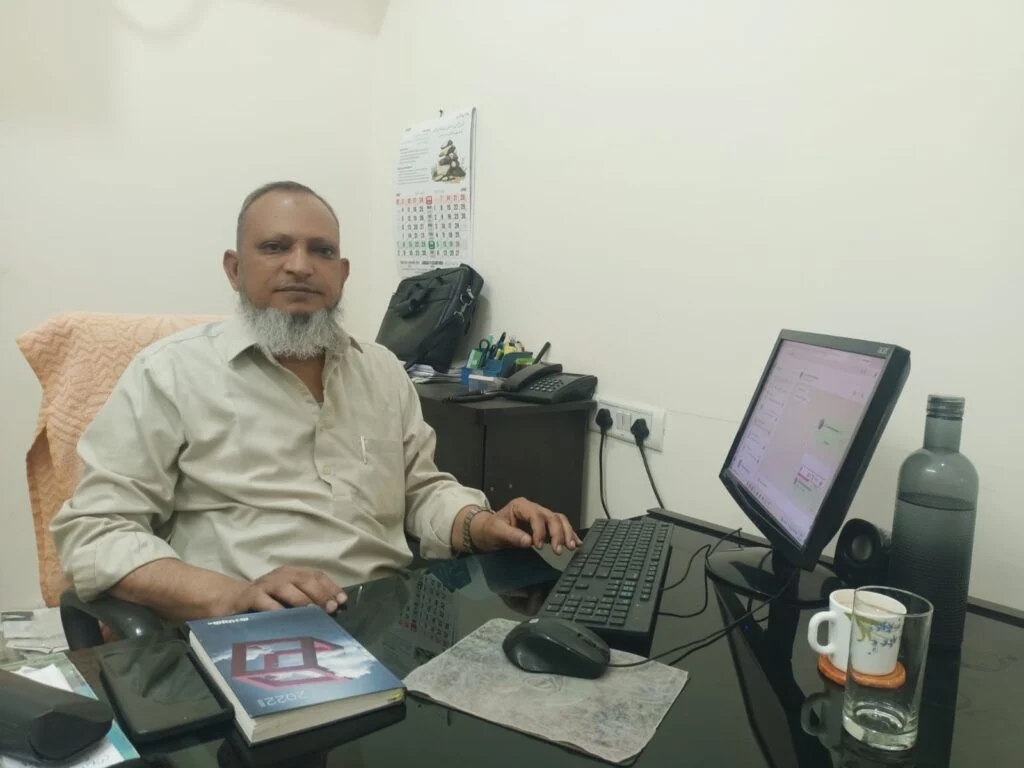
In an extensive interview with Mohd Naushad Khan, Jamaat-e-Islami Hind (JIH) Delhi President Md Salimullah Khan shared his views on education, skill development, government participation, financial literacy, social harmony and the future initiatives of the organisation. Speaking at length about the challenges facing the Muslim community, particularly in urban centres such as Delhi, he stressed that education remains the most critical issue and called for a collective effort by the government, community institutions and civil society to address existing gaps.
Md Salimullah Khan observed that while there is widespread concern about education and a growing demand for educational institutions, the real challenge lies in improving the quality of education rather than merely increasing the number of schools.
Referring to government schools in Delhi, he said the system is under tremendous pressure. Citing the example of Noor Nagar School, he noted that thousands of students study there and admissions continue despite severe overcrowding. While enrolment may be high, he argued that the quality of education often suffers due to overcrowded classrooms and inadequate resources.
The community should not only focus on opening educational institutions but also advocate for quality education within government schools. Since government institutions cater to the largest number of students, no private or community initiative can truly replace the state’s responsibility in education.
Both urban and rural populations are increasingly turning toward private education. However, he expressed concern that many private institutions are unable to deliver high-quality education because the community often prioritises infrastructure over teaching quality.
“The issue is not buildings; the issue is classroom teaching,” he remarked. He stressed the need to improve teaching methods, identify students’ weaknesses and strengthen foundational literacy and numeracy skills. Without these basics, students remain disadvantaged throughout their educational journey.
Recalling discussions with the late Saiyid Hamid and late Siddique Hasan, Khan said that primary education remains one of the biggest concerns for Muslims. He argued that while considerable attention has been given to universities and higher education institutions, insufficient focus has been placed on foundational schooling.
He noted that many universities have been established by Muslims, yet the number of Muslim students studying in them remains relatively small. This demonstrates the need to strengthen primary education first, ensuring that children acquire the skills necessary to succeed in higher studies.
Another area of concern highlighted by Khan was technical and vocational education. He observed that many Muslims work in the non-organised sector and rely primarily on traditional skills for survival. While these skills provide livelihoods, they often lack formal certification, limiting opportunities for advancement.
He argued that proper certification and structured technical education can help individuals move beyond subsistence-level employment and access better opportunities. The community should invest more seriously in vocational training and skill development programmes.
The JIH Delhi chief shared an example from Shaheen Bagh, where retired and serving academics from Jamia Millia Islamia have begun working with local mosques to improve children’s educational foundations.
The initiative focuses on teaching basic numeracy and language skills to young students, helping them build the competencies necessary for academic success. He described such efforts as essential for addressing learning deficiencies at an early stage.
Discussing employment, he said that many Muslim students aspire to prepare for the IAS, but comparatively fewer focus on state-level public service commissions and other government recruitment opportunities.He argued that greater attention should be given to state services because Muslim participation in government employment remains very low. According to him, representation of Muslims in government sectors is estimated at less than 3%, a figure he described as unhealthy and inadequate.
He called upon families, educational institutions and community organisations to encourage young people to explore a wider range of government career opportunities.
Khan highlighted the severe educational challenges faced by economically vulnerable families in metropolitan cities. He noted that many urban poor households survive on daily earnings and often depend on every family member contributing to household income.
As a result, children frequently end up in informal labour sectors, including rag-picking and waste collection. Providing education to such children, he said, is a major challenge that requires dedicated outreach efforts.He stressed that these communities often suffer from low literacy levels and limited awareness, making educational intervention even more urgent.
Khan expressed concern about the reduction of educational support schemes and scholarships. Referring to scholarship programmes that were previously available from the primary level, he argued that such assistance remains necessary for economically weaker students.He criticised the reduction of funding for educational welfare programmes and called for renewed support to ensure that students from disadvantaged backgrounds are not forced to discontinue their studies.
Explaining JIH Delhi’s work among professionals, Khan said the organisation has been trying to connect professionals from various fields and encourage them to contribute positively to society.
He observed that Muslims have produced many successful professionals, but their numbers are not yet sufficient to represent the community proportionately. More importantly, he argued that professional success should be accompanied by ethical responsibility and social commitment. Professionals should be guided by Islamic values and a sense of accountability to society. Fear of God and ethical conduct should translate into positive contributions for the wider community.
Khan referred to the historical contributions of Muslims in India, mentioning the work of scholar Syed Suleiman Nadvi. He noted that Muslims historically added value to various fields of knowledge and helped advance scientific and medical understanding.Muslim scholars introduced new methods and knowledge systems that benefited society at large. He urged Muslims today to revive this spirit of innovation and value addition, becoming contributors to national development rather than remaining confined to community-specific concerns.
Responding to a question about China’s educational system, Khan said that government commitment to education can dramatically transform a nation.He pointed to China’s emergence as a global innovation hub and argued that its success reflects long-term investment in human resource development. Comparing technological advances and innovation, he suggested that education has been central to China’s rise.
India, he said, is often described as one of the world’s youngest nations. However, if a substantial section of the population remains inadequately educated, the country will struggle to fully realise its innovative potential. Therefore, strengthening education must remain a national priority.
Khan also discussed an educational survey recently conducted in Jamia Nagar. Although the area is often regarded as one of the most educated Muslim localities, he noted that multiple organisations and NGOs work there without necessarily possessing reliable data about actual educational gaps.The purpose of the survey, he explained, was to identify deficiencies and provide evidence-based insights. By making the findings publicly available, organisations can focus their efforts where they are most needed.
The survey found that educational participation among Muslims was approximately 97%, while dropout rates increased significantly after Class 10. This indicates that many students face challenges related to guidance, financial constraints or career planning during their secondary and higher secondary education.He described data collection and authentication as one of the survey’s most significant achievements because it allows policymakers, NGOs and educational institutions to design targeted interventions.
Khan identified financial literacy as another major weakness within the community. Many people, he said, lack a proper understanding of financial systems, taxation and economic planning.As a result, they often perceive economic developments only through the lens of losses and difficulties. Improving financial literacy can help individuals make better economic decisions and participate more effectively in modern financial systems.
He highlighted several initiatives undertaken by JIH Delhi, including a programme called Health Connect Delhi. Through this initiative, the organisation seeks to help people access healthcare services and understand available facilities.
The organisation has also engaged IT professionals, encouraging them to contribute in three ways: by adding value through their expertise, training new professionals and supporting individuals involved in beneficial social work.
Khan said JIH Delhi has established a Zakat Centre to help address various socio-economic challenges faced by Muslims in the capital. The centre focuses on education, entrepreneurship and assistance for financially vulnerable individuals.In addition, the organisation has created a Majlis-e-Ulama to address religious and social concerns requiring public awareness and guidance.
Discussing religious education, Khan explained that efforts are underway to strengthen the traditional Juzwaqti Maktab system. Rather than limiting religious instruction to basic Arabic learning, the aim is to prepare children to become confident representatives of Islam in contemporary Indian society.
This broader educational vision seeks to combine religious knowledge with social awareness and civic responsibility.
Another initiative under development is an online platform designed to answer questions about Islam. The proposed website will be managed by qualified scholars who can respond to public queries and address misunderstandings.Where necessary, individuals will also be able to communicate directly with trained representatives. Khan said such efforts are important for promoting dialogue and reducing misconceptions.
Looking ahead, Khan revealed plans to organise poetry conferences across different parts of Delhi through Sadbhavna Manch. He believes that increasing social divisions have reduced interaction between communities, creating unnecessary suspicion and distance.The proposed events are intended to bring people together through cultural engagement and dialogue. He shared an example from Malvia Nagar, where cooperation between members of different communities led to assistance for a needy individual. Inspired by such experiences, JIH Delhi hopes to promote similar initiatives across the city.
He also talked about Legal Connect Delhiwhich provides affordable legal assistance, advocacy, and mediation for underserved communities. They handle both civil and criminal matters to ensure equal access to justice.
A major focus for the coming year, according to Khan, will be increasing youth participation. He stressed the need to involve younger generations in community service, educational development and social harmony initiatives.
By empowering youth and encouraging active citizenship, he believes the community can contribute more effectively to national progress while preserving its ethical and social values.
Throughout the interview, Salimullah Khan repeatedly returned to a central theme: meaningful progress requires quality education, ethical leadership and informed community participation. While acknowledging the challenges facing Muslims in areas such as schooling, employment, financial literacy and social representation, he expressed confidence that targeted interventions, data-driven planning and collective effort can bring positive change.From strengthening primary education and vocational training to promoting social harmony and youth engagement, his vision presents a comprehensive roadmap for community development in Delhi and beyond.