

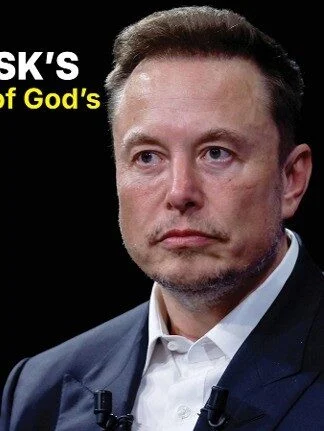
Just as a prominent Indian cinema personality was busy preparing notes to defend his atheist beliefs for a high-profile debate last month in Asia on “Does God Exist?”– a dialogue with a young Indian Islamic scholar – on the other side of the planet, America’s modern ‘pharaoh’ of science proclaimed his return to theism by confessing a belief in God.
Javed Akhtar, 80, has undoubtedly carved out a niche in the Hindi film industry through his extensive work as a screenwriter, lyricist and poet. The winner of numerous national and industry awards, he is also known as a political activist advocating secularism, freedom of expression and gender equality.
Yet, the figure in focus today is American tech billionaire Elon Musk, 54, widely regarded as one of the most brilliant minds of the 21st century – a metaphor for material progress and a veritable ‘deity’ in the realms of physics and space technology. A businessman, entrepreneur and former senior adviser to US President Donald Trump, Musk commands global attention.
During his December 20 debate with Mufti ShamailNadwi in New Delhi, Javed, a staunch atheist, failed to convincingly argue for the non-existence of God. Meanwhile, on December 11, Musk – who had previously described himself as “agnostic”, “atheist” and a “Cultural Christian” – stunned the world by confessing to belief in God while sharing his thoughts on faith in an interview. Is this not a form of divine irony?
In the widely circulated interview on American conservative political adviser Katie Miller’s podcast, Musk, the co-founder and CEO of Tesla, SpaceX, X and xAI, was asked if he believed in God. He replied that he believed “this universe came from something”.
“Who do you look up to the most?” Miller pressed. “The Creator,” Musk answered. When she further emphasised, “What’s your position on God?”, he stated plainly: “God is the Creator.”
Miller followed with, “You don’t believe in God though, do you?” This time, Musk responded: “Well, I believe this universe came from something. People have different labels.”
With this clear admission, the world’s wealthiest individual now stands at the threshold of religious belief.
It is a mark of modern mankind’s misfortune that the brilliance of technology has blinded its inner insight. The prevailing narrative has been that science, God forbid, has buried God. The 19th-century German philosopher Friedrich Nietzsche declared, “God is dead” (God forbid). Today, those who build rockets, create AI, and plan settlements on Mars are often treated as deities. Yet, Musk’s confession serves as a scientific slap to New Atheism – one that will resonate in the halls of anti-religion advocates such as British scientist Richard Dawkins and American atheist Sam Harris.
A Spiritual Awakening
To grasp the significance of Musk’s admission, one must first understand his intellectual journey. Born in South Africa, Musk was fascinated by physics and logic from childhood. Not traditionally religious, he was a product of “Western secularism”, which often posits that “what is not proven in the laboratory does not exist”.
For years, Musk claimed to be agnostic or atheist. He repeatedly stated he had never prayed to God and believed only in physics, considering the universe merely an accidental dance of atoms. However, as he delved deeper into the complexity of the cosmos and the nuances of artificial intelligence (AI), his “scientific arrogance” began to crumble. In recent years, Musk has revealed an apparent spiritual awakening, concluding that God exists.
By stating “God is the Creator”, he invoked the foundational premise of the First Cause Argument in science. This sentence also serves as a modern endorsement of ancient concepts such as the Greek philosopher Aristotle’s “Prime Mover”, and Islam’s “Necessary Existence” (واجبالوجود).
Modern physics tells us the universe began with the Big Bang, but it remains silent on what – or who – initiated it. Musk, a king of logic, has understood the principle that “nothing comes from nothing”. If the universe exists, he reasoned in the interview, there must be a “Super Intelligence” behind it. This confession is not born of emotion, but of pure logical deduction.
Another facet of this transformation is Musk’s social observation. In August, he wrote a pointed critique on X: “Woke is a religion that is filling the gap left by Christianity.”
Here, Musk highlights a profound sociological reality: Human nature inherently seeks an object of worship. Remove “God”, and humanity will deify something else. As the West drifted from Christianity, he remarked, it made “liberalism”, the “LGBTQ agenda,” and “Wokeism” into new religions.
This implies that Musk – who declared himself a “Cultural Christian” in July 2024 – understands that without religion, society risks descending into moral chaos. He observes that atheism has not liberated humanity but has instead enslaved it to desires and contributed to widespread mental unrest.
Alternative Terminologies
Musk often speculates that “there is a one per cent chance in billions that we are living in base reality; we are probably in a simulation (a video game)”. What he terms a “simulation”, spiritual thinkers call “maya” or “mirage”. What he calls the “programmer”, Muslims call the “Creator”. What he refers to as “coding”, Muslims understand as لوحمحفوظ (the Preserved Tablet).
Musk’s view that “human life is like a video game” parallels a modern, scientific interpretation of this Qur’anic verse: “And the life of this world is nothing but play and amusement.” (Surah Al-An’am: 32)
Musk’s U-turn teaches us a singular lesson: The deeper we venture into genuine science, the closer we approach the concept of God. Atheism often stems from a superficial or “bad science”. When one contemplates the complexity of DNA or the fine-tuning of the universe, only two options remain: Deny the reason for one’s own existence or acknowledge the “Creator”.
Musk did not deny his intelligence; therefore, he had to acknowledge the Creator. This universe is no blind accident. If someone like Musk can accept that a “rocket builder” exists, is it not a logical necessity that there exists a Creator who made the “rocket builder” (humanity)?
This is not rocket science but a logical imperative – one that atheists like Javed Akhtar, shaped by “bad science”, would do well to ponder and ultimately accept.
[The writer is a Singapore-based senior journalist. He may be reached at +65 91195711]