

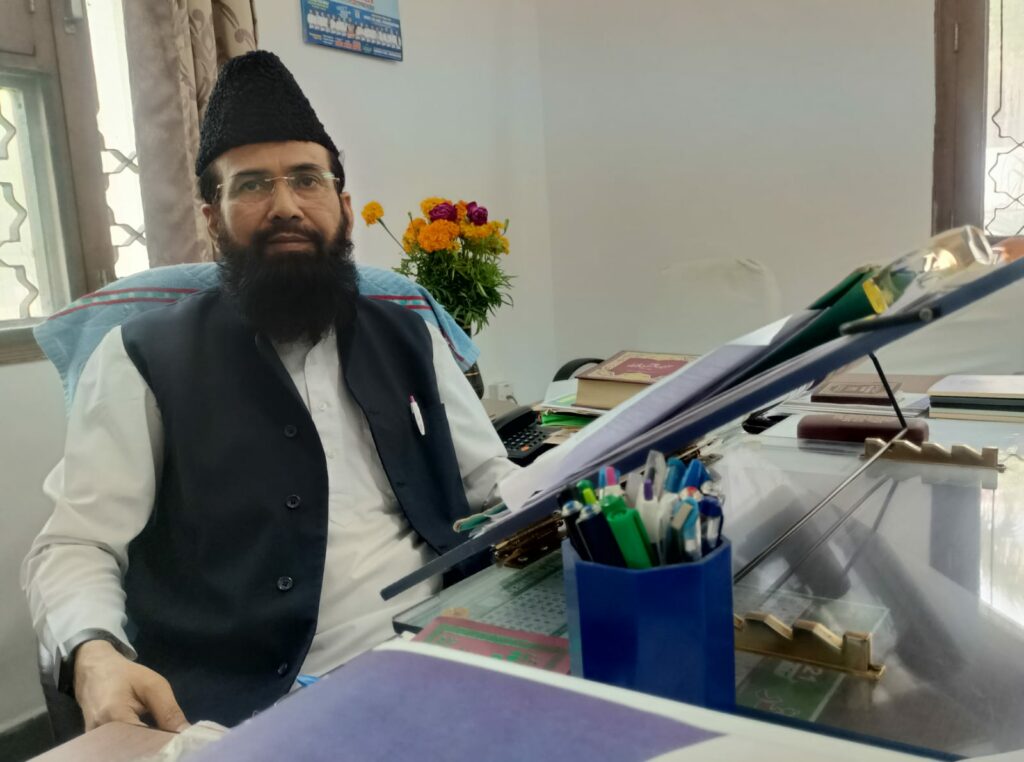
MAULANA MUHAMMAD JAFAR is presently Vice President, Jamaat-e-Islami Hind (JIH). He also served the JIH as the Secretary General for four consecutive terms until 2007. Maulana Jafar served the organisation as Bihar state president from 1986 to 1990. He was elected as first president of the SIO in 1983 and led the organisation until 1985. He was Vice President of the Mushawarat. He also held the position of the Vice President of leading NGOs Human Welfare Trust, Human Welfare Foundation and Dawat Trust. He is also on the Governing Council and General Body of the Board of Islamic Publications (BIP), which publishes Radiance Viewsweekly. He is Vice President of SahulatMicrofinance Society. He is Chairman of the Managing Committee of AlshifaMultispeciality Hospital in New Delhi. He is a founder trustee of Indian Centre for Islamic Finance (ICIF) and Islamic Academy Trust. He is also a trustee of the Ishaat Islam Trust. Maulana Jafar became a member of the Executive Committee of All India Muslim Personal Law Board in 1990. In an interview with MOHD NAUSHAD KHAN, he said the ideology of Jamaat which has been widely accepted now requires to gain more strength vertically and horizontally.
As introspection, how would you like to recall 75-year journey of Jamaat?
As far as introspection is concerned, it has to be seen in two ways like expansion of the organisation and the impact of its work conducted in the last 75 years. If we talk of organisational strength, it has now become clear that Jamaat is the biggest cadre-based organisation within the Muslim community. Organisational strength also determines its activities and approach. Jamaat has worked in many fields, keeping in mind its aims and objectives and theorganisational strength, trained cadre, volunteers and sympathisers have helped to facilitate those activities in an effective manner.
There may be some shortcomings but overall it has done meaningful work in many fields. For example, in media Jamaat began in a limited manner but today it has expanded greatly and today it has publications in English, Urdu, Hindi and almost all regional languages in many states. These publications present Jamaat’s point of view and also to bring awareness in masses in order to create a better society where there is justice for all. The primary objective of media is to reform minds, reconstruct society, create awareness and to educate and inform people.
Jamaat has also publications for women and youth. There areAura and Haadiya and they are addressing women’s issue very effectively. Students wings also have their own publications and they are catering to the interest of youth, students and other issues as well. A lot of activities are going on in the fields of education and social welfare. Trained cadre and organisational strength have always tried to do meaningful work as per aims and objectives of the Jamaat. A lot has been done in many fields in the past 75 years but there is always scope to do better and Jamaat is trying to improve every time and will keep on improving year after year.
What were the challenges when Jamaat was established and do you think the challenges are same today or different?
Jamaat had challenges initially when it was established on 16 April 1948 after Independence and in April 2023 it has completed 75 years. At that point of time, forget about others even the Muslim Ummah was not aware of Dīn and Islam in the desired manner and making them aware of leading a life based on the Qur’ān and the Sunnah was a big challenge then.
There were some institutions to propagate Dīn and Ulama were also there to do so but it was more or less confined to specific areas. But there was not any kind of ideological movement like Jamaat. With the establishment of Jamaat, it tried to create awareness to uphold a way of life that submits to the Will of God.
Jamaat conveyed the Islamic message and invited human beings to turn to their Lord, worship Him alone and surrender themselves to Him, in all aspects of life. It was then a challenge to convince people after coming from a different ideological movement against existing sects with different ideologies. Jamaat also faced some kind of opposition from other religious leaders initially. In the beginning one or two people got inspired with Jamaat’s ideological movement and thereafter more and more people joined and got inspired and today the result is before all of us.
Can Emergency be said to be the biggest challenge?
Emergency was not only for the Jamaat but it was imposed in the entire country. At that point of time even within the government there was misconception about Jamaat and the doubts are still there. But today the government is more aware of its modus operandi and its ideology as compared to initial years. These days Jamaat’s interaction with leaders and the government has increased but initially there was no interaction and there were a lot of misunderstandings about Jamaat and its activities. The government considered Jamaat to be a firqaparasttanzeem (sectarian organisation) like RSS.
Therefore, Jamaat was also bracketed with RSS and other organisations. Emergency was imposed not against Jamaat and Jamaat was not its prime target. Just because of the strict provisions at the time of Emergency some members of Jamaat had to go to jail. But it proved to be a blessing in disguise for Jamaat because in jails Jamaat had the opportunity to interact with people who later became leaders and part of the government. These people came to know Jamaat much better and some doubts and misunderstandings were cleared. So, in a way, it can be said that Jamaat did not lose much but instead was able to clear some doubts and misunderstandings which were there about Jamaat in the minds of people. Jamaat leaders stayed with RSS members, Socialist leaders, Communist leaders, including all Opposition leaders except Congressmen because they were in power.
Many citizens and party leaders in jail wondered and were surprised as to why we were in jails. They were surprised because Jamaat had no direct confrontation with the government. Even people from Sarvodaya group who had supported Jai Prakash Narayan were also surprised and said they were there because they had supported Jai Prakash but why you all are in jail because Jamaat neither had confrontation with the government nor supported Jai Prakash. One leader of that group, SiddhrajJhanda, who was Editor of Everyman’s Science, who was with me in Patna Jail told me about the letter he had written to (then Prime Minister) Indira Gandhi in which he had written:“You have jailed some people along with us and they are in no way threat to you all and you have simply made them your enemy.”
It is also said that after Partition the Muslims who were left behind were terrified. They believed it was impossible for them to live in India with their Muslim identities and JIH worked to placate those and tried to create confidence among them.
Even today, Muslims are in a state of fear, anxiety and depression.Do you believe that Jamaat should play its role to create confidence among Muslims?
After Independence, it is true that Muslims who had stayed in India as their choice were very worried and terrified and a sense of insecurity prevailed at that point of time. Jamaat had at that point of time a great challenge to assuage those fear of insecurity and to build confidence among them and JIH’s mission in creating confidence at that point of time was very successful. Jamaat tried to convince them that Allah is our protector as we believe in one God. And simply changing one place to another may not be sufficient because if Allah wants to protect us, He will protect us here also. And if Allah doesn’t, one cannot be safe anywhere. Through awareness Jamaat tried to educate them that if a person is born in a country, his or her responsibility becomes paramount there. Jamaat tried to convince the Muslims as per the basic principles of Islam about love and responsibility towards nation and its people.
After that communal riots started and Jamaat did a lot of relief work, including medical relief so that they may not think that nobody is here for them to take care of in troubled times. Jamaat stood by them in their difficult time after riots through different kinds of relief work.And through this all Jamaat tried to instil confidence among Muslims. Those who wanted to go to Pakistan left India but a majority of Muslims stayed in India and decided to live in India as a choice to share the burden and responsibility towards people and the country. Things improved and people started to feel secure despite the fact that there were people to disturb communal amity and as a result riots took place from time to time. Jamaat was there to serve the people as and when required.
Not only Jamaat but even many other organisations some time even along with Jamaat stood by Muslims, visited places where riots took place. Relief and rehabilitation were done as and when required. From time to time they were engaged in representation of Muslims and also reminded the government about its responsibilities. Jamaat also created Sadbhawana Manch which is represented by religious leaders and people from different faiths to work for communal harmony. Even the creation of All India Muslim Majlis-e-Mushawarat with the initiative of Jamaat was also to deal with such situations.
Even today the situation for Muslims is not very conducive because of hate, violence, attack on their identities, religious places and belief. Muslims are subjected to violence and lynching. Jamaat has always believed that hate and divisive polity is not only harmful for Muslims but also dangerous for the entire people and the country. Even today Jamaat is continuously working to diffuse communal atmosphere and to create awareness among people as to convert the atmosphere of hate into love. There were many such initiatives like Karwan-e-Mohabbat. It is true that even today some Muslims are in a state of fear and anxiety. Jamaat has always asked Muslims and specially youths not to be provoked under any situation.
In the last 75 years is there anything that Jamaat wanted to do but couldn’t do?
The policy and programme of Jamaat is very comprehensive and it covers almost every ambit of life. The perception was created about Jamaat that it is a political Jamaat. Jamaat believes that if politics is separated from religion, the Dīn will remain incomplete. Politics is also an important aspect. If Dīn guides us in every sphere, it also guides us in politics, too; so, how can politics be separated from religion. Jamaat has from the very beginning tried to concentrate on it. Jamaat has always advocated for value-based polity. But so far Jamaat has not been able to achieve the desired result and the kind of awareness it wanted to create among people. Jamaat has to ponder over it in the year to come.
Another aspect is that the ideology of Jamaat which has been widely accepted requires to gain more strength vertically and horizontally. Also, there are many more issues before us where Jamaat has not been able to make legal interventions as desired like Gay culture, live-in-relationship, same sex marriage. Jamaat has not been able to make the kind of social intervention against these inhuman practices. People need to be educated how these kinds of culture have ruined the entire community and it is dangerous for entire humanity as well. We need to work more on it to educate, to create awareness about its danger and to create an atmosphere so that people can refrain from all such evil practices.