

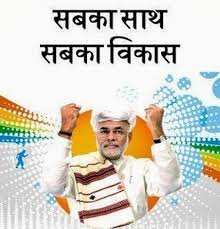
In an environment where we face threats (from terrorist organisations) to divide India in the name of religion, and some political parties are trying to polarise votes on the basis of religious communities, it will suffice saying like “If anyone thinks Indian Muslims will dance to their tune, they are delusional. Indian Muslims will live for India. They will die for India; rather we need to ensure that Muslims are not missing in the progressive work led in the name of ‘Sabka Saath – Sabka Vikas’.”
If the second largest religious community (with almost poverty and illiteracy level) in India realises being deprived, there is need to ensure that they are not forgotten in the fray of economic growth with right to practise their religion.
Considerably 20.5% Muslim workers engaged in manufacturing are crucial if India’s Prime Minister wants to succeed in ‘Make in India’ campaign. Similarly, 16.8% Muslim workers engaged in wholesale and retail activities play a vital role in boosting domestic and international trades.
Interest-based lending contradicts with Islamic law (prohibiting interest based transactions). So ethical finance has been banned and unethical banking opened for Indian Muslims – forcing them to choose between religious ethos and sinful growth prospects. Muslims also failed to proportionately share the regulatory bodies in India. Muslims’ representation in the Reserve Bank of India is farther below (0.75%) than their share (3.2%) in candidates selected as Civil Services officers.
Though after recognising the need of inclusive growth, much has been done to ensure sector, region, caste and gender based inclusive growth; we have yet to observe any initiative to include religious minorities for inclusive growth of India.
We need to recall the remarks made by the Sachar Committee Report that “the access of other minorities to credit from banks and other programmes is far better than Muslims and they are at times the principal beneficiaries of some programmes wherever targeting has been done. In some programmes where Muslims have received an adequate share of credit, the total flow of funds has been low.”
Though there has been many reasons including poor illiteracy for backwardness of Muslims in India, the unavailability of faith based finance has been major road block for resurgence of India’s second largest community. Indian Muslims kept losing 28% of their Deposits at SCBs (amounting to Rs. 1,16,841 crores) to avail as finance for meeting their livelihood needs.
The government should move ahead with following minimum-sought policy initiatives to clear the obstacles in the process of financial inclusion and inclusive growth in India.
1. The Government is requested to implement following specific policy recommendations suggested by Sachar Committee (PMHLC):
a. We recommend a creation of a National Data Bank (NDB) where all relevant data for various SRCs are maintained. All the data should be eventually computerised and made available on the Internet.
b. An Equal Opportunity Commission (EOC) should be constituted by the government to look into the grievances of the deprived groups.
c. The Committee recommends that on the lines of initiatives taken by the Andhra Pradesh government, appropriate state level laws can be enacted to ensure minority representation in local bodies.
d. The Committee also recommends the elimination of the anomalies with respect to reserved constituencies under the delimitation schemes.
e. Given the commitment to provide primary education in the child’s mother tongue, the State is required to run Urdu medium schools.
f. The Committee recommends promoting and enhancing access to Muslims in Priority Sector Advances.
g. Provide financial and other support to initiatives built around occupations where Muslims are concentrated and that have growth potential.
2. Will Dr. Raghuram Rajan take the following Recommendations made by him as head of the Committee for Financial Sector Reforms?
“… Certain faiths prohibit the use of financial instruments that pay interest. The non-availability of interest-free banking products… results in some Indians, including those in the economically disadvantaged strata of society, not being able to access banking products and services due to reasons of faith. This non-availability also denies India access to substantial sources of savings from other countries in the region.
“… the Committee recommends that measures be taken to permit the delivery of interest-free finance on a larger scale, including through the banking system. This is in consonance with the objectives of inclusion and growth through innovation. The Committee believes that it would be possible, through appropriate measures, to create a framework for such products without any adverse systemic risk impact.”
3. Steps be taken to induct Muslims in bodies framing regulatory frameworks, policies and acts related to commerce, finance and industries. Separate bodies may be constituted to propose development plans and schemes for Muslims’ economic development in line with overall national development. Visions like Equal Opportunity Commission have no meaning if Muslims are not allowed to join Sabka Saath Sabka Vikas with right to follow their religious ethos and practices.
Hope that, unlike the UPA Government, the Modi Sarkar would not sense any mysticism to implement above recommendations, but would like to do justice allowing Indian Muslims to be part of Sabka Saath Sabka Vikas.
[economicinitiatives@gmail.com]