

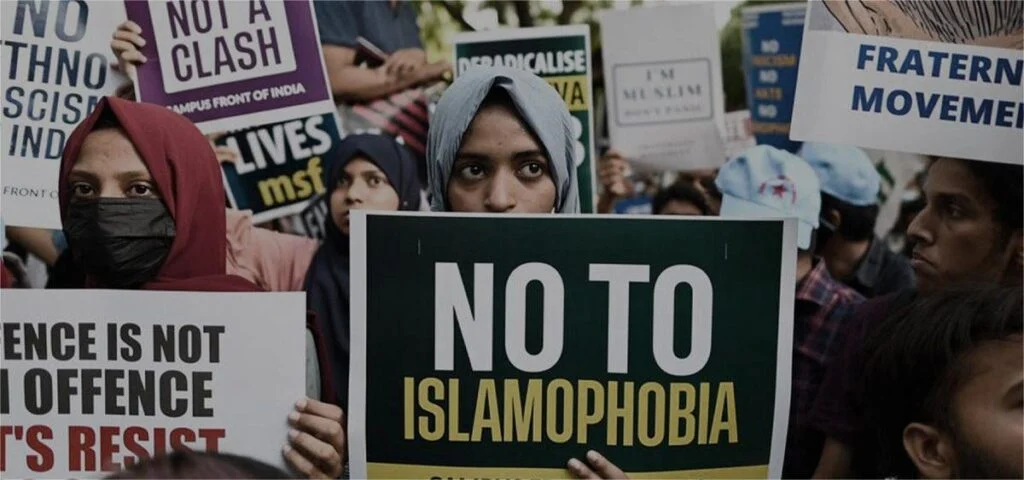
In recent years, the discourse surrounding religious identity in India has undergone a troubling transformation. Once celebrated for its pluralistic fabric, the world’s largest democracy is increasingly witnessing a surge in Islamophobia, hostility, prejudice, and discrimination against Islam and Muslim communities. This growing phenomenon has permeated public life, politics, media narratives, and law enforcement, raising urgent questions about pluralism, equality, inclusivity and constitutional guarantees in the country.
Islamophobia is considered an irrational fear or hatred of Islam and Muslims which is not unique to India, but its manifestations here are shaped by specific historical, political, and social dynamics. With Muslims constituting around 14 percent of India’s population, they have historically faced socio-economic marginalisation and discrimination. Scholars and rights groups argue that these inequalities have deepened under the rise of Hindu nationalist politics.
In the political realm, anti-Muslim rhetoric has moved into mainstream discourse. Reports note an alarming increase in hate speech, including from politicians and public figures, contributing to normalising prejudice and making Muslim identities targets of suspicion.
Across India, incidents of bias, discrimination, and violence against Muslims, both subtle and overt, underscore the severity of the issue. Below are some illustrative examples from recent years and ongoing debates.
In February 2024, violent clashes erupted in Haldwani, Uttarakhand, after the court-ordered demolition of an unauthorised madrasa in a predominantly Muslim area. The confrontation quickly escalated into riots, resulting in deaths and widespread injuries. Although the initial cause was framed as an encroachment issue, critics pointed to underlying communal tensions and fears of targeted action against Muslim institutions.
One of the most widely condemned instances of Islamophobic abuse was the Bulli Bai case, an online platform used for a mock auction of Muslim women’s images without consent. The incident symbolised digital age hate, humiliating Muslim women and exposing them to threats and public shaming.
Recent documentation shows disturbing episodes of hate crimes across multiple states. In Kanpur, a 13-year-old Muslim boy was stabbed by minors for refusing to chant a Hindu religious slogan. In Betul, Madhya Pradesh, a Muslim youth suffered a similar assault for the same reason. In Mokama, Bihar, 32 madrasa students were detained for hours over their religious attire. In Faridabad and Dehradun, mosques and dargahs were demolished despite legal and historical significance.
These incidents reflect not just isolated acts of violence, but a broader pattern where religious identity becomes a fault line in everyday life, affecting safety, freedom of worship, and dignity.
The legal and political frameworks have sometimes aggravated minorities’ sense of insecurity. India’s Supreme Court recently denied bail to Muslim activists Umar Khalid and Sharjeel Imam, who had spent five years in jail without trial over alleged roles in the 2020 Delhi riots. Critics argue that anti-terror laws are being used disproportionately against Muslim voices and dissenters, further alienating an already vulnerable community.
Additionally, international concern has been expressed over an escalation in anti-Muslim hate campaigns across India, with foreign bodies highlighting these developments as “gravely alarming.”
Islamophobia in India is not confined to sensational news headlines; it plays out in societal attitudes and communal interactions.
A 2024 report noted over a thousand incidents of hate speech, with the majority targeting Muslims in political rallies, processions, and campaigns. Terms like “love jihad,” “land jihad,” and others have become part of political lexicon, often devoid of evidence but potent in stoking fear and division.
Discriminatory practices also extend to economic and social life. There are documented cases of businesses boycotting Muslim vendors, challenges in housing access, and unequal treatment in employment and public services.
In West Bengal, offensive Islamophobic signboards during religious festivals triggered violence and highlighted how even cultural expressions can be weaponised to marginalise Muslim communities, with media often downplaying the root prejudice.
The rise of Islamophobia in India has deep repercussions socially, politically, and morally. It erodes trust between communities, undermines the constitutional promise of equality before law, and jeopardises India’s global image as a pluralistic nation. For many Muslims, especially the youth, these trends foster feelings of insecurity, exclusion, and despair.
Critics argue that the government and political leadership must take a more decisive and principled stand against all forms of hate speech and discrimination. Concerted efforts are needed to rebuild the ethos of inclusivity and mutual respect that once defined India’s social imagination.
Addressing Islamophobia requires multi-layered action like strengthening protections against hate crimes and ensuring unbiased application of the law.Leaders must refrain from incendiary rhetoric and work towards unity.Fair and balanced reporting is essential to prevent stoking communal biases.And interfaith dialogue and grassroots efforts can foster mutual understanding and break down stereotypes.
India’s strength lies in its diversity, a mosaic of religions, languages, and cultures coexisting for centuries. The rise in Islamophobia not only harms one community but weakens the social fabric that binds the nation together.
Reaffirming secular principles, protecting minority rights, and nurturing respect for plural identities are not optional ideals; they are essential for the future of Indian democracy. Only by confronting prejudice head-on can India hope to uphold its constitutional promise of justice, liberty, and equality for all.