

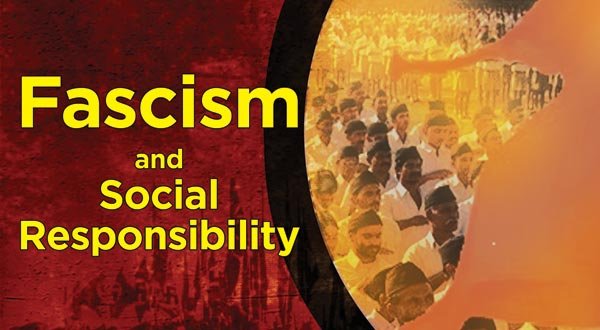
ASIF HUSSAIN analyses in brief the nature and consequences of fascism with special reference to Germany and provides food for thought to see through the deception played on the people of India.
Robert Paxton argues that fascism is “a form of political behaviour, marked by obsessive preoccupation with community decline, humiliation, or victimhood and by compensatory cults of unity, energy, and purity, in which a mass-based party of committed nationalist militants, working in uneasy but effective collaboration with traditional elites, abandons democratic liberties and pursues with redemptive violence and without ethical or legal restraints goals of internal cleansing and external expansion.”
Fascist movements shared certain common features, including the veneration of the state, a devotion to a strong leader, and an emphasis on ultra- nationalism and militarism. Fascism views political violence, war, and imperialism as a means to achieve national rejuvenation and asserts that stronger nations have the right to expand their territory by displacing weaker nations.
Gaetano Mosca in his work The Ruling Class (1896) developed the theory that claims that in all societies an “organised minority” will dominate and rule over the “disorganised majority”. Mosca claims that there are only two classes in society, “the governing” (the organised minority) and “the governed” (the disorganised majority). He claims that the organised nature of the organised minority makes it irresistible to any individual of the disorganised majority.
Fascist governments emerged in the world during the first part of the 20th century, after the World War I. Obviously, the damage caused by the war had created helplessness among the citizens of the country, many of whom had lost their land, loved ones and their pride as the war had destroyed their lives and country. Disappointment and anger was common.
In Italy it was Benito Mussolini and in Germany Adolf Hitler admired him. Both emerged as strong leaders who promised to rebuild their countries and regain the lost pride. Their private armies in uniform and their followers were aggressive and started fights with other citizens and regular soldiers. The rise to power was sudden, and once in power they were swift in nullifying any opposition.
Fascism is a system of governance in which the state has all the power. A dictator (now a strong leader) or a powerful individual is the head of such a state with unrestricted power and authority.
He uses his strong army and police force to keep law and order especially to subjugate all opposition. As is in the beginning of their careers such leaders are admired for their authoritarian and strong personal aura by his followers.
A fascist state controls the way people live. No criticism is tolerated and any dissent is punished. Prison and execution are commonly used to do away with rebellion. Schools become centres of indoctrination and children are groomed to be soldiers of fascism. Military might and powers are adored and lead to war mongering. No other political views are allowed nor are other political parties tolerated. The flow of information is strongly controlled. Newspaper, TV and radio, all operate under the watchful eyes of the state. Freedom of speech remains a distant dream.
Germany was the biggest loser in the World War I. Its pride was dented and its territory lost. Its finances turned upside down and the treaty of Versailles put extreme pressure on its economy. The ground was set for Adolf Hitler and his party. Hitler was appointed Chancellor by President Paul von Hindenburg on 30 January 1933 and The Enabling Act virtually assured that Hitler could thereafter constitutionally exercise dictatorial power without legal objection.
Upon seizing power, Hitler’s Nazi party took repressive measures against their political opposition and rapidly began the comprehensive marginalisation of socially undesirable persons. Under the guise of combating the Communist threat, the National Socialists secured immense power. Above all, their campaign against Jews living in Germany gained momentum.
A major element of fascism is its goal to promote the right of claimed superior people to dominate while purging the society of claimed inferior elements. Adolf Hitler, who had been deeply influenced by his own history teacher, was fully aware that schools posed a potential threat to the dominant fascist ideology. Teachers who were critical of Hitler’s Germany were sacked and the rest were sent away to be trained to become good fascists. With a strong police force and the largest army in Europe, Hitler went about with his expansionist agenda.
He was married to the thought that the Germans were better, stronger and more intelligent than any other people. According to him, the others, whom he considered weak and a hurdle for the development of the state, had to be eliminated. As was Benito Mussolini in Italy so were General Franco in Spain, Juan Peron in Argentina and Augusto Pinochet in Chile. All were detrimental to the interests of their nations.
The question is: Didn’t the majority of the Germans see the imminent conversion of Germany into a fascist State? We have seen it before and see it before us where the whole people, like individuals, can become irrational on occasions, or at times for a brief moment, sometimes for years and sometimes for decades. Hatred, ambition and fear can get better of them and the gross lies told by the leaders can deceive their otherwise rational minds. This is what happened in Germany when the whole nation was deceived by Hitler. The meanness and arrogance and menace, throwing opponents in jail, beating them and even killing them was no match for the traditional democratic culture in Germany. The opponents had no tools to repel the onslaught of the Minister of Propaganda Joseph Goebbels and the hard ball politics of the Nazi Party.
As Bismarck once remarked in a famous speech, moral courage is, in any case, a rare virtue in Germany, but it deserts a German completely the moment he puts on his uniform and given the inbuilt weakness and willingness to swallow the most outrageous big lies emanating from the propaganda ministry and the media. Most Germans were fruit waiting to be plucked by Nazi harvesters. As was the case with the burning down of the parliament, which pointed an accusatory finger at a Communist arsonist, Hitler used the opportunity to create a police state and shut up all opposition. The Germans accepted it submissively and lost the little personal freedom they were guaranteed in the constitution.
In Germany the opponents to the Nazi Party were overrun with simple line of thought that is “all the predictions by the opponents of the Nazi have not come true; they had said the Nazis could not win. Now they have won; therefore the opponents were wrong and the Nazis must be right. The intellectuals of Germany believed they could change the face of the Nazi Party by becoming its member.”
At the moment of truth, when other nations rise spontaneously to the occasion, the Germans collectively and limply collapsed. They yielded and capitulated, and suffered a nervous breakdown. The result of this million-fold nervous breakdown is the unified nation, ready for anything, (police state, restricted freedom of speech, controlled lives) that is today the nightmare of the rest of the world. (Dr. Bernard Weiner)
This brief background to fascism in Germany and its consequences on Germany, a country that had the potential to be the Super Power, should be food for thought in India to see through the deception played on the people of India. In India too we have individuals and groups of people aligned to such thoughts and harbour the vision as presented by Adolf Hitler. We should not detest them but must detest their line of thought and attitude. This is the symptom of the same irrationality that individuals tend to succumb in a state of heightened euphoria, pride and prejudice. It is the duty of the sane voices from among the intellectuals in the Indian society to identify this irrationality of their thinking and enlighten such individuals and groups with values of equality, justice, liberty, peace and human brotherhood that are proven pillars on which a society can achieve success.