

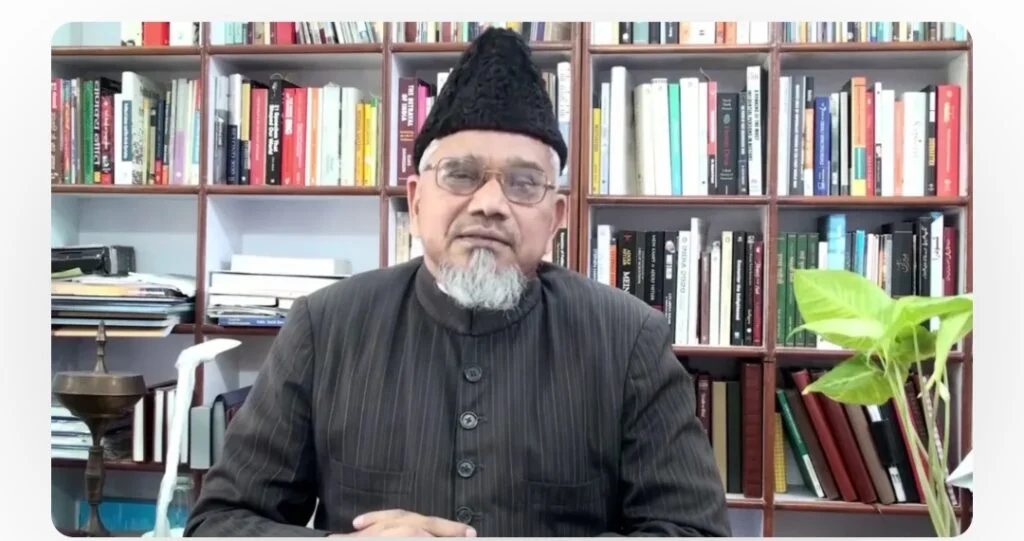
The Forum for Democracy and Communal Amity (FDCA), a platform founded in the aftermath of Babri Masjid demolition and the communal violence that followed, is seeking to expand its reach and revive its activities across India as concerns over rising communal polarisation continue to grow. In an interview with Mohd Naushad Khan, Prof. Salim Engineer, Vice President of Jamaat-e-Islami Hind, National General Secretary of FDCA and a leading figure reflected on the origins of the organisation, its enduring objectives, and the challenges facing democratic and communal harmony in contemporary India.
Tracing the roots of the organisation, Prof. Salim Engineer explained that the FDCA was established in October 1993 in response to the communal unrest that engulfed the country following the demolition of Babri Masjid in December 1992. The demolition, he said, was followed by widespread violence in several parts of India, including major riots in Mumbai, creating a deep sense of concern among intellectuals, jurists, social activists, and public figures.
According to Prof. Engineer, a number of distinguished personalities came together in Delhi to deliberate on ways to strengthen democratic values and communal harmony in the country. The destruction of Babri Masjid and the ensuing violence served as a wake-up call for many who believed that India’s constitutional and democratic foundations were under threat.
He stated that the forum was established with the objective of protecting and strengthening the core constitutional values enshrined in the Preamble of the Constitution. These include equality for all citizens, liberty and freedom of thought and belief, justice for every individual, and fraternity among all communities. These four principles, he argued, form the bedrock of India’s democratic framework and social fabric.
“The purpose of the forum was to ensure that these values are not weakened,” Prof. Engineer said. “We wanted to create awareness, strengthen harmony in society, and resist attempts to spread hatred and division among communities.”
He warned against the dangers of majoritarianism and authoritarian tendencies, describing them as threats to the democratic character of the nation. The forum, he said, was conceived as a platform to promote democratic ideals and reinforce constitutional principles in public life.
The FDCA’s founding leadership included several prominent figures from different walks of life. Justice V.M. Tarkunde served as its first president and Professor Muchkund Dubey, India’s former Foreign Secretary was its second president, while other notable members included Justice Rajinder Sachar, veteran journalist Kuldeep Nayar, social activist Swami Agnivesh, Maulana Mohammad Shafi Munis, Syed Yusuf, Salim Qasmi, and Lt. Gen. Jagjit Singh Aurora, among others.
Following its establishment at the national level, the forum undertook extensive outreach efforts across major states. State-level units were formed, and the organisation gradually developed a nationwide presence aimed at fostering communal harmony and democratic engagement.
Three decades later, Prof. Engineer believes the relevance of the forum has only increased. Referring to what he described as the growing visibility of hatred in everyday life, he noted that tensions can now be observed “from classrooms to streets, markets, trains, and buses.” Despite these concerns, he argued that hatred should not be mistaken for a deeply rooted social sentiment.
“Hatred is like a storm or a fire,” he remarked. “It may create fear and destruction, but it is not permanent. Human nature is fundamentally inclined towards peace, brotherhood, and coexistence.”
He maintained that the overwhelming majority of Indians desire peace and justice but often remain silent in the face of divisive rhetoric and communal incidents. According to him, this silence enables a relatively small group of individuals promoting hatred to dominate public discourse.
The primary task of organisations like FDCA, he argued, is therefore to awaken society and encourage ordinary citizens to speak out against injustice and communal division. He emphasised that the organisation’s core mission has remained unchanged since its inception, although the challenges confronting it have become more severe.
“In fact, the situation today is more serious than when the forum was established,” he said. “The challenges have increased, and therefore the need for such a platform has become even greater.”
Addressing concerns that the forum has lost some of the momentum and stature associated with its founding generation, Prof. Engineer acknowledged that many of the towering personalities who established the organisation are no longer alive. While new individuals have stepped forward to continue their work, he admitted that comparisons with the founding leaders are inevitable.
Nevertheless, he stressed that the forum continues to remain active in several states, particularly West Bengal, Maharashtra, Karnataka, Kerala, Gujarat, and Rajasthan. Efforts are currently underway to strengthen organisational structures in these regions while simultaneously reviving units in states where activity has diminished over time.
The objective, he said, is to expand the organisation’s reach and involve a wider cross-section of society. While some observers have suggested that rebuilding the organisation could take a decade or more, Prof. Engineer expressed confidence that significant progress could be achieved within the next two to three years.
“Earlier, the forum existed in almost every state,” he explained. “In some places it became inactive. Our goal is to reorganise and reactivate it. We want a platform in every state for people who believe this work is necessary.”
He noted that the landscape of civil society has evolved since the 1990s, with numerous organisations now working on issues of peace, democracy, and communal harmony. In some regions, he said, the FDCA may collaborate with existing groups rather than function independently, but the broader objective remains the same: creating a network of citizens committed to democratic values and social cohesion.
A significant portion of the discussion focused on contemporary communal tensions and what Prof. Engineer described as attempts to deepen divisions between Hindus and Muslims. Referring to controversies surrounding religious sites and disputes over places of worship, he expressed concern that efforts to locate mosques beneath temples or reopen historical disputes are contributing to an atmosphere of mistrust and hostility.
According to him, communal harmony has become a more difficult challenge today because individuals and groups accused of spreading hatred no longer fear administrative intervention these days.
He alleged that elements involved in mob violence, vigilantism, and campaigns targeting minorities often feel emboldened because they perceive a lack of effective action against them. “These people believe they have support or protection,” he said. “As a result, they feel motivated to continue creating tensions and disturbing social harmony.”
To counter these trends, Prof. Engineer outlined a two-pronged strategy. The first, he said, involves mobilising public opinion and encouraging ordinary citizens to speak out against hatred and violence. The second requires holding governments and administrative authorities accountable for enforcing the law impartially.“If there is a fire, one task is to extinguish it,” he explained. “The other is to stop those who are lighting the fire. Both responsibilities are equally important.”
He stressed that India’s legal and constitutional framework already contains provisions against hate speech and activities that incite communal tension. The challenge lies in ensuring that these laws are implemented consistently and fairly.
Given what he described as shortcomings in official responses, Prof. Engineer asserted that public awareness and collective action have become indispensable. He called for citizens to organise themselves around principles of truth, justice, peace, unity, and fraternity.
Prof. Engineer also addressed the difficulties faced by peace activists and social workers attempting to counter communal polarisation. He acknowledged that many individuals who oppose hatred and violence are reluctant to speak publicly because they fear repercussions.
According to him, some citizens worry that criticism of divisive politics may be interpreted as opposition to the government, while others fear harassment from extremist or criminal elements. This atmosphere of apprehension has contributed to widespread silence among those who privately oppose communalism.
Despite these challenges, he maintained that peace activists are not isolated and continue to enjoy substantial support among the general public. The key is transforming this passive support into active participation.
“If people believe that society stands with them, they will find the courage to speak,” he said. “Once public pressure builds, governments will have to act responsibly, and political parties will be compelled to reconsider agendas that promote hatred and division.”
Concluding the discussion, Prof. Engineer reiterated his belief that the future of communal harmony and democratic values in India depends largely on citizens’ engagement. While acknowledging the seriousness of present challenges, he expressed confidence that a mobilised and aware public can counter divisive forces and strengthen the constitutional principles on which the nation was founded.
His remarks underline the continuing relevance of organisations like FDCA, which emerged during one of India’s most turbulent communal crises and now seeks to reposition itself as a platform for democratic engagement, inter-community dialogue, and the defence of constitutional values in an increasingly polarised social and political environment.