

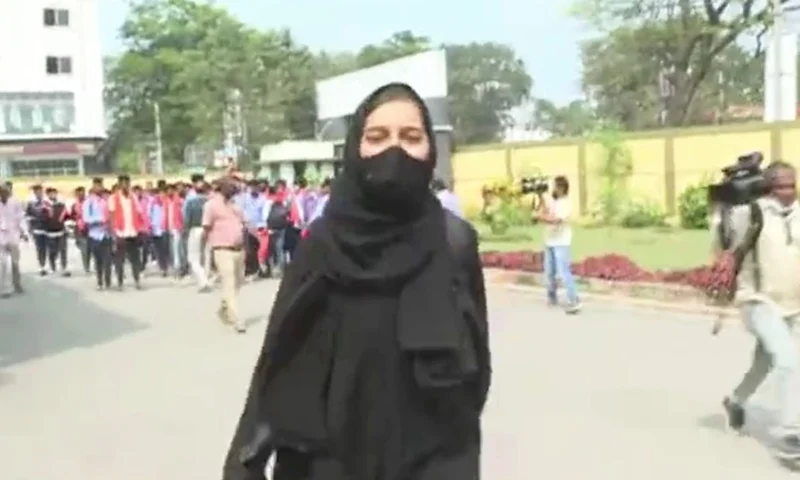
For many Muslim families in Karnataka, the state government’s recent decision allowing students to wear hijab in educational institutions has brought a quiet sense of relief. For young women who struggled to balance faith and education – or, in some cases, stepped away from classrooms altogether – the move represents more than a policy shift. It has revived a larger debate on constitutional rights, religious freedom, women’s education, and the place of diversity in India’s public institutions.
The controversy had earlier become nationally visible through one widely circulated image from Karnataka: aMuslim girl student confronting slogan-shouting youth outside her college campus, responding with Allahu Akbar amid chants of Jai Shri Ram. To many, the moment came to symbolise the emotional intensity of the debate. Yet behind the viral visuals lay a quieter reality – students caught between faith and education, families uncertain about the future, and classrooms drawn into a wider national conversation on identity, inclusion, and constitutional rights.
The hijab controversy began in early 2022 after Muslim students in Karnataka’s Udupi district were reportedly denied entry into classrooms for wearing hijab. What initially appeared to be a campus-level dispute soon escalated into a statewide and national debate on religious freedom, educational access, and the limits of institutional uniformity. The matter later reached the Karnataka High Court, which upheld restrictions on religious dress in classrooms. A subsequent split verdict in the Supreme Court left the larger constitutional questions unresolved, allowing the debate to continue in public and political discourse.
Against this backdrop, the Karnataka government’s recent decision to revoke restrictions has been welcomed by a broad coalition of religious leaders, constitutional activists, civil society organisations, education advocates, and women’s groups. Supporters describe the move as a corrective step toward restoring educational access and constitutional freedoms, while critics, particularly from the BJP, have accused the government of promoting what they describe as the “Islamisation of education.”
Responding to criticism, Karnataka’s Education Minister Madhu Bangarappa defended the decision, questioning why religious symbols are viewed selectively. If sacred threads and other visible expressions of faith are accepted in educational spaces, he asked, why should hijab alone become controversial? According to the minister, the government’s objective is not to privilege one community but to ensure that students from all faiths can pursue education without discomfort or exclusion. Education, he argued, should become easier, not harder, for children of every religion.
Educationists and constitutional scholars argue that schools and colleges should reflect India’s constitutional promise of diversity rather than a rigid uniformity shaped through exclusion.
The Human Cost of the Controversy
The hijab controversy in Karnataka did not unfold merely in courtrooms or television studios. Its deepest consequences were felt in homes, classrooms, and among students whose educational journeys were interrupted.
No comprehensive state-wide data appears to exist on how many students discontinued education due to the restrictions. Yet community groups, educators, and rights advocates consistently reported emotional distress, disruptions in attendance, and educational discontinuity among Muslim women students during the period of heightened tension. For many families, the conflict posed a painful question: could a girl pursue education without compromising her religious identity?
Dr. Mohammed Saad Belgami, State President of Jamaat-e-Islami Hind Karnataka, described the government’s move as an important step toward rebuilding confidence in constitutional values and social harmony. He argued that protecting religious freedom in educational institutions reflects the spirit of a democratic and plural society, where diversity is not treated as a threat but as a shared civic reality.
According to Dr. Belgami, respect for religious freedom in schools and colleges strengthens tolerance, mutual respect, and coexistence. India’s social fabric, he said, has always drawn strength from religious and cultural diversity, and educational spaces should nurture that spirit rather than undermine it. He also appealed to Muslim girls who had discontinued education during the controversy to return to classrooms and complete their studies with renewed confidence.
At the same time, he urged political parties to avoid turning education into a site of polarisation, arguing that classrooms should remain spaces of learning rather than ideological confrontation.
Maulana Maqsood Imran Rashadi, Imam and Khateeb of Bengaluru’s City Jamia Masjid, said the decision had renewed hope among minorities, particularly Muslims. He emphasised that the issue was never merely about dress but about religious freedom, dignity, and constitutional protections.
Several other Muslim leaders also welcomed the decision. These included Maulana Iftikhar Ahmad Qasmi of Jamiat Ulama Karnataka, Maulana Syed Tanveer Hashmi of Markaz Ahl-e-Sunnat, Masoud Abdul Qadir of Karnataka Muslim Muttahida Mahaz, Maulana Shuaibullah Muftahi of Imarat-e-Sharia Karnataka, and Maulana Abdul Rahim Rashidi of Jamiat Ulama-i-Hind Karnataka. Collectively, they described the move as an important step toward restoring confidence among affected students and reaffirming the constitutional principle that religious identity should never become a barrier to education.
Tashkeela Khanam, Secretary of the Women’s Wing of JIH Karnataka, described the decision as “a just and constitutionally aligned step,” arguing that forcing a student to choose between religious identity and education violates principles of equality, dignity, and justice. According to her, the decision has renewed hope among thousands of young women and their families.
Across Community Lines
In Karnataka, resistance to the hijab restrictions did not remain confined to Muslim circles alone. Over time, what began as a concern within the community gradually evolved into a wider constitutional and democratic question, drawing support from civil society groups, legal activists, women’s organisations, and secular voices.
Observers point out that throughout the controversy, Muslim organisations, scholars, women’s groups, legal experts, and community forums largely chose constitutional and democratic methods over emotional escalation. According to community observers and civil society participants, Muslim leadership largely discouraged reactive politics, emphasising legal remedies, peaceful engagement, and democratic resistance. As a result, the issue remained within the framework of constitutional rights and educational justice rather than escalating into wider social conflict.
Secular institutions and civil society groups also entered the conversation, broadening the issue beyond religious identity.
Malligey Madam of Karnataka Janashakti welcomed the government’s decision and called for healthier public discussions on religious freedom in educational institutions. According to her, meaningful democratic dialogue is essential to creating educational spaces grounded in dignity and mutual respect.
Tara Rao of Eddelu Karnataka argued that educational institutions must reflect India’s plural social reality, where every religion, culture, and community is accorded equal respect and opportunity. She described the decision as an important democratic step toward protecting inclusive education.
One woman advocate associated with constitutional rights work, who requested anonymity, described the decision as “a shared constitutional victory” rather than the triumph of one community alone, emphasising that social groups, legal activists, and civil society collectively fought to restore religious freedom and fundamental rights.
The Unfinished Questions of Justice
For many rights advocates, however, revoking restrictions marks only the beginning.Human rights activist Aishwarya of the PUCL welcomed the withdrawal of the government order but warned against viewing it as closure. No religious symbol, she argued, should ever obstruct a student’s right to education. She also pointed to what she described as multiple violations of dignity and fundamental rights suffered by Muslim students during the controversy.
Aishwarya called upon the Karnataka government to assess educational losses experienced by affected students, withdraw FIRs filed against student protesters, and act against media platforms accused of compromising the privacy and dignity of young women during coverage of the protests. Most importantly, she stressed the need to ensure that educational institutions never become spaces of hate speech, humiliation, or harassment of vulnerable communities.
High Court advocate Poorna, also associated with PUCL, echoed similar concerns. While welcoming the government’s decision, she argued that lifting restrictions alone would not be enough. The state, she said, must actively rehabilitate students who suffered educational disruption and emotional distress during the conflict while ensuring safeguards against hate speech and communal tensions in the aftermath of the policy reversal.
More Than a Hijab Debate
Karnataka has long stood as a symbol of coexistenceshaped by linguistic diversity, religious plurality, and layered cultural histories. The hijab controversy tested those foundations.
The government’s decision may not resolve every tension or silence political disagreement. But it has reopened a possibility: that educational institutions can become places where constitutional freedoms and diversity coexist rather than compete.
The larger question now is whether Karnataka will stop at revoking restrictionsor move further toward repairing what was damaged: interrupted education, fractured trust, and the sense of exclusion experienced by many young women.
For countless Muslim girls, the debate was never simply about winning a political argument. It was about something far more personal – the right to enter a classroom without leaving part of themselves behind.