

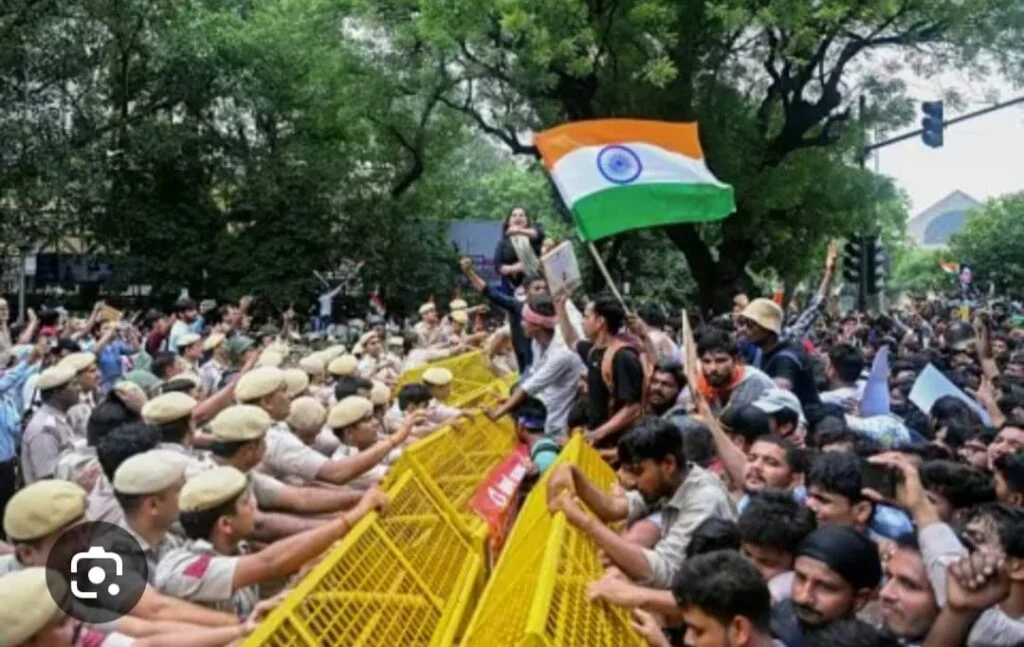
The contrasting police responses to the Cockroach Janta Party’s July and October 10, 2026, demonstrations raise fundamental questions about the right to peaceful assembly, proportionality in crowd control, administrative accountability and the relationship between public order and democratic dissent.
The role of the police in a democracy extends far beyond maintaining public order. It includes protecting citizens’ constitutional rights, ensuring the safety of demonstrators, preventing violence, facilitating lawful assemblies and holding those responsible for unlawful acts accountable. When protests become confrontational, the police must balance competing responsibilities without allowing either public safety or civil liberties to become an excuse for arbitrary action.
The two major demonstrations organised by the Cockroach Janta Party (CJP) at Delhi’s Jantar Mantar in July and on October 10, 2026, offer an important case study of this balance. The July protest, which began amid demands for accountability over examination-related issues, escalated into clashes between protesters and police. The October mobilisation, directed against Chief Election Commissioner Gyanesh Kumar over alleged irregularities in the revision of electoral rolls, was met with extensive preventive measures, detentions and restrictions across the capital. The Delhi Police subsequently cited its experience during the July protest to justify its October response.
The central question is not whether the police should prevent violence. They must. It is whether the methods adopted in doing so remain lawful, necessary, proportionate and accountable.
The July 20 protest was marked by serious clashes. According to Delhi Police, more than 118 police personnel were injured, government vehicles and property were vandalised, and around 70 protesters were detained. The police maintained that protesters had violated prohibitory orders and attacked personnel with stones and other objects. Protesters, however, alleged excessive force, including lathi-charge and the use of pellet guns. The competing accounts make an independent investigation essential rather than allowing either side’s version to settle the matter.
The gravity of the allegations is reflected in the Supreme Court’s subsequent intervention. On Oct. 9, the Court directed the High Powered Enquiry Committee to submit an action-taken report within two weeks concerning allegations of pellet-gun use, police excesses, harassment of women protesters and excessive force during the July demonstrations. The Court also emphasised the need to provide the committee with the resources necessary to carry out its work.
This judicial scrutiny matters because police personnel are entitled to protection from violence, but that protection does not place their conduct beyond examination. If protesters assaulted officers, those responsible must face the law. If officers used disproportionate force, the same principle of accountability must apply to them.
A former senior police officer’s perspective is particularly relevant here. Former Delhi police personnel, through the Delhi Police Federation, sought permission for a separate demonstration in July to express solidarity with officers allegedly injured during the clashes. This highlights a legitimate concern: police officers frequently operate under difficult conditions, sometimes facing physical danger while attempting to control volatile crowds.
However, the institutional interest in protecting police personnel must not be confused with an exemption from accountability. The appropriate professional response to allegations of violence against officers and allegations of police brutality is an impartial investigation that establishes individual responsibility through evidence. That is also the central lesson of the Supreme Court’s call for an independent probe and for those responsible for excesses to be held accountability.
The October 10 episode presented a different policing challenge. The CJP had announced a demonstration demanding the resignation of CEC Gyanesh Kumar over concerns surrounding the Special Intensive Revision of electoral rolls. The Election Commission and the BJP rejected allegations of wrongdoing, while critics questioned the scale and implications of voter-list deletions. The protest therefore concerned a disputed public issue, not a judicially established finding of electoral misconduct.
Delhi Police denied permission for the proposed demonstration, citing the late application, alleged non-compliance with conditions during earlier protests, public-safety concerns and potential traffic disruption. In its subsequent defence, the police administration argued that the July experience and intelligence inputs justified preventive action. It maintained that the restrictions were intended to prevent renewed violence and damage to property.
The scale of the October operation, however, raised questions about proportionality. Reuters reported that more than 2,000 people were detained in Delhi, while security forces sealed off Jantar Mantar and imposed extensive restrictions, including the suspension of mobile internet services in central areas and the closure of dozens of metro stations and markets. The restrictions affected not only prospective demonstrators but also ordinary commuters and other residents.
Several journalists were also reportedly detained while covering the protest. The Quint reported that reporters from multiple news organisations were taken away despite displaying press identification. Reuters separately reported the brief detention of journalists covering the demonstration.
These incidents raise an important operational question: how does a preventive strategy distinguish between a person intending to commit an offence and someone exercising a legitimate right to protest, report or simply travel through the city?
The police may reasonably act on credible intelligence of imminent violence. But preventive measures require clear legal grounds, individualised assessment wherever practicable, safeguards against arbitrary detention and a means of challenging wrongful action. A citywide security operation should not become a substitute for distinguishing between peaceful citizens and those who pose a demonstrable threat.
Articles 19(1)(a) and 19(1)(b) of the Constitution protect freedom of speech and the right to assemble peacefully and without arms, subject to constitutionally permitted restrictions. These rights do not give protesters an unrestricted licence to occupy every road, march into prohibited areas or damage public property. Equally, the existence of restrictions does not mean that every person seeking to participate in a demonstration may automatically be treated as a threat.
The Supreme Court has repeatedly addressed the balance between peaceful assembly, public order and the rights of others. The legal test should not be reduced to whether police officers issued an order. The questions are whether the order had a valid legal basis, whether the restrictions were necessary in the circumstances, whether less restrictive alternatives were available and whether enforcement remained proportionate.
This is where the legal fraternity has an essential role. Lawyers representing detained protesters, constitutional experts and independent investigators must examine the orders issued, the grounds for individual detentions, the use of force, access to legal assistance and the treatment of those taken into custody. Equally, the evidence concerning alleged assaults on police personnel and damage to public property must be examined fairly.
The Supreme Court’s October intervention concerning the July protest makes this accountability question especially urgent. It demonstrates why allegations of police excesses cannot simply be dismissed as political criticism. The allegations must be tested through evidence and an independent process.
The perspective of a senior retired police officer can help distinguish effective policing from merely extensive deployment. Crowd management depends on preparation, communication, negotiated routes, trained personnel, clear command responsibility and carefully graduated responses to disorder. Force should be a last resort where feasible, not the default means of controlling a gathering.
The July experience may reasonably have influenced the October security assessment. But lessons from a previous confrontation should improve operational planning, not automatically determine the treatment of every subsequent protester. A professional police force must learn from earlier violence while remaining capable of recognising that the circumstances, participants and risks of a new demonstration may differ.
The administration also has responsibilities beyond issuing prohibitory orders. It should communicate decisions promptly, explain restrictions transparently, provide accessible channels for permission and appeal, and coordinate transport and traffic arrangements without imposing avoidable burdens on the public. If a protest cannot safely proceed at its proposed location, authorities should consider whether a mutually acceptable alternative venue, time or route can preserve the substance of the right to assemble.
The detention of journalists is particularly concerning because independent reporting provides public scrutiny of both protesters and police. Journalists must follow legitimate safety instructions, but displaying press credentials and reporting on a public event should not, by themselves, become grounds for detention. Any restriction must be supported by specific lawful reasons.
The July and October CJP protests illustrate two distinct challenges: responding to a confrontation that police say involved violence, and preventing a planned mobilisation through extensive restrictions and preventive detentions. The administration has a legitimate duty to protect life, property and public movement. Yet the breadth of preventive action on October 10, together with the allegations arising from July, makes transparency and independent scrutiny indispensable.
A democratic police force is not judged solely by the number of protesters dispersed, personnel deployed or arrests made. It is judged by whether it prevents violence, protects the vulnerable, applies the law impartially and remains accountable when its own conduct is questioned.
The role of the police is neither to facilitate every demand made by protesters nor to suppress every demonstration that presents administrative difficulties. It is to uphold the law without discrimination, protect peaceful dissent while confronting genuine violence, and ensure that public order does not come at the cost of constitutional freedoms.
The ultimate test for Delhi’s police and administration is therefore straightforward: can they protect the public without treating peaceful dissent as a threat in itself? The answer will depend not on official assurances alone, but on transparent investigations, reasoned restrictions, proportionate policing and accountability for violations committed by anyone, whether a demonstrator or a police officer.