

Bangladesh stands at a defining inflection point in its economic history. As the nation prepares to shed its Least Developed Country status and navigates a global trade landscape fractured by protectionism and geopolitical realignment, the urgency to identify new engines of growth has never been more acute. The reliance on a narrow export base dominated by ready-made garments is no longer a viable long-term strategy for a country aspiring to upper-middle-income status within the next decade.
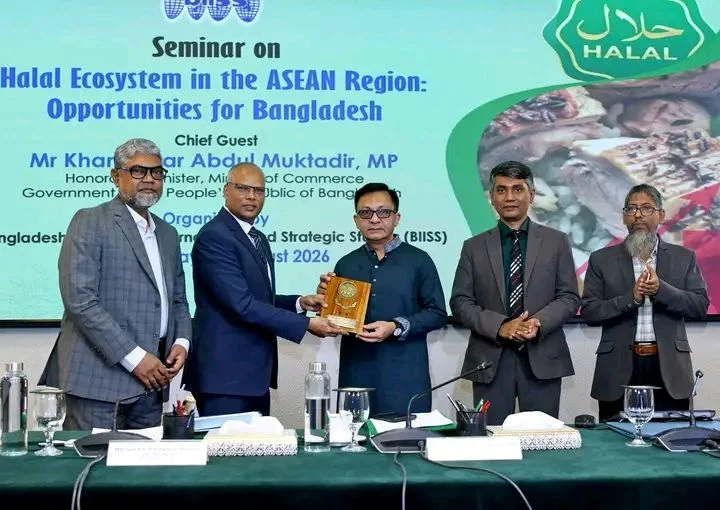
In this context, Commerce Minister Khandaker Abdul Muqtadir’s recent call to prioritise the halal economy is not merely a policy suggestion but a strategic imperative.
Speaking at a seminar organised by the Bangladesh Institute of International and Strategic Studies, the minister argued that the halal economy has transcended meat and beverages to become a comprehensive global system spanning pharmaceuticals, cosmetics, logistics, finance, and digital technology.
His observation pierces through a common misconception: halal is no longer a niche religious requirement but a multi-trillion-dollar global standard for quality, ethics, and safety. For Bangladesh, a nation with a profound Muslim identity and a diversifying industrial base, this sector represents a rare alignment of demographic strength and economic opportunity.
The Scale of the Opportunity: Global, Regional, and Local Dynamics
The global halal economy represents one of the fastest-growing market systems in the world:
Global Scale ($7.5–$8 Trillion): The comprehensive global halal ecosystemspanning food, pharmaceuticals, lifestyle, and Islamic finance is currently valued at an estimated $7.5 to $8 trillion annually. Even within tangible consumer goods alone, the halal food and lifestyle sector commands over $2.5 to $3 trillion, propelled by an expanding global Muslim population and a growing segment of non-Muslim consumers drawn to its safety and ethical standards.
Asian Dominance (60–65% Share): Asia forms the undisputed epicentre of both demand and production, accounting for 60 to 65 per cent of the global halal market.
The Asia-Pacific regional halal market alone exceeds $1.2 trillion, led by industrial powerhouses like Indonesia and Malaysia that have turned demographic realities into high-value export engines.
The Bangladesh Disconnect ($125 Billion Domestic vs. <$1 Billion Exports): Locally, Bangladesh represents a major consumer force, with a domestic halal market estimated at over $125 billion, making it one of the largest individual halal consumer bases in the world. Yet, on the global export stage, Bangladesh exports barely $850 million to $1 billion in halal-certified goods annually, capturing a negligible fraction (under 0.05%) of world trade.
Malaysia’sStrategic Execution
Malaysia in particular offers a masterclass in strategic execution. It did not merely create a certification logo but built a sovereign industrial strategy. By integrating research and development, logistics, finance, and trade diplomacy under a unified Halal Master Plan, Malaysia turned a religious obligation into an export powerhouse.
Today, Malaysian halal certification functions as a passport to global markets, recognised and respected from the Gulf states to Europe. The country demonstrates that halal development requires vision, institutional commitment, and sustained investment over decades, not sporadic policy announcements or fragmented initiatives.
Herein lies the uncomfortable paradox for Dhaka. Despite being home to one of the world’s largest Muslim populations, a robust agricultural base, and a booming pharmaceutical sector, the gap between Bangladesh’s domestic potential ($125B+) and its international performance (<$1B in exports) is striking. The problem is not supply or demand, but institutional inertia. Bangladesh possesses all the raw ingredients for success yet lacks the cohesive framework to transform potential into performance.
If the halal economy is a building, certification is its foundation. Currently, Bangladesh’s foundation is fractured. The single greatest barrier to entry into high-value markets like the Gulf Cooperation Council or the European Union is the lack of an internationally recognised, credible, and integrated halal assurance framework.
Current Landscape
The current landscape is fragmented, lacking the harmonisation required by modern supply chains. To compete, Bangladesh must move from a passive, inspection-based model to a proactive, technology-driven certification architecture.
This requires mutual recognition agreements with bodies in Malaysia, Indonesia and the Gulf states, without which Bangladeshi products will remain locked out of premium markets. It requires digital traceability systems that prove the integrity of the supply chain from farm to fork or factory to pharmacy. It requires investment in world-class laboratory testing facilities capable of detecting cross-contamination at the molecular level. Without this architecture, ‘Made in Bangladesh’ will be relegated to low-trust, low-margin trade, and a strong certification regime will remain an elusive aspiration rather than an economic passport.
The halal economy also offers a solution to Bangladesh’s most pressing economic vulnerability: over-reliance on a single export sector. While ready-made garments will remain vital to the national economy, the halal framework allows for the transformation of existing strengths and the creation of entirely new verticals. Consider the pharmaceutical industry, already a Bangladeshi success story with exports to numerous countries. The global demand for halal pharmaceuticals – medicines free from animal-derived gelatine or alcohol – is expanding rapidly, particularly in the Middle East and Southeast Asia.
Compelling Opportunities
By integrating halal-compliant excipients and production lines, Bangladeshi pharmaceutical companies can move from generic commodity producers to value-added suppliers in high-margin markets.
The gastronomic frontier presents equally compelling opportunities. Bangladesh possesses immense agricultural wealth, yet the lack of halal-compliant cold-chain logistics prevents processed food exporters from capturing the premium frozen food and ready-to-eat markets that are growing rapidly across the Islamic world and beyond. This requires investment in dedicated halal logistics hubs and port facilities to prevent cross-contamination during transit, infrastructure that would benefit not only halal trade but the entire agricultural export sector.
The global modest fashion market, worth hundreds of billions of dollars annually, represents a natural extension of Bangladesh’s existing garment capacity. The country’s factories, with their scalable production capabilities and growing compliance standards, are perfectly positioned to pivot toward this segment.
Furthermore, aligning with the halal economy’s emphasis on ethical sourcing and worker welfare corresponds directly with the compliance standards demanded by modern retailers across all markets. In this sense, halal certification becomes not a constraint but a competitive advantage.
The minister’s call to action must be followed by a paradigm shift in governance. Halal cannot be treated as a peripheral issue managed by a single ministry or religious authority. It must be elevated to a national strategy of the highest order, much like the Digital Bangladesh initiative that transformed the country’s technological landscape.
Whole-of-government Approach Required
This requires a whole-of-government approach where the ministries of commerce, industries, agriculture, and religious affairs operate under a unified policy framework rather than competing mandates. The central bank must develop specialised financing windows for halal small and medium enterprises, recognising that the majority of sectoral growth will come from these dynamic smaller players. Through aggressive economic diplomacy, Bangladesh must brand itself as a trusted source in global markets, leveraging its reputation as a moderate, stable, and industrious nation to sell not just products but a promise of ethical integrity.
Bangladesh has a history of defying expectations when it focuses its collective will, and the ready-made garment sector remains the most prominent example of this capacity for transformation.
However, the next phase of growth cannot rely on low-cost labour alone. It requires institutional trust, quality infrastructure, and global credibility. The halal economy is not a panacea, but it is a mirror that forces Bangladesh to confront its deficiencies in quality control, standardisation, and international marketing. If the country can fix these deficiencies to compete in the halal market, it will by default improve the quality and competitiveness of its entire export basket.
The global halal market is not waiting. As Malaysia and Indonesia consolidate their dominance in Asia, and as the United Arab Emirates positions itself as the logistics hub for the Islamic world, the window of opportunity for Bangladesh is finite. The country has the population, the productive base, and the entrepreneurial zeal.
What has been missing is the strategic architecture to connect these assets into a coherent economic force. It is time to move from reactive policy statements to sustained institutional action.
The halal economy represents Bangladesh’s bridge to a diversified, resilient, and high-value economic future, but that bridge must be built now, with vision, determination, and an unwavering commitment to credible execution. The only question that remains is whether the nation possesses the institutional will to cross it.